A multidimensional guide to what is being tokenized, what rights holders receive, which record controls, where the supporting information comes from, and what changes with tokenization.
In the individual series of work about Real World Assets (RWA) that led to this, one part developed a more detailed taxonomy of the kinds of oracle data an asset may require, while others examined the people, incentives, controls, and failure modes surrounding those records. Those remain companion frameworks rather than branches of the hierarchy presented in this final wrap-up.
This will be an extensive long-form article bringing together a central classification framework. The underlying asset, service, right, or credential forms the primary taxonomy. The token-holder’s rights, the authoritative record, the provenance of supporting information, and the changes introduced by tokenization operate as separate dimensions across that hierarchy.
Want to skip this entire article? Then here it is in a sentence: “Buying a token does not mean you own the underlying asset; it means you own whatever contractual rights the issuer’s legal jurisdiction enforces.”
That’s really it. If you want all the details, or at least as much as I’ve been able to get together, then continue…
I’ve used GPTs to help generate the graphics, and they’ve come out fairly well, but may require a click to enlarge them in some cases. (Or right-click and enlarge in a new window.) If you want, you can use them to just skim and pick up the basic ideas here without having to read through everything.
How the Taxonomy Is Structured
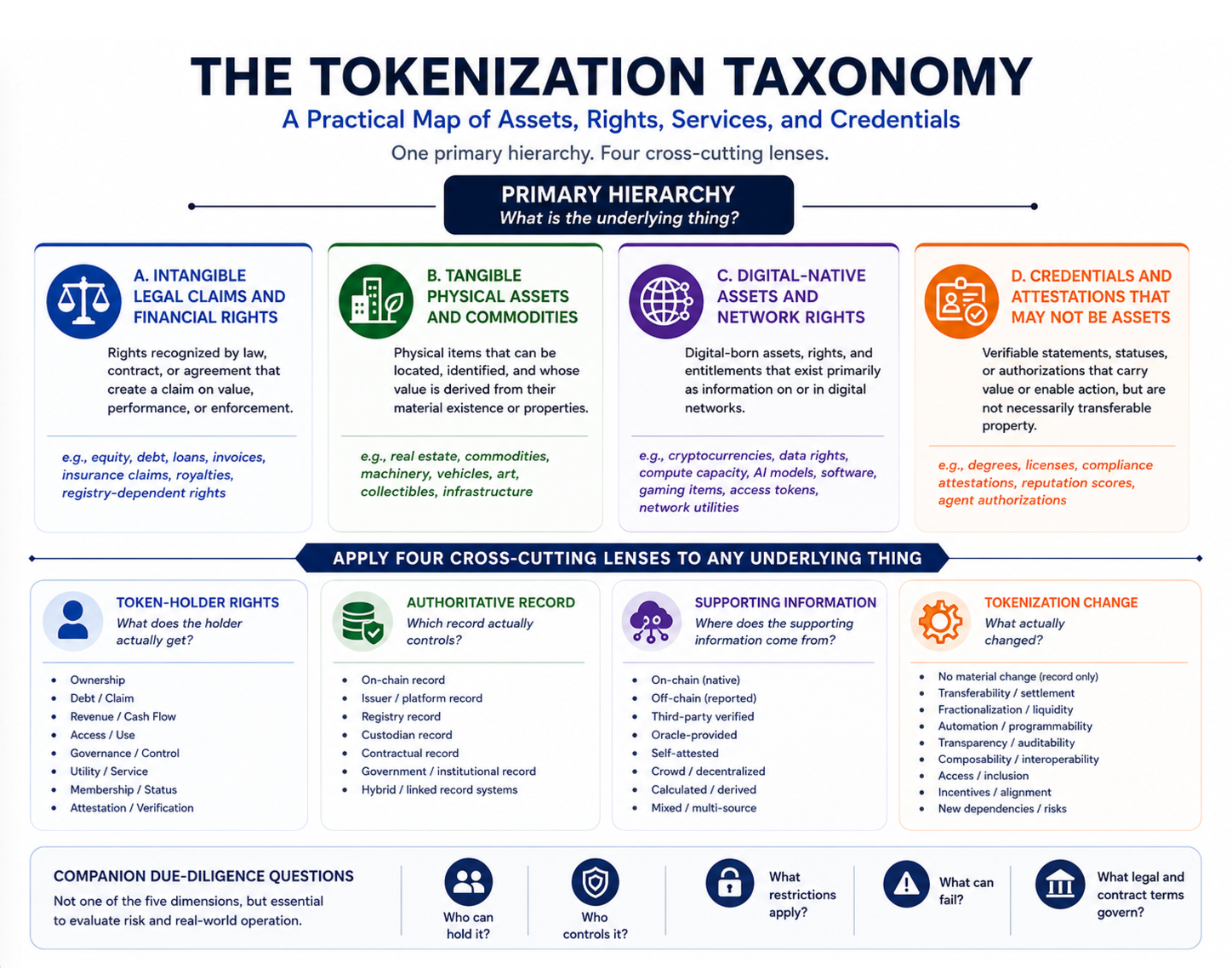
Just what something is often depends on how you choose to look at it. The framework starts by classifying the underlying thing, then applies four additional cross-cutting dimensions: the token-holder’s rights, the authoritative record, the supporting information, and what tokenization changed.
I started the “RWA, Meet RWL” series with a complaint that was simple enough: “Real-World Asset” is becoming such a broad term that it’s in danger of not meaning much of anything. Real World Lies (RWL) is just taking a critical approach as a warning to what we need to guard against.
What’s the scope of RWAs anyway? It’s vast. Pretty much anything real. A Treasury bill can be called an RWA. So can an apartment building, a bar of gold, an unpaid invoice, a carbon allowance, an aircraft, and a painting. Then we move further into the digital world and add datasets, GPU time, AI models, game objects, governance tokens, memberships, credentials, and things that may not really be assets at all. (At least in terms of how we generally think of typical assets.)
At some point, we’re no longer talking about an asset class. We’re talking about nearly every kind of economic thing that can be represented, controlled, financed, accessed, transferred, or coordinated through a digital token.
That doesn’t make tokenization meaningless. There’s many claimed benefits, as by now we’ve all likely heard. Tokenization may improve issuance, recordkeeping, transfer, settlement, collateral management, access, fractionalization, automation, and interoperability. These are potentially meaningful changes.
But the word “tokenized” still doesn’t tell us what the thing is. It tells us something about the rails. It doesn’t really tell us what is traveling on them. Or rather, it doesn’t necessarily tell us. There remain a great many gaps in information transfer and metadata about assets that might not always travel with them.
Either way, it’s time to break all of this down and see about an overarching view of the pieces.
Is This Really a Taxonomy?
Is what I’m proposing here really a taxonomy? I think so. Let’s look.
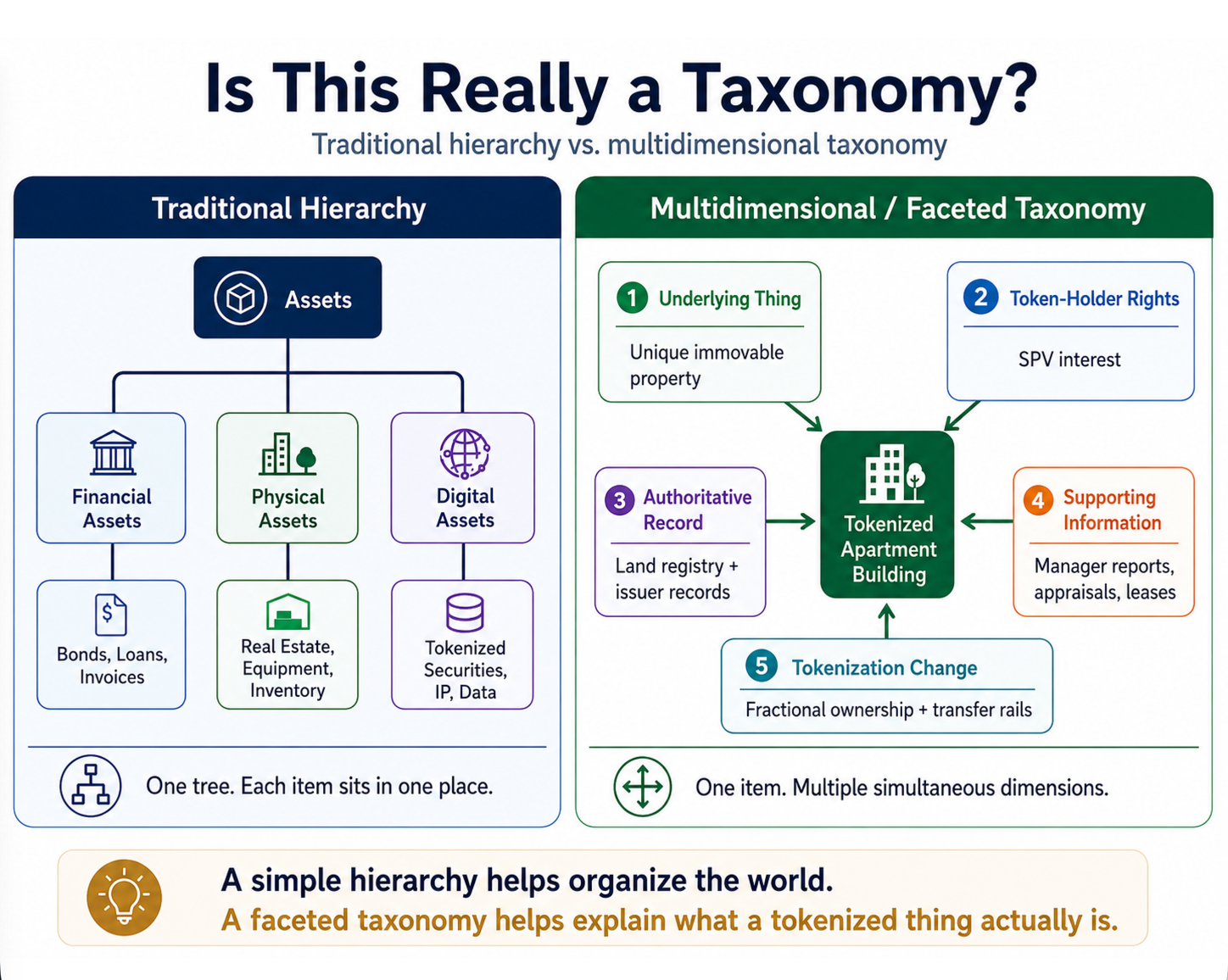
We need an appropriate framework for evaluation. So yes, “Taxonomy” is the right word for the primary hierarchy that follows. It groups the underlying things into major families and then divides those families into narrower categories.
But this is really a multidimensional, or faceted, taxonomy.
A simple hierarchy can tell us that a token is connected to real estate, a security, a commodity, a dataset, or an AI service. That’s useful, but it isn’t enough. We also need to classify the token holder’s actual rights, identify the authoritative ownership or control record, understand where the supporting data comes from, and determine what tokenization changed.
A tokenized apartment building, for example, might be classified in several ways at once:
- The underlying thing is unique immovable property
- The token might represent shares in an SPV rather than title to the property (SPV = Special Purpose Vehicle as some legal entity, such as an LLC or corporation. So the token holder may own shares or membership interests in the SPV, while the SPV itself holds legal title to the building.)
- The authoritative land record may remain in a county or municipal registry
- Financial and occupancy data may come from the property manager
- Valuation may come from an appraiser or model
- Tokenization may change the token’s transfer mechanics, settlement, and ability to represent fractional interests without changing the building, the leases, or the local property law.
One branch of a tree can’t capture all of that. So the hierarchy is the starting point, and the additional dimensions complete the classification.
I wouldn’t call this an ontology yet. An ontology formally defines entities, properties, and relationships in a way that can be implemented as structured data or software. This framework could eventually become one. For now, “practical multidimensional taxonomy” is accurate.
Semi-Appropriate Digressions
While this is about taxonomy, insofar as part of the purpose here is investor and practitioner understanding, a couple of areas deserve some explanation regarding RWAs. I’ll be quick here, but this will give you enough to do more diligence on your own if you like.
An additional note on transferability: Tokenization may change transfer mechanics, settlement, or market access without necessarily changing how legal title to the underlying asset transfers. Where the tokenized ledger is legally authoritative, movement of the token may also transfer the associated right. Where it is not, the token and the legally controlling record can diverge.
An additional note on SPVs: An SPV is really a holding company set up solely to protect the asset from the rest of the parent business. SPVs are not new. They’ve been around since the 1700s for maritime business purposes. Why so popular for RWAs When someone tokenizes real estate, private debt, gold, or a fleet of aircraft, blockchains cannot natively hold legal title to physical or off-chain assets. An SPV solves this fundamental “on-chain to off-chain gap”.
Let’s get back to our story now.
Is This Original Work?
Why bother building this? Aren’t there other lists and hierarchies? Yes, but incomplete and point solution focused vs. trying to understand by purpose and category. Of course this will also be incomplete in that we’re generating new things faster than they can be easily captured in such lists, so details may age quickly. But overall framework will ideally remain sound.
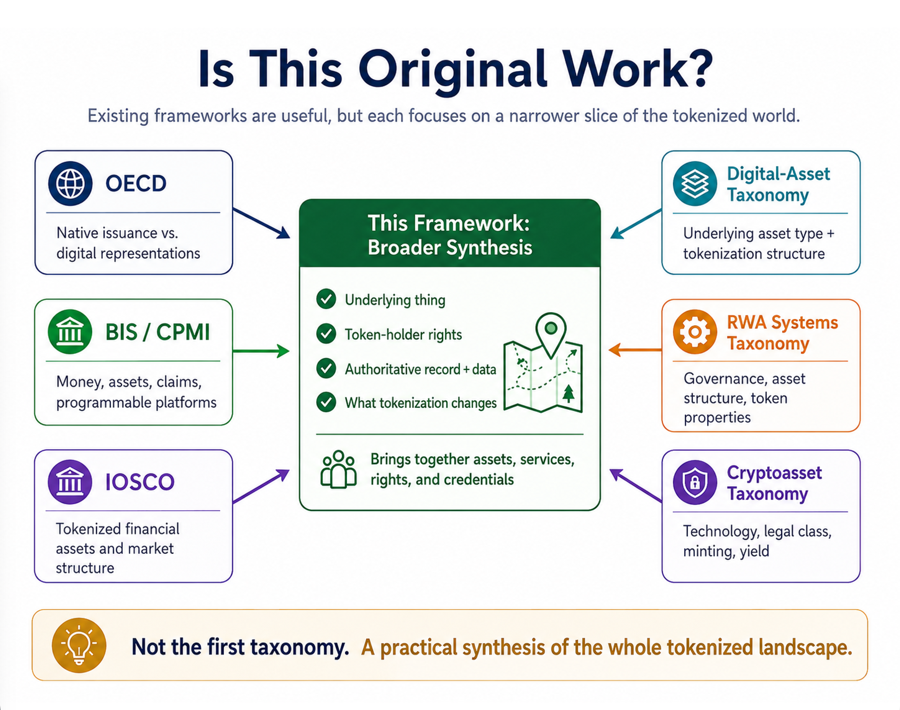
This isn’t the first attempt to classify crypto assets, tokenized financial instruments, or RWA systems. It would be a mistake to claim otherwise.
The OECD has distinguished between digital representations of pre-existing off-chain assets, sometimes called digital twins, and tokens issued natively on a ledger. The Bank for International Settlements and the Committee on Payments and Market Infrastructures have developed a broad conceptual framework for money, assets, tokens, and programmable platforms. IOSCO has focused more specifically on tokenized financial assets and the implications for market integrity and investor protection.
Researchers have also developed increasingly sophisticated frameworks. A 2026 paper, Toward a Comprehensive and Unifying Taxonomy of Digital Assets, uses the underlying asset type and tokenization structure as its two main dimensions. Another 2026 paper, A Taxonomy of Real-World Asset Tokenization for Blockchain-Based Financial Infrastructure, uses 23 dimensions across governance, asset structure, token properties, distributed-ledger technology, and economics. A separate cryptoasset taxonomy for investors and regulators examines technology, legal classification, centralization, minting, yield, and redemption.
So the ingredients are not new. This particular synthesis is for a specific purpose. I haven’t found one generally accepted framework that combines all of the following in a cohesive and approachable structure:
- Traditional financial and contractual claims
- Physical commodities, property, productive assets, and collectibles
- Digital-native money, data, AI, compute, software, gaming, and network rights
- Access, membership, and service entitlements
- Credentials and attestations that may not be assets
- The exact legal or economic right represented by the token
- The location of the authoritative ownership or control record
- The provenance of supporting data
- A practical test for what tokenization changed
The result is an attempt to synthesize the broader tokenized world into one practical hierarchy, starting with the underlying thing and then adding separate dimensions for the rights represented by the token, the authoritative record, the provenance of the supporting data, and what tokenization actually changes.
How to Use the Taxonomy
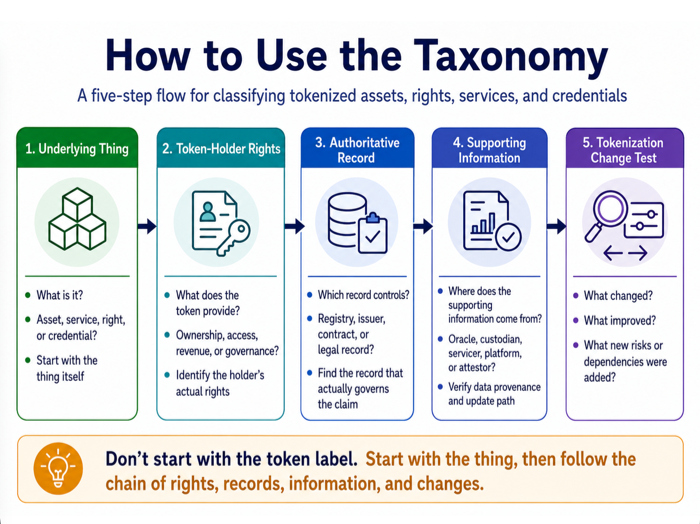
Start with the underlying thing. Don’t start with the project’s preferred label, token ticker, blockchain, or marketing category. That all might be real. And perhaps true. But can also be filled with marketing smoke or obscured by other means.
We want to work through five questions:
- What is the underlying asset, service, right, or credential?
- What about rights? What does the particular token legally, economically, or technically provide?
- Where is the authoritative record for the ownership, right, or claim?
- Where does the supporting information come from?
- What changed when the thing was tokenized?
These questions sound basic. That’s the point. Terms such as RWA token, AI token, gaming token, governance token, or tokenized stock often create an illusion that we already know what we’re looking at. However, we sometimes don’t. New regulations are helping to clarify thing finally. Still, things can be a little wild out there.
Dimension One: The Underlying Thing
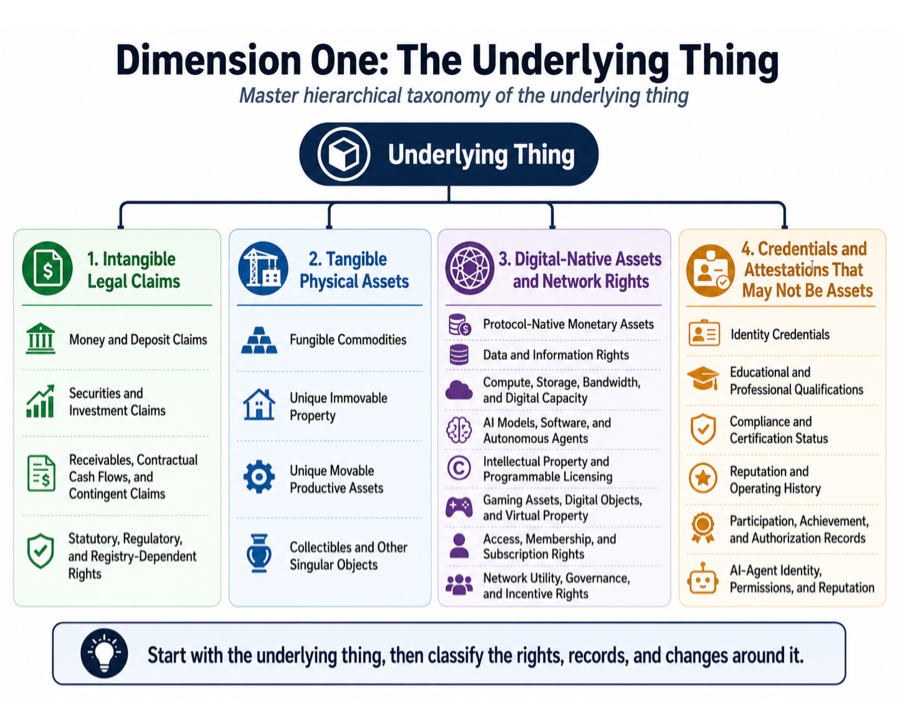
The first dimension classifies what actually exists beneath or within the token arrangement.
- Intangible Legal Claims
- Tangible Physical Assets
- Digital-Native Assets, Services, and Network Rights
- Credentials and Attestations That May Not Be Assets
The first two branches mostly mimic the traditional world. The third adds assets, services, and rights that originate digitally or exist primarily through software and networks. The fourth stops us from forcing every valuable digital record into an asset category.
1. Intangible Legal Claims
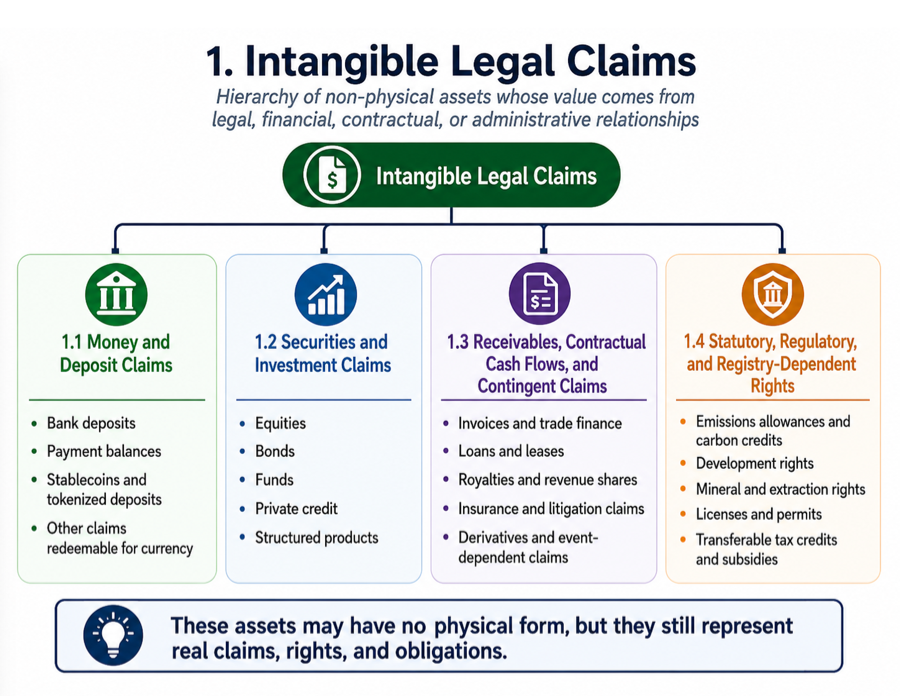
These do not need to exist as physical objects. Their value comes from a legal, financial, contractual, statutory, or administrative relationship.
1.1 Money and Deposit Claims
- Bank deposits
- Payment and stored-value balances
- Tokenized bank deposits
- Stablecoins backed by deposits, cash equivalents, or other reserves
- Tokenized central-bank money or CBDCs, where such systems exist
- Other privately issued claims redeemable for currency
The underlying economic relationship depends on the instrument. A bank deposit is a liability of a commercial bank. A CBDC or other tokenized central-bank money is a direct liability of the central bank. A stablecoin or other privately issued monetary token may provide redemption or other claims against an issuer, reserve structure, or intermediary depending on how it is legally constructed. None of these necessarily represents ownership of a particular stack of cash.
1.2 Securities and Investment Claims
- Public and private equities
- Government and corporate bonds
- Money-market funds
- Mutual funds and other pooled investment interests
- Private credit
- Structured financial products
A stock is a bundle of legal and economic rights. A bond is an obligation to pay. A fund share is an interest in a pool of assets. There may be variants, but the general ideas here have become fairly well known over a long period of time.
Tokenization may change issuance, recordkeeping, transfer, settlement, collateral use, and market access. It should not be assumed to preserve every existing right automatically. A tokenized equity product might be the actual legally issued share, beneficial ownership through an intermediary, an SPV interest, a depositary-style claim, or synthetic exposure to the share price.
They may all be called tokenized stock. Though they’re not necessarily the same thing.
1.3 Receivables, Contractual Payment Rights, and Contingent Claims
- Invoices and accounts receivable
- Trade-finance obligations
- Consumer and commercial loans
- Leases
- Royalties
- Revenue-sharing agreements
- Insurance-related payment rights
- Litigation claims
- Derivatives and contingent claims
- Prediction-market contracts
- Parametric insurance claims
- Other event-dependent payment rights
Contractual claims do not always require someone to pay money. They can also provide a right to future performance, such as a hotel stay, transportation, equipment rental, vehicle charging, professional services, facility access, or a reservation. Tokenization can represent these prepaid or otherwise enforceable service entitlements just as it can represent rights to future cash flows. (These might arguably need another category called “Contractual rights to future performance.” Or similar. We’ll see how things develop and maybe that will get split out later.)
Note that Some derivatives may also be legally classified as securities or other financial instruments. For purposes of this taxonomy, they are grouped here according to their underlying contractual and contingent economic structure. Do all of these things seem like they belong together or not? We might not think of them in the same category, but consider… Here, the underlying thing is a right to receive money if specified conditions are met.
A factored invoice depends on a valid invoice and a customer who can pay. A royalty interest depends on a contract and the underlying revenue. An insurance contract might depend on an event crossing a defined threshold. A prediction-market position depends on a specified outcome and an agreed resolution source. (It actually might be more precise to call that category “Event contracts and prediction-market positions” but that just feels a bit clumsy. The point is, the contract/position is the contingent claim, not the market itself. That may seem obvious enough if you’re just betting on something, but just wanted to clarify that.)
Tokenization may automate transfer and settlement. It doesn’t make the invoice genuine, the debtor solvent, the weather station accurate, or the event definition unambiguous.
1.4 Statutory, Regulatory, and Registry-Dependent Rights
- Emissions allowances
- Certain carbon credits
- Transferable development rights
- Mineral leases and extraction rights
- Spectrum licenses
- Permits and operating rights
- Certain transferable tax credits and subsidies
These rights exist because a government, regulator, registry, or recognized standards program creates or accepts them. Tokenization may make the rights easier to track, finance, divide, or transfer. It does not make them independent of the program. Their value may change if the rules, registry, verification standards, eligibility requirements, transfer restrictions, or political priorities change.
2. Tangible Physical Assets
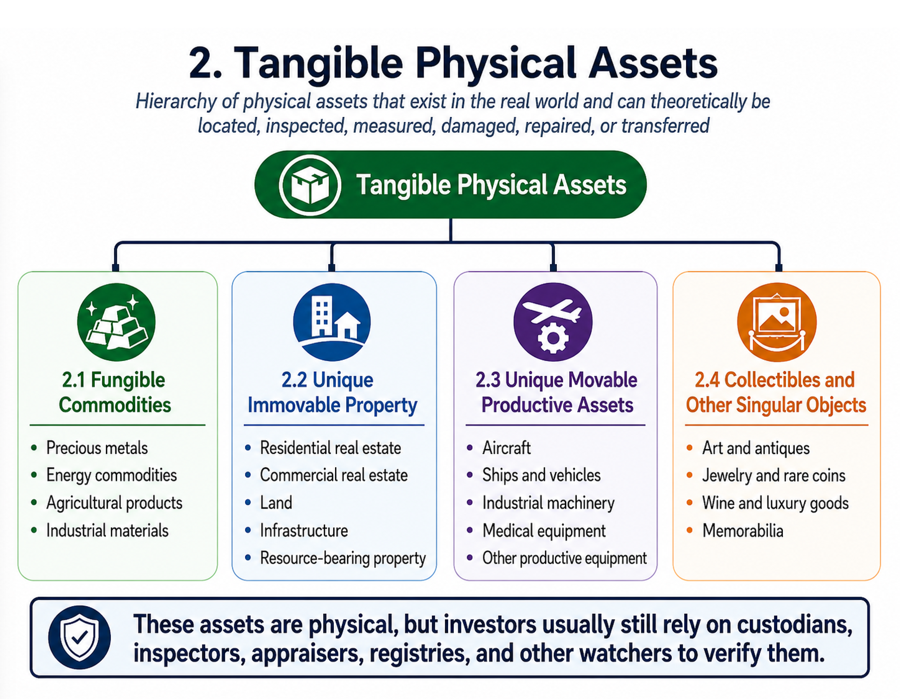
These assets exist somewhere in the physical world. Someone can theoretically locate, inspect, measure, damage, repair, steal, replace, or destroy them.
Theoretically.
Most token holders won’t personally inspect the vault, warehouse, property, aircraft, machinery, or artwork. Or even if they do, they might not have the depth of expertise to know exactly what they’re seeing. They’ll rely on custodians, inspectors, registries, property managers, appraisers, auditors, warehouse operators, and other supposed expert watchers. This can be problematic for a number of reasons, starting with how to even verify identity of such individuals or their credibility.
2.1 Fungible Commodities
- Gold and other precious metals
- Oil and natural gas
- Agricultural products
- Industrial metals
- Other standardized raw materials
A properly specified unit can generally be substituted for another qualifying unit. That makes commodities comparatively easy to pool, divide, price, and trade. The token commonly represents a claim against stored inventory. It is not the inventory itself. The holder still needs to know whether the commodity exists, meets the stated grade, is available for redemption, is legally segregated, and hasn’t been pledged somewhere else. Mostly, holders just assume this. For anyone who’s held or traded such items via exchange, did you actually visit where the commodity was held? Even that might not matter as it’s not likely you’d be able easily scoop out your particular bushel of corn. Though you shouldn’t have to because it should be a fungible item. The question is, if everyone showed up with their scoops at the same time, would there be enough for everyone.
2.2 Unique Immovable Property
- Residential real estate
- Commercial buildings
- Land
- Infrastructure
- Resource-bearing property
Real estate is location-specific, legally unique, difficult to divide physically, expensive to transfer, and governed by local title, zoning, tax, tenant, and property law. A tokenized real-estate investment often represents shares, partnership interests, debt, or another claim connected to an entity that owns or finances the property. It usually doesn’t mean the token holder’s wallet has replaced the legally recognized deed.
2.3 Unique Movable Productive Assets
- Aircraft
- Ships
- Vehicles
- Industrial machinery
- Medical equipment
- Other identifiable productive assets
- Other Physical goods and ordinary inventory (These may include standardized or effectively fungible items, although specific lots, batches, serial numbers, grades, locations, or conditions can make particular units distinguishable. This is therefore a potentially ambiguous boundary with fungible commodities.)
These assets can produce income or services, but their value may depend heavily on condition, maintenance, certification, usage, location, and remaining useful life. A maintenance database can report that an inspection occurred. A blockchain can preserve that report. Neither proves that the inspection was performed competently. And what about required inspections? Aircraft, for example, may have service bulletins or airworthiness directives pop up that are model specific or related to a range of serial numbers. Is that being tracked by a smart contract? Doubtful.
2.4 Collectibles and Other Singular Objects
- Art
- Antiques
- Jewelry
- Rare coins
- Wine
- Luxury goods
- Memorabilia
These derive much of their value from identity, provenance, authenticity, condition, scarcity, aesthetics, cultural significance, status, and buyer opinion. The object may not exist. It may be counterfeit. Its history may be fabricated. Its condition may be misrepresented. Or the token issuer may not own it.
The token can be authentic while the claimed relationship to the object is false.
3. Digital-Native Assets, Services, and Network Rights
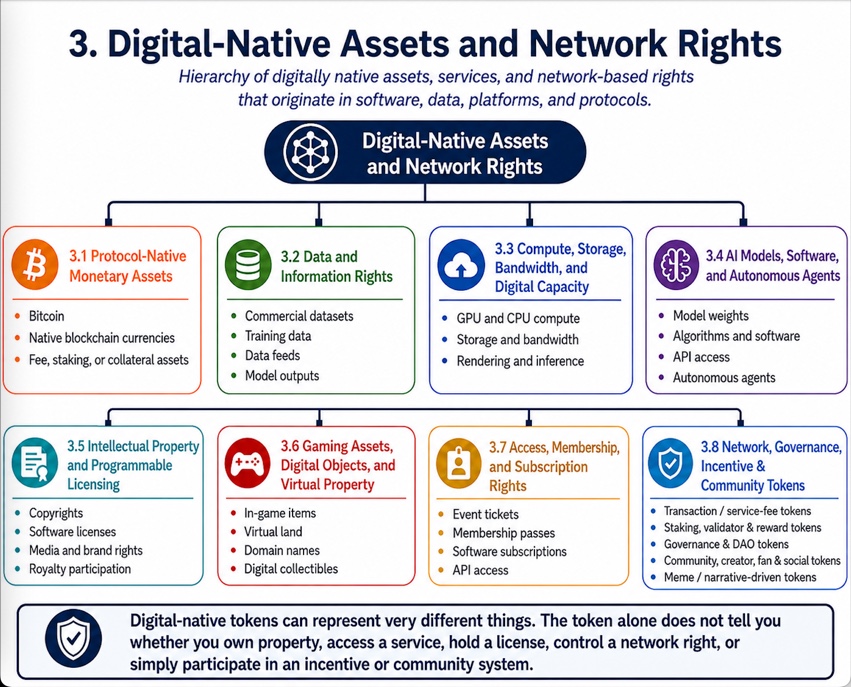
This branch covers things that originate digitally, exist primarily through software and networks, or combine digital rights with physical infrastructure. Some are genuine assets. Some are services. Some are licenses. Some are network coordination mechanisms. And some are speculative tokens using fashionable words to avoid explaining what they actually do. Whatever they are, people are slapping tokens on them, or rather, having aspects of such things represented by tokens.
3.1 Protocol-Native Monetary Assets
- Bitcoin
- Native blockchain currencies
- Protocol-native settlement assets
- Native assets used for fees, staking, or collateral
Bitcoin doesn’t represent dollars in a bank, gold in a vault, shares in a company, or a promise from an issuer. There is no separate underlying asset against which each bitcoin can be redeemed. The network-native asset is the thing.
Other native assets may perform several functions at once. ETH, for example, can be used for transaction fees, staking, collateral, settlement, and investment. That overlap is exactly why labels such as “utility token” are often inadequate.
3.2 Data and Information Rights
- Commercial datasets
- Training datasets
- Scientific and geospatial data
- Market and business information
- Data feeds
- Model outputs
- Proprietary databases
A token may represent ownership of IP, an exclusive license, limited query access, a subscription to a feed, a right to revenue, or a reward for contributing data. “Tokenized data” does not necessarily mean the holder owns the data. It may mean only that the holder has permission to access or use it under specified conditions.
3.3 Compute, Storage, Bandwidth, and Digital Capacity
- GPU and CPU compute
- Cloud and decentralized storage
- Network bandwidth
- Rendering capacity
- AI training capacity
- Inference requests
- Other digital processing services
These are often better understood as tokenized service entitlements. The customer may receive access to capacity rather than ownership of the servers, GPUs, disks, or network infrastructure providing it. The service feels digital, but it still depends on physical hardware, power, cooling, connectivity, facilities, and operators.
One thing that’s really hard about categories is not everything fits clearly. So I have to note the following as well. Some digital-native categories describe services or capabilities rather than independently possessed assets. Compute, storage, bandwidth, and API access typically require continued performance by a provider or network. Here the taxonomy classifies the digital capability or service as the underlying thing, while the holder’s contractual, technical, or economic entitlement to use it is classified separately under Dimension Two. I realize that’s maybe splitting hairs somewhat. And things may change over time. But this is how I see them right now.
Also, from an ontological perspective, conceptually, GPU compute time, dataset access, API keys, or cloud resources are contractual service rights. So are they really intangible legal/contractual claims, and not a fundamentally separate class? Placing them in a distinct bucket may be creating an artificial boundary. This may bear some more thought based on how these areas evolve, but it seems to make sense at present.
3.4 AI Models, Software, and Autonomous Agents
- Model weights
- Fine-tuned models
- Algorithms and software
- Prompts and workflows
- API access
- Autonomous agents
- Rights to model- or agent-generated revenue
“AI token” is not an asset class. It might be a payment token, access right, staking mechanism, governance token, software license, revenue claim, token associated with an agent, or speculative asset with an AI-themed name.
A token connected to a model may provide rights to the software, weights, service, revenue, governance, brand, or none of those things. A token connected to an autonomous agent raises additional questions about control, identity, credentials, liability, revenue, and who can change or shut down the agent.
3.5 Intellectual Property and Programmable Licensing
- Copyrights
- Patent rights
- Software licenses
- Music and media rights
- Character and brand rights
- Rights to create derivative works
- Model and dataset licenses
- Royalty participation
Ownership and permission are different. One token might represent the claimed underlying IP interest. Another might provide a limited license to use it. A third might represent royalties.
An NFT can make a token scarce. It doesn’t make the underlying digital file impossible to copy, and it doesn’t prove that the person who minted the token owned the copyright. And by the way, the underlying digital file might not even be where it should be. An NFT is really just a unique token recorded on a blockchain that points to data saying some address happens to own it. The file itself might not even be onchain. Or if it is, maybe it’s a reference via an IPFS CID (Content Identifier), but the availability of the file depends on someone continuing to host it. It is not inherently persistent the way people often assume. Are you clear on just exactly what you bought and now own?
3.6 Gaming Assets, Digital Objects, and Virtual Property
- In-game items, skins, weapons, avatars, and pets
- Digital art and collectibles
- Virtual land
- Game and metaverse currencies
- Guild interests
- User-created game content
- Domain names
- Other platform- or registry-dependent digital objects
Gaming deserves explicit treatment because one game can contain several completely different kinds of rights. A sword may be a digital object. A battle pass may be an access right. An achievement may be a credential. A guild token might provide membership, governance, shared assets, or revenue participation.
“Gaming asset” describes the environment, not the underlying legal or economic category.
Regardless of what it represents, a gaming token may remain in a wallet after the publisher changes the item, bans the account, discontinues the game, or stops recognizing the token. The token can survive while the economically meaningful object disappears.
3.7 Access, Membership, and Subscription Rights
- Event tickets
- Membership passes
- Software subscriptions
- Game passes
- API access
- Private communities
- Media subscriptions
- Loyalty and reward entitlements
These are generally licenses or service entitlements rather than ownership of the underlying company, venue, platform, or content.
A token may make the right easier to verify, transfer, expire, revoke, or resell. It does not make the access independent of the provider. The event can be canceled. The service can close. The API can change. The issuer may retain the ability to revoke access or alter the benefits. Some of these items may cutover into direct access as well. Payments standards such as x402 might allow direct purchases of such things with a token.
3.8 Network, Governance, Incentive & Community Tokens
- Transaction and service-fee tokens
- Staking assets
- Validator and provider incentives
- Governance tokens
- DAO tokens
- Guild tokens
- Creator, fan, social, and community tokens
- Tokens used to allocate emissions or rewards
- Pure community, fan, social, and meme-style tokens whose primary value derives from attention, narrative, or collective belief rather than enforceable claims or protocol functions.
These tokens may pay for services, reward resource providers, support staking, vote on protocol changes, allocate incentives, or provide collateral. Some perform several roles at once. A governance token is not automatically equity. A DAO (Decentralized Autonomous Organization) token does not automatically provide direct legal ownership of the DAO’s treasury or investments. A fan token may provide access or voting on selected decisions without providing any economic rights at all.
The label describes a context or possible function. It doesn’t fully describe what the holder can claim.
A Note on Protocol-Native Financial Positions
Protocol-native finance can also produce tokens representing vault shares, liquidity positions, staking claims, lending receipts, wrapped assets, bridged assets, or other on-chain financial interests. These do not necessarily require a separate underlying-thing category. (Though maybe they could. In my efforts to avoid further ‘taxonomy creep’ though, they all seemed to most naturally belong here.) In many cases, the underlying asset or protocol position can already be classified within the categories above, while Dimensions Two and Three identify what economic claim or entitlement the token provides and which record actually controls it.
For example, ETH and a liquid-staking token representing staked ETH are not necessarily the same underlying thing. Likewise, a wrapped asset, LP token, vault share, or lending receipt may be better understood as a tokenized claim or position built on top of another digital-native asset or protocol arrangement. The point is to classify what sits underneath the wrapper rather than create a new category for every DeFi token form.
4. Credentials and Attestations That May Not Be Assets
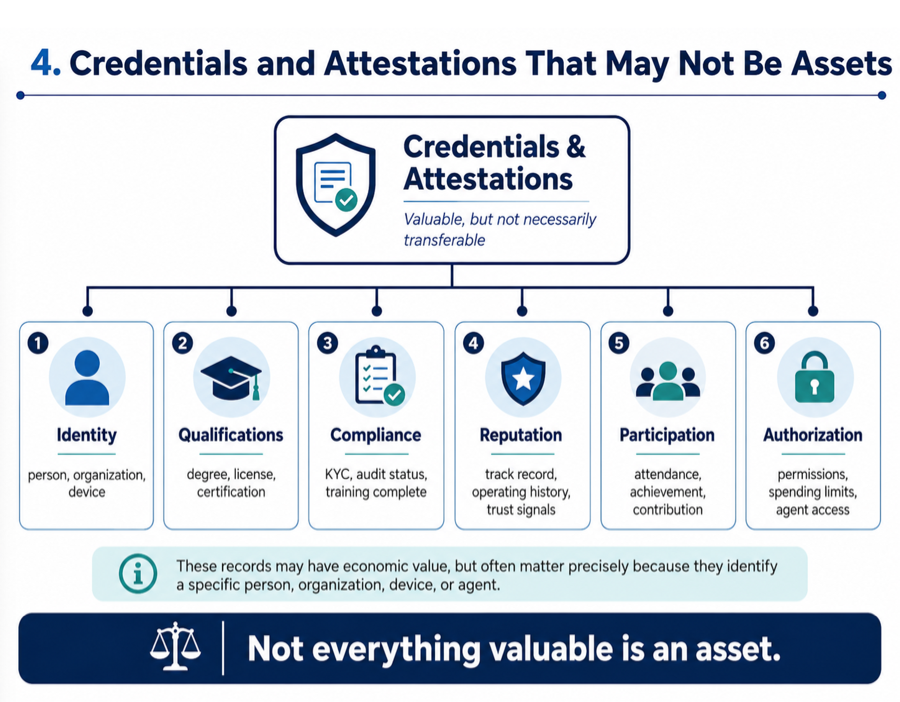
- Identity credentials
- Educational qualifications
- Professional licenses
- Compliance and certification status
- Reputation and operating history
- Achievements and participation records
- Proof of authorization
- AI-agent identity and permissions
These records can have tremendous economic value, but they are often valuable precisely because they refer to a particular person, organization, device, or agent and cannot legitimately be transferred.
I can’t sell you my college degree, pilot certificate, professional license, or clean driving record. Turning the credential into a token doesn’t change that. It may make the record easier to verify, harder to alter, or simpler to revoke. Those are useful capabilities. But the token is evidence of a status or claim, not necessarily property.
This distinction matters because not everything useful should be forced into a market. Not everything valuable is an asset as we typically think of such tradable things.
Dimension Two: What rights does the token actually provide?
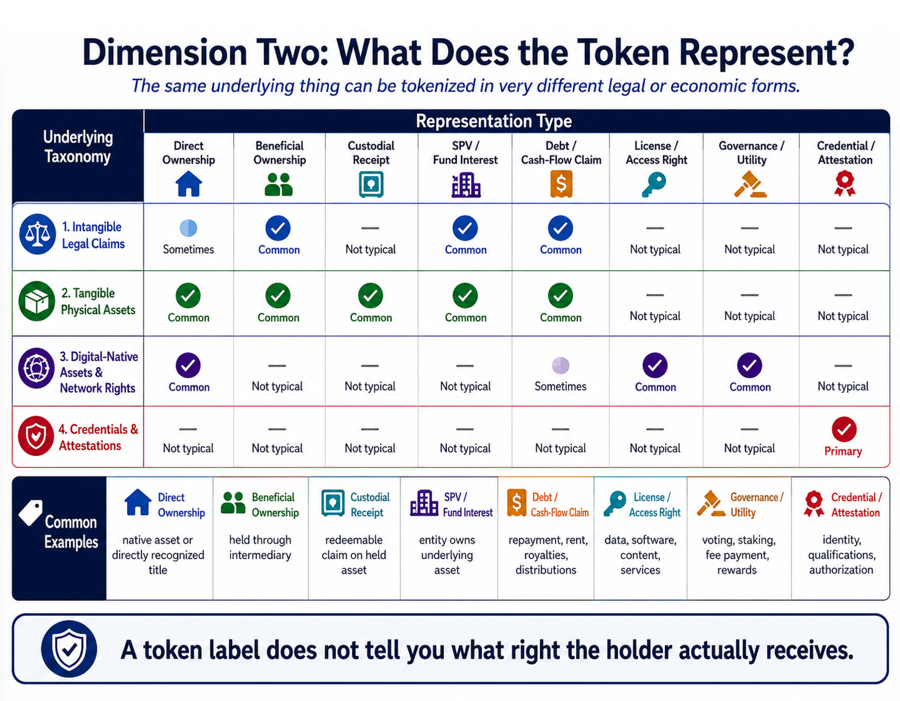
Once the underlying thing is identified, classify the holder’s actual right. (Not all are represented in the chart.)
- Direct legal ownership: The authoritative ownership record recognizes the token holder
- Beneficial ownership: An intermediary holds legal title on the holder’s behalf
- Custodial receipt: The token is redeemable for an asset held by a custodian
- SPV, company, partnership, or fund interest: The token represents an interest in an entity that owns or finances the underlying thing
- Debt claim: The holder has a repayment claim secured or supported by the asset
- Contractual cash-flow right: The holder is entitled to revenue, royalties, rent, payments, or event-dependent proceeds
- License or access right: The holder may use data, software, content, IP, a platform, or a service
- Service entitlement: The token can be exchanged for compute, storage, bandwidth, rendering, inference, or another service
- Governance right: The holder may vote on specified network, treasury, or organizational decisions
- Network utility or incentive position: The token supports payment, staking, rewards, or other protocol functions
- Synthetic economic exposure: Payments track the value or performance of something the holder does not own
- Credential or attestation: The token or record provides evidence of identity, status, qualification, participation, or authorization
These are not minor distinctions. They determine ownership, income, voting, redemption, custody, remedies, bankruptcy treatment, and which legal system must enforce the relationship.
Two tokens can reference the same asset and still provide completely different rights.
Dimension Three: Where Is the Authoritative Record?
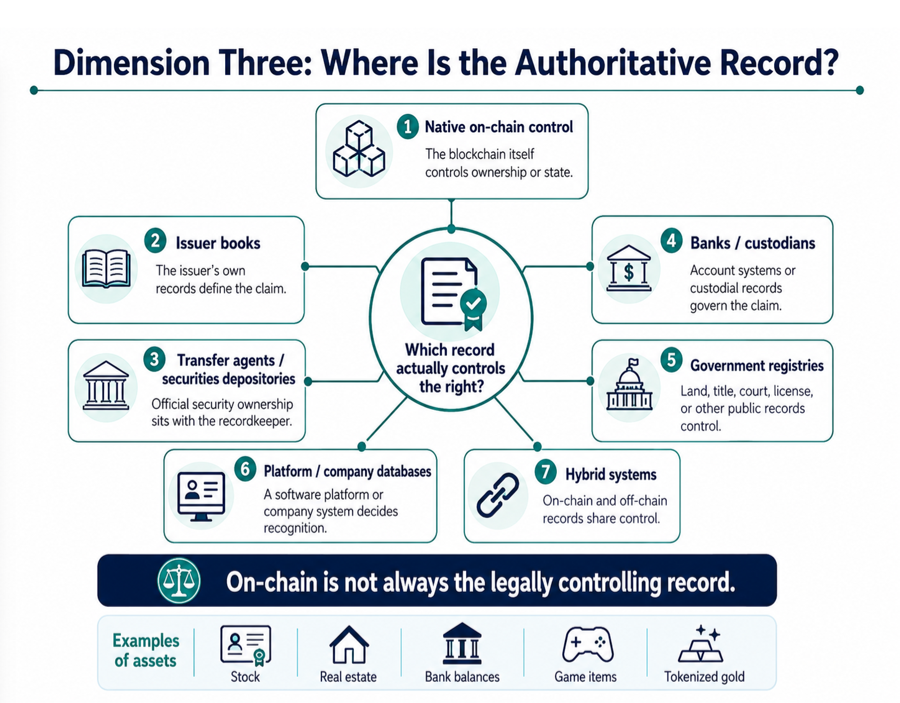
A blockchain record may be important without being legally authoritative.
The controlling record might exist:
- Natively on the blockchain
- On the issuer’s books
- With a transfer agent or securities depository
- In a bank or custodian’s account system
- In a government land, licensing, title, or court registry
- In a private standards registry
- In a game, platform, or software company’s database
- Across a hybrid arrangement in which the blockchain controls some functions and off-chain systems control others
This is one of the most important questions in tokenization.
If the blockchain says I own the token but the land registry says someone else owns the building, which record wins? If the token is burned but the transfer agent still recognizes the old holder, what happened legally? If a game token remains in my wallet but the publisher’s database no longer recognizes the item, what do I have?
“On-chain” is not the same thing as “legally controlling.”
Dimension Four: Where Does the Supporting Information Come From?
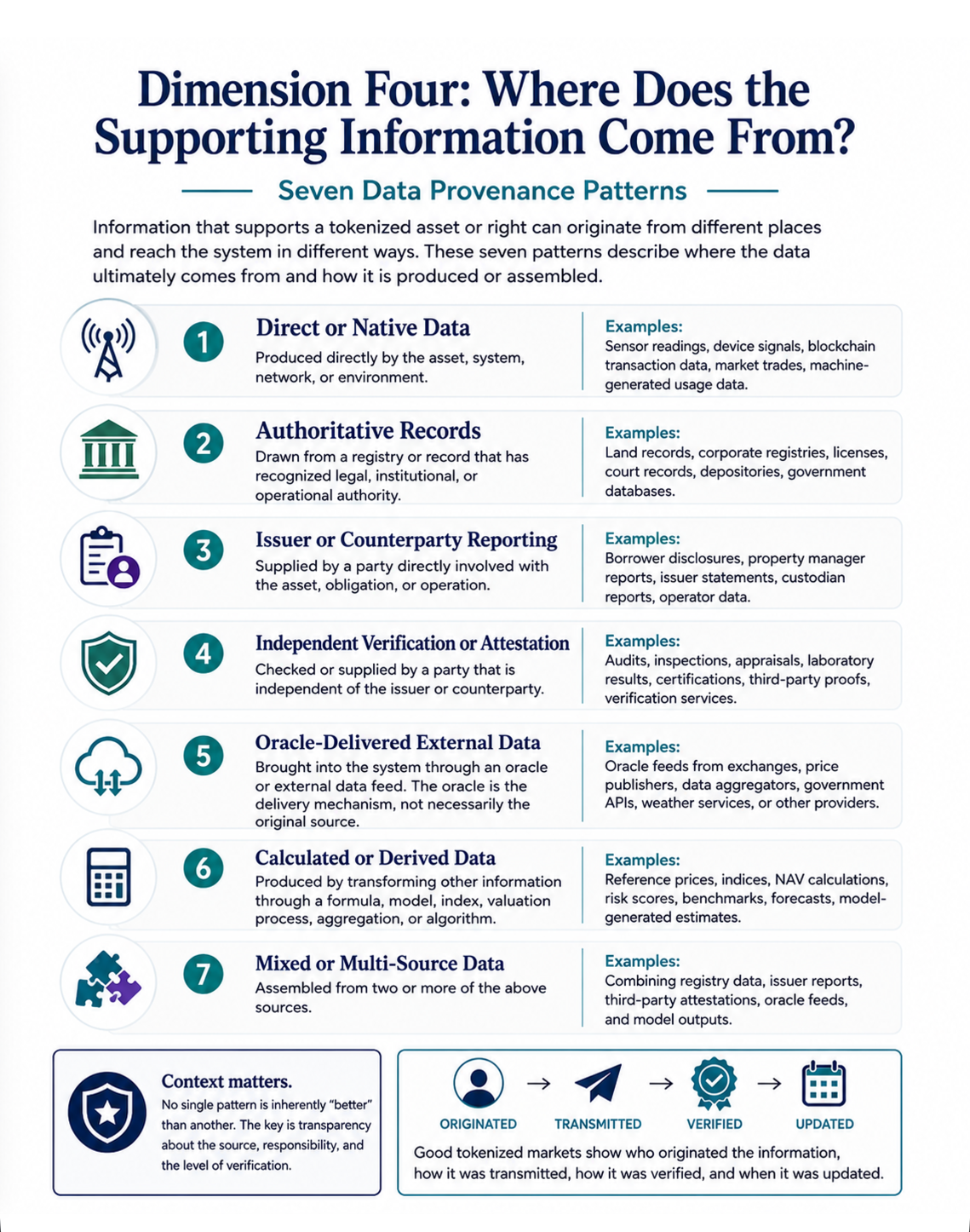
Supporting information generally falls into seven patterns.
1. Direct or Native Data
Information produced directly by the asset, system, or network rather than reported by an intermediary. Examples include blockchain transaction history, sensor readings, machine-generated usage data, or other directly observable events.
2. Authoritative Records
Information drawn from a registry or record that has recognized legal, institutional, or operational authority. Examples include land records, corporate registries, licensing databases, court records, or official government databases.
3. Issuer or Counterparty Reporting
Information supplied by a party directly involved with the asset or obligation. Examples include property-manager reports, borrower disclosures, issuer financial statements, servicing data, inventory reports, or statements from an asset custodian.
4. Independent Verification or Attestation
Information checked or supplied by a party that is comparatively independent of the issuer or counterparty. Examples include audits, appraisals, inspections, certifications, third-party proofs, and verification services.
5. Oracle-Delivered External Data
Information brought into a blockchain or application through an oracle or external data feed. The oracle is the delivery mechanism, not necessarily the original source. The underlying information may itself come from an exchange, registry, sensor, publisher, government database, or other source.
6. Calculated or Derived Data
Information produced by transforming other information through a formula, model, index, valuation process, aggregation, or algorithm. Examples include reference prices, risk scores, NAV calculations, benchmarks, forecasts, and model-generated estimates.
7. Mixed or Multi-Source Data
Information assembled from several of the above sources. A tokenized asset may, for example, depend simultaneously on an official registry, issuer reporting, an independent appraisal, and an oracle carrying selected data on-chain.
None is automatically trustworthy. Sensors fail. Registries contain errors. Auditors miss things. Owners lie. Models make bad assumptions. But they don’t deserve the same level of confidence either.
Every important data point should ideally carry information about who originated it, who transmitted it, who verified it, when it was observed, when it was updated, which definition was used, and whether it was measured, reported, attested, or calculated.
Otherwise, the blockchain may provide a beautifully transparent view of a number whose meaning and reliability remain unclear. Ever hear this famous quote by mathematician John von Neumann: “There’s no sense in being precise when you don’t even know what you’re talking about”. It highlights the idea that false accuracy or strict technical details mean nothing without core understanding.
Dimension Five: What Changed With Tokenization?
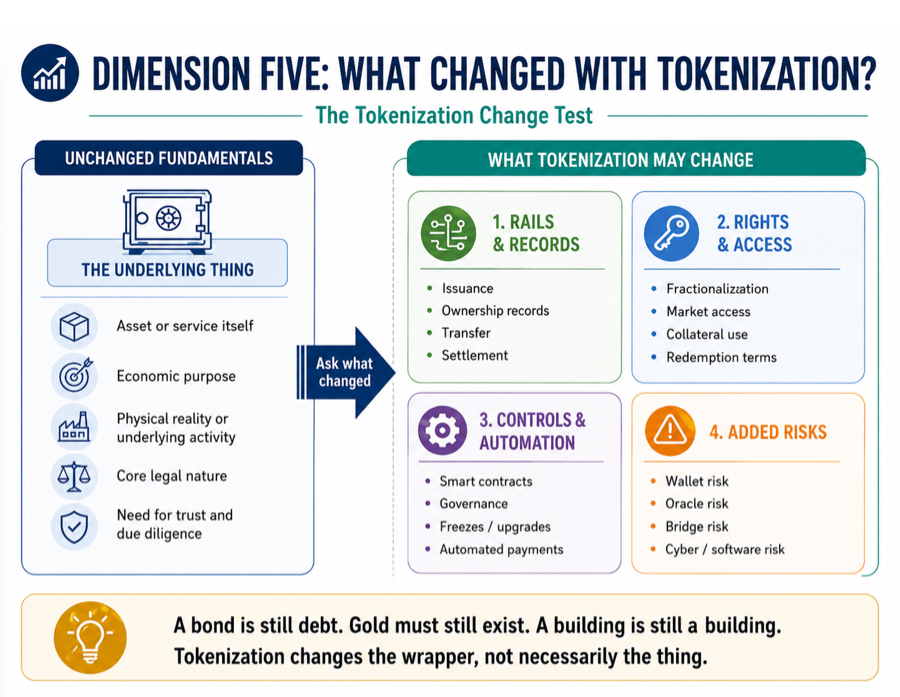
Finally, compare the tokenized arrangement with the thing that existed before it.
Tokenization may change:
- How the interest is issued
- How ownership or control is recorded
- Who serves as the legal counterparty
- Who holds custody
- Whether the interest is directly redeemable
- How quickly and when it can be transferred
- Whether it can be divided into smaller units
- Who is allowed to buy or hold it
- How it can be used as collateral
- Whether payments and other actions can be automated
- Which jurisdiction and rules apply
- What happens in bankruptcy
- Who can freeze, pause, upgrade, or reverse activity
- Which wallet, smart-contract, bridge, oracle, governance, and cybersecurity risks are added
Sometimes tokenization changes very little about the fundamental relationship. A bond is still a debt claim, even if its issuance and settlement move to a programmable platform.
Other times, the structure changes substantially. Instead of owning stock, the holder may own a claim against an intermediary that owns the stock. Instead of owning real estate, the holder may own an SPV interest. Instead of owning data, the holder may have a revocable access license. Instead of buying compute, the holder may own a volatile network token that can be exchanged for service under changing conditions.
The right question isn’t whether tokenization is good or bad. Ask what changed.
The Tokenization Due-Diligence Checklist
If this graphic is too small to read, try clicking on it for larger version.
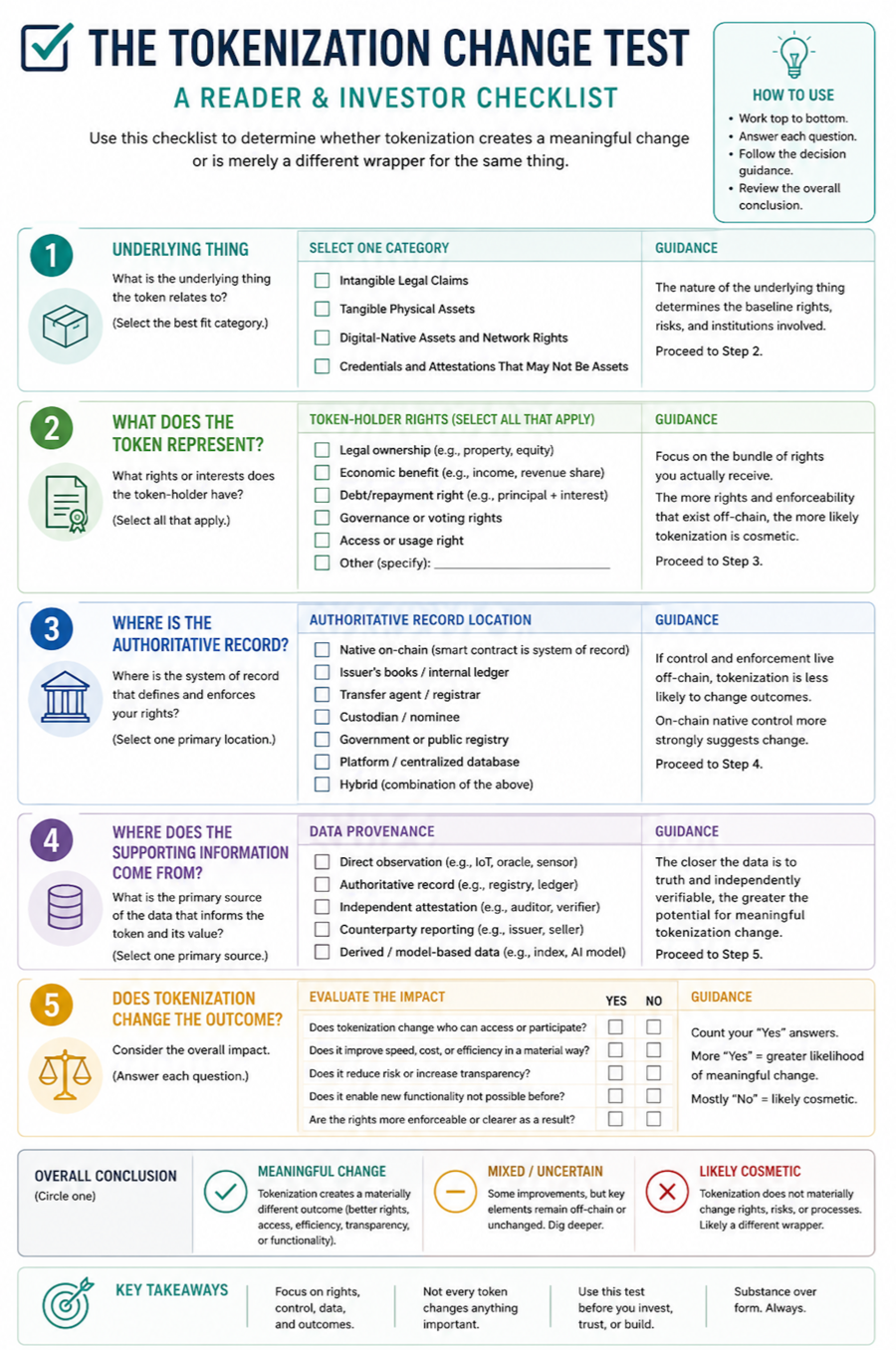
- Identify the underlying thing. Is it money, a security, a contract, physical property, data, software, compute, IP, a game object, network participation, access, or a credential?
- Identify the token-holder’s exact rights. Do you receive ownership, beneficial ownership, redemption, income, access, governance, service, synthetic exposure, or merely a token associated with the project?
- Identify the authoritative record. Does the blockchain control the right, or does the controlling record remain with an issuer, transfer agent, custodian, government registry, company, or platform?
- Identify the people and institutions. Who issued the token? Who holds the asset? Who operates the service? Who verifies the information? Who can change the rules?
- Identify the data provenance. Is the information direct or native, drawn from authoritative records, supplied by an issuer or counterparty, independently verified or attested, delivered through an oracle, calculated or derived, or assembled from multiple sources?
- Identify what tokenization improved. Did it create useful access, automation, liquidity, transfer mechanics, settlement efficiency, transparency, or collateral functionality?
- Identify what tokenization added. Did it introduce new counterparties, custody layers, software controls, wallets, smart contracts, bridges, oracles, governance dependencies, or legal uncertainty?
- Identify the failure path. What happens if the asset is missing, the service stops, the data is false, the issuer fails, the platform changes the rules, or the token and authoritative record disagree?
That sounds like ordinary due diligence because it mostly is.
Again, that’s the point. Some people might still like to play with meme coins and magic tokens. But for those for whom the get rich quick meme fun has faded, (or never existed), these are the more serious investment concerns.
Worked Examples
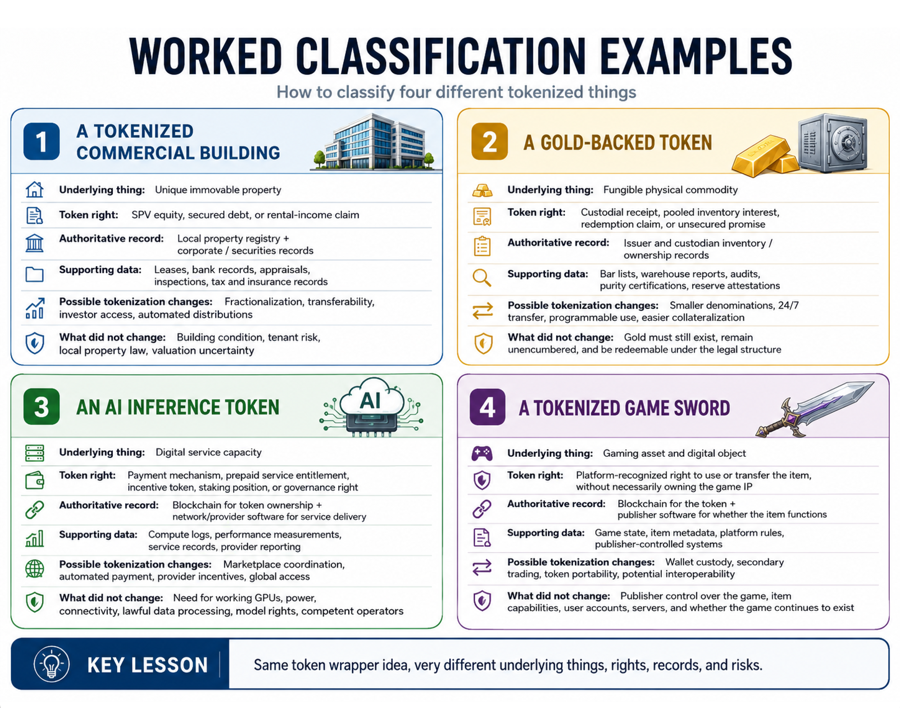
A Tokenized Commercial Building
- Underlying thing: Unique immovable property
- Token right: Possibly equity in an SPV, debt secured by the property, or a contractual right to rental income
- Authoritative record: Local property registry for the building; corporate or securities records for the investor’s actual interest
- Supporting data: Property manager reports, leases, bank records, appraisals, inspections, tax records, and insurance documents
- Possible tokenization changes: Fractionalization, transferability, settlement, investor access, and automated distributions
- What did not change: The building, local property law, maintenance needs, tenant risk, and the possibility that reported occupancy or valuation is wrong
A Gold-Backed Token
- Underlying thing: Fungible physical commodity
- Token right: A custodial receipt, beneficial interest in pooled inventory, redemption claim, or unsecured promise
- Authoritative record: The issuer and custodian’s inventory and ownership records
- Supporting data: Bar lists, warehouse reports, audits, purity certifications, and reserve attestations
- Possible tokenization changes: Smaller denominations, 24/7 transfer, programmable use, and easier collateralization
- What did not change: The need for the gold to exist, remain unencumbered, and be available to the holder under the legal structure
An AI Inference Token
- Underlying thing: Digital service capacity
- Token right: Payment mechanism, prepaid service entitlement, network incentive, staking position, or governance right
- Authoritative record: The blockchain for token ownership; the network or provider’s software for service delivery
- Supporting data: Compute logs, performance measurements, service records, and provider reporting
- Possible tokenization changes: Open marketplace coordination, automated payment, provider incentives, and global access
- What did not change: The need for working GPUs, power, connectivity, lawful data processing, model rights, and competent operators
A Tokenized Game Sword
- Underlying thing: Gaming asset and digital object
- Token right: A platform-recognized right to use or transfer the item, possibly with no ownership of the artwork or game IP
- Authoritative record: The blockchain for the token; the game publisher’s software for whether the item functions
- Supporting data: Game state, item metadata, platform rules, and publisher-controlled systems
- Possible tokenization changes: Wallet custody, secondary trading, portability of the token, and potential interoperability
- What did not change: The publisher’s control over the game, item capabilities, user accounts, servers, and whether the game continues to exist
Putting It All Together: The Full Taxonomy
The pieces can now be brought together into one framework. Dimension One provides the hierarchy of underlying things. Dimensions Two through Five classify the rights, authoritative record, supporting information, and changes introduced by tokenization. The graphic below combines all five into a single reference map. It may require clicking to enlarge.
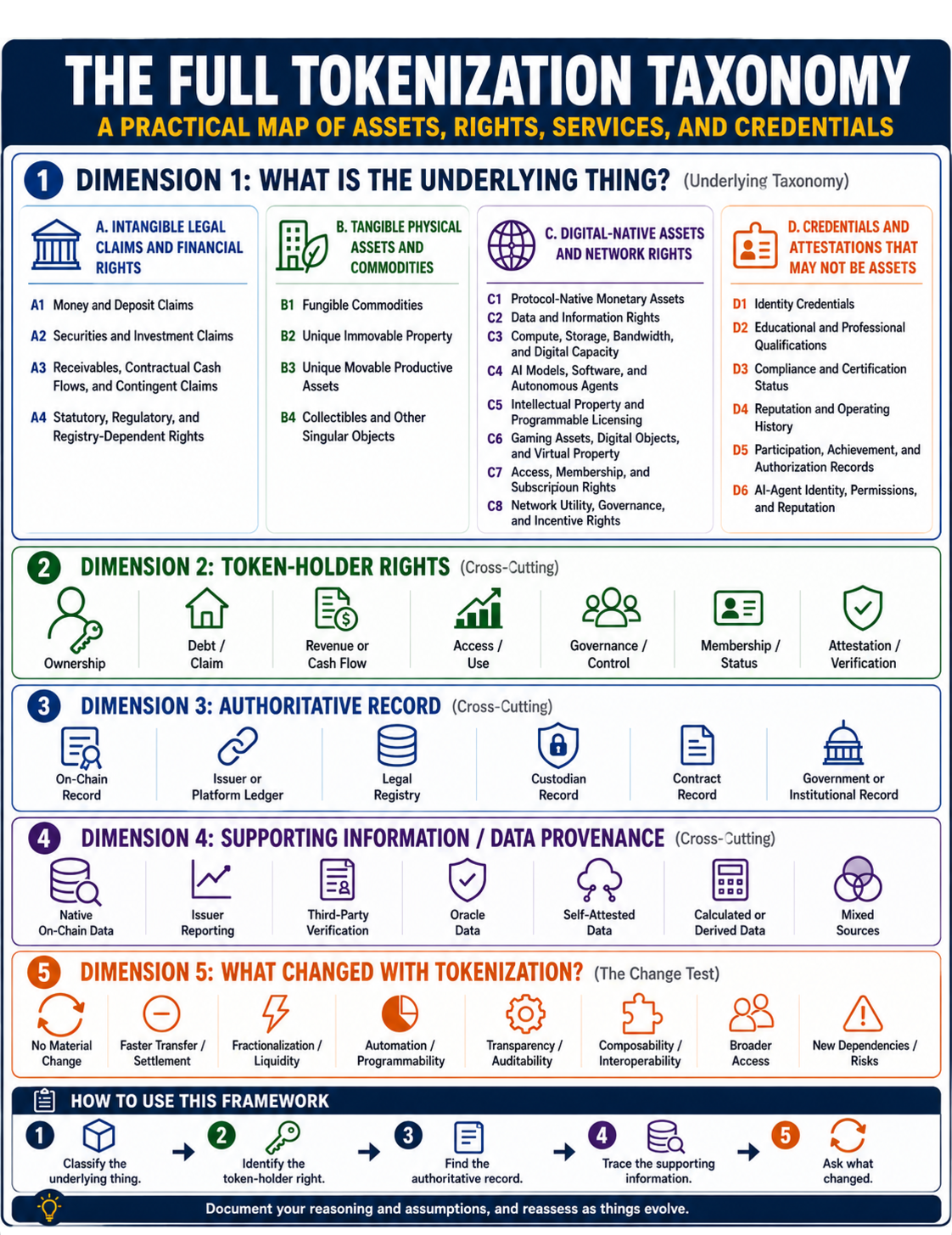
Dimension One Reference: The Full Underlying-Thing Hierarchy
- Intangible Legal Claims
- Money, Deposits and Monetary Claims
- Bank deposits
- Payment and stored-value balances
- Stablecoins and tokenized deposits
- Tokenized central-bank money or CBDCs
- Other claims redeemable for currency
- Securities and Investment Claims
- Equities
- Bonds
- Funds
- Private credit
- Structured products
- Receivables, Contractual Payment Rights, and Contingent Claims
- Invoices and trade finance
- Loans and leases
- Royalties and revenue shares
- Insurance and litigation claims
- Derivatives
- Prediction-market and event-dependent claims
- Statutory, Regulatory, and Registry-Dependent Rights
- Emissions allowances and carbon credits
- Development rights
- Mineral and extraction rights
- Licenses and permits
- Transferable tax credits and subsidies
- Money, Deposits and Monetary Claims
- Tangible Physical Assets
- Fungible Commodities
- Precious metals
- Energy commodities
- Agricultural products
- Industrial materials
- Unique Immovable Property
- Residential real estate
- Commercial real estate
- Land
- Infrastructure
- Resource-bearing property
- Unique Movable Productive Assets
- Aircraft
- Ships and vehicles
- Industrial machinery
- Medical equipment
- Other productive equipment
- Collectibles and Other Singular Objects
- Art and antiques
- Jewelry and rare coins
- Wine and luxury goods
- Memorabilia
- Fungible Commodities
- Digital-Native Assets, Services, and Network Rights
- Protocol-Native Monetary Assets
- Data and Information Rights
- Compute, Storage, Bandwidth, and Digital Capacity
- AI Models, Software, and Autonomous Agents
- Intellectual Property and Programmable Licensing
- Gaming Assets, Digital Objects, and Virtual Property
- Access, Membership, and Subscription Rights
- Network Utility, Governance, and Incentive Rights
- Credentials and Attestations That May Not Be Assets
- Identity Credentials
- Educational and Professional Qualifications
- Compliance and Certification Status
- Reputation and Operating History
- Participation, Achievement, and Authorization Records
- AI-Agent Identity, Permissions, and Reputation
What This Framework Is For
This is not intended to determine whether a token is legally a security, commodity, payment instrument, property interest, or something else in every jurisdiction. Those are legal questions, and the answers may differ. It’s a practical framework for understanding the thing before becoming distracted by the implementation.
It can help an investor ask better questions. It can help a product manager define what a tokenized product is supposed to do. It can help a writer avoid grouping unrelated things under one label. It can help a regulator, attorney, technologist, or operator identify where the real dependencies and risks sit.
Most importantly, it helps separate five questions that are too often collapsed into one:
- What is the underlying thing?
- What rights does the token actually provide?
- Where is the authoritative record?
- Where does the supporting information come from?
- What changed with tokenization?
The answers to those five questions can align neatly. Or they can reveal very different legal, economic, technical, and operational realities.
Start With the Thing
Again, always start with the thing…
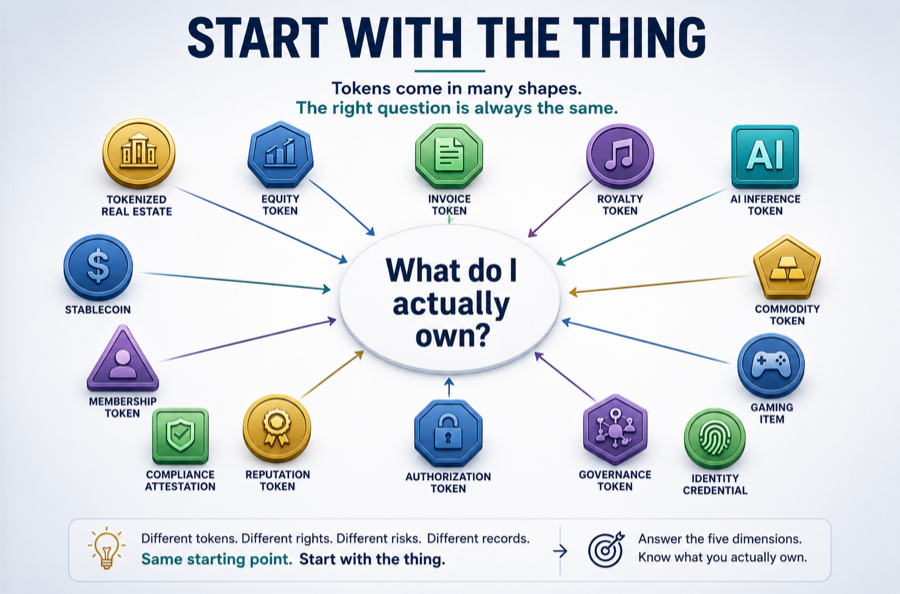
Tokenization may eventually become ordinary infrastructure. We may stop emphasizing that an asset is tokenized in the same way we stopped emphasizing that records are electronic or that a business uses databases and the internet. Until then, the newness of the technology can create a marketing halo around the underlying product. Familiar risks can appear as though they’ve been engineered away simply because the record is on-chain, the settlement is automated, or the dashboard looks impressive.
They haven’t.
A bad loan is still a bad loan. A fake invoice is still fake. A poorly maintained aircraft is still poorly maintained. Missing gold is still missing. A copied dataset may still have been copied illegally. A useless AI service doesn’t become useful because its token trades on an exchange. A credential doesn’t become transferable because someone turned it into an NFT.
Blockchain can improve the machinery around these things. In some cases, it can create better records, faster settlement, new markets, programmable controls, useful verification, and meaningful reductions in cost or friction. It can also add new counterparties, dependencies, software controls, attack surfaces, and ways to obscure the relationship between a token and whatever it supposedly represents.
So forget about the ticker for a moment. Forget about the chain, token standard, oracle, marketplace, dashboard, and clever new category name.
- Start with the thing.
- Then identify the right.
- Find the authoritative record.
- Trace the data.
- And ask what changed.
- In the end, the question remains the same: What do I actually own?
Related Frameworks and Further Reading
- BIS and CPMI, “Tokenisation in the Context of Money and Other Assets”: A broad institutional framework for understanding tokens, money, assets, claims, and programmable platforms.
- IOSCO, “Tokenization of Financial Assets”: A financial-market-focused treatment of tokenized securities, funds, bonds, infrastructure, investor protection, and market integrity.
- OECD, “Understanding the Tokenisation of Assets in Financial Markets”: Distinguishes representations of pre-existing off-chain assets from tokens issued natively on a ledger.
- “Toward a Comprehensive and Unifying Taxonomy of Digital Assets”: A 2026 two-dimensional academic taxonomy based on underlying asset type and tokenization structure.
- “A Taxonomy of Real-World Asset Tokenization for Blockchain-Based Financial Infrastructure”: A 2026 systems-level RWA framework using 23 dimensions across governance, asset structure, token properties, technology, and economics.
- “Crypto-asset Taxonomy for Investors and Regulators”: A multidimensional framework covering technology, centralization, function, legal classification, minting, yield, and redemption.
- “SoK of RWA Tokenization: A Systematization of Concepts, Challenges, and Legal Interoperability”: A broader review of RWA concepts, boundaries, implementations, and research questions.