In this part 5 of 5 for the series, we’re going to tie everything we’ve gone over about digital product connectivity together with a In this part 5 of 5 for the series, we’re going to tie everything we’ve gone over about digital product connectivity together with a field guide with learning references.
The first four parts are intended to offer a survey of product technical communications interfaces from APIs to agents and so on. This page is a See Also reference for more detailed information. A lot of it was used to craft the article series. Practically by definition, as a curated list of web things, it is likely to be outdated quickly. So consider this as just a snapshot for what the landscape of this space looks like in 2026.
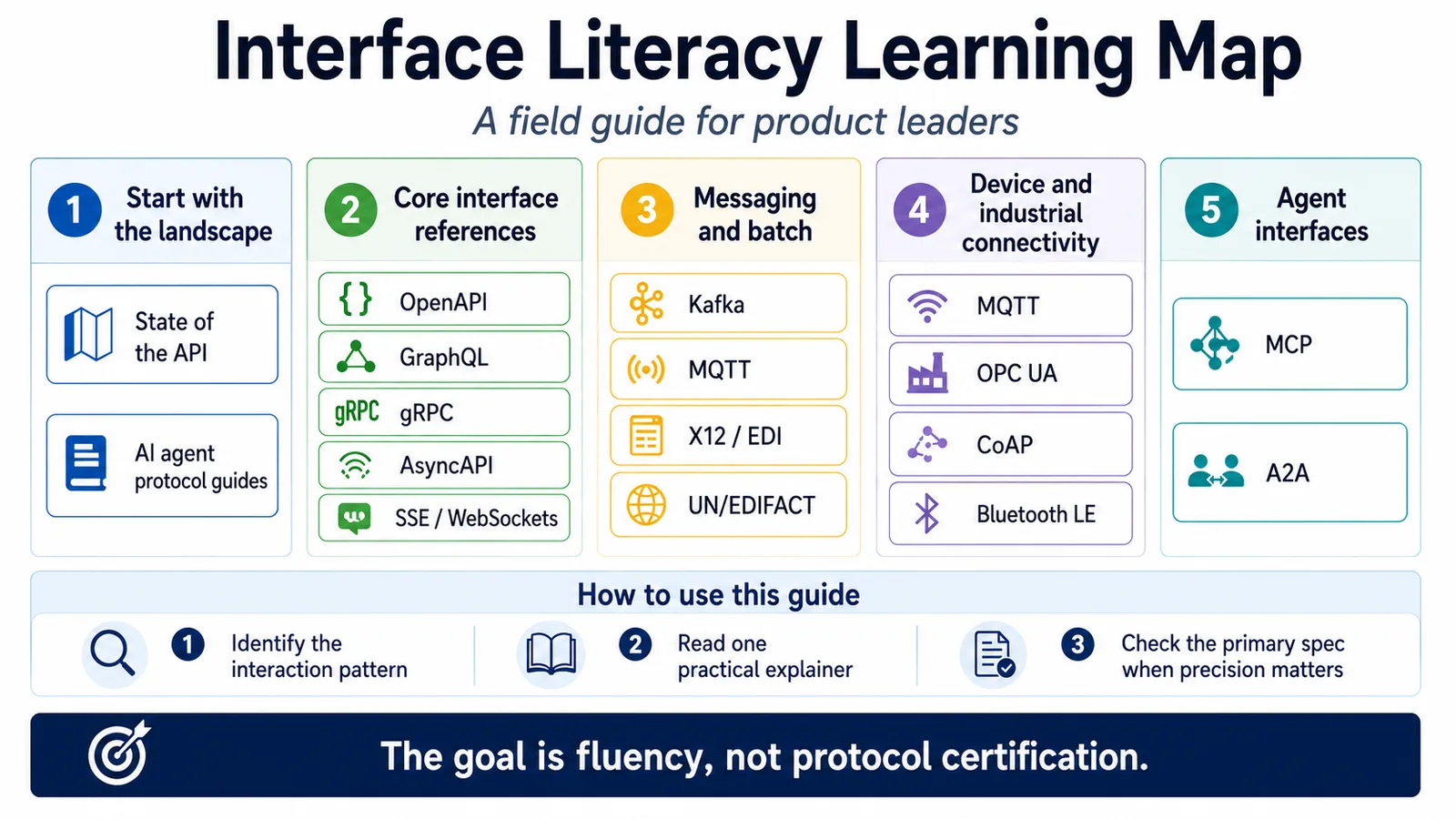
Start with the landscape
- Postman, State of the API 2025 – useful current data on API-first adoption, API revenue, AI agents as API consumers and MCP awareness.
- Google, Developer’s Guide to AI Agent Protocols – a current map of MCP, A2A and newer agent protocols using one worked scenario.
- Every API Authentication Method Explained (Don’t Choose the Wrong One) (YouTube)
Core interface references
- OpenAPI Specification 3.2 – the formal description standard for HTTP APIs, including webhooks.
- GraphQL Specification – authoritative GraphQL language and execution model.
- gRPC Introduction – service definitions, RPC methods and Protocol Buffers.
- gRPC Core Concepts – unary and streaming RPC models.
- gRPC in 5 Minutes – YouTube
- AsyncAPI Documentation – event-driven and message-based API concepts.
- Apache Kafka Documentation – event streaming, producers, consumers, topics and decoupled processing.
- MDN Server-Sent Events – practical reference for one-way server-to-browser streams.
Enterprise messaging and batch integration
Not every important integration is an always-on API or event stream. Many industries still rely heavily on structured business-document exchange and scheduled or batch-oriented flows.
- What is Messaging? (IBM)
- X12 – EDI standards used across healthcare, finance, transportation, supply chain and other industries.
- UN/EDIFACT Executive Guide – United Nations global EDI standard for computer-to-computer exchange of business documents such as purchase orders, invoices and customs declarations.
- What is a MESSAGE QUEUE and Where is it used? (YouTube)
Device and industrial connectivity
IoT is not one separate interface category. Connected devices may use request/response, publish/subscribe messaging, streams, command/control or other patterns depending on constraints such as bandwidth, power, connectivity and scale. These are useful starting points:
- Blogs/An Overview of Industrial Communication Protocols
- MQTT (Message Queuing Telemetry Transport) – lightweight publish/subscribe messaging designed for IoT and constrained or unreliable network environments.
- OPC UA Overview – industrial interoperability across sensors, actuators, control systems, enterprise software and cloud integration, including IIoT and M2M.
- Which IoT Protocol Is Best (LoRa, Thread, MQTT, CoAP & Matter Explained) (YouTube)
- MQTT Tutorial: An Easy Guide to Getting Started with MQTT
Agent interfaces
- Model Context Protocol
- Introducing the Model Context Protocol
- Agent experience: How to design products that agents can actually use
- The New Front Door – Agents Don’t Click
- MCP July 28, 2026 Specification Update – current major MCP release and the move to a stateless protocol core.
- MCP Tools – how servers expose discoverable functions to AI applications.
- A2A Protocol – current documentation for agent-to-agent interoperability.
- A2A v1.0 announcement – why the 1.0 release matters and how A2A complements MCP.
Product-manager-oriented explainers
- IdeaPlan, API Design for Product Managers (This is a great writeup, but even though only from February, 2026, it’s already slightly out of date. They say, “Your API is a product with its own users (developers).” This is true. but increasingly, it’s going to be about AI agents as well.)
- Every Type of API Simply Explained in 9 Minutes! (YouTube)
- Department of Product, APIs Explained for Product Managers
- Department of Product, Webhooks Explained for Product Managers
- Smashing Magazine, Understanding API-Based Platforms
- REST APIs for Product Managers
- Unified.to, MCP Guide for Product Managers
- Snyk, MCP Servers for Product Managers
How to use this guide
A PM does not need to read every specification front to back. Start with the taxonomy from Part 2, identify the interaction you are trying to understand, read one PM-oriented explanation, then go to the primary specification when a decision depends on precise behavior.
The companion code from Part 3 is the hands-on layer. The goal is not certification in protocols. It is enough fluency to recognize the decision, ask better questions, and know where to go deeper.