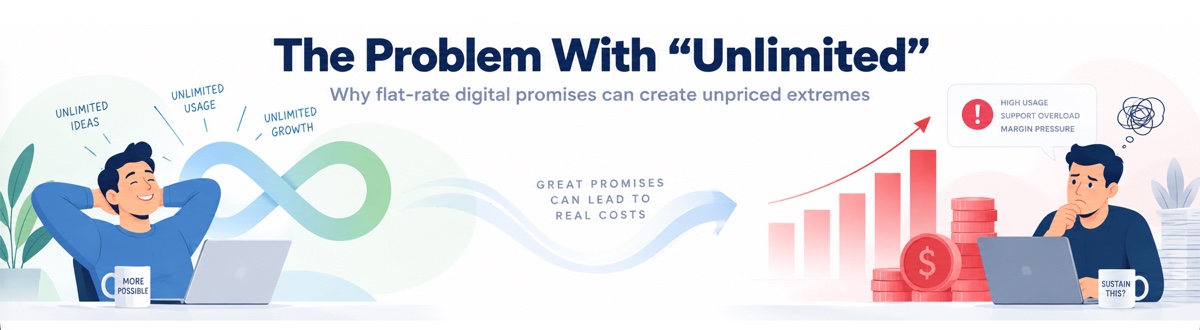
tl;dr
Saying “Unlimited” might be a great marketing pitch and plenty of products try it. Personally, I’m a big fan of this at the buffet. And maybe it works in some contexts where there’s clearly some kind of consumption limit such that even the outliers don’t utterly destroy your margin. (For example, try as I might, there’s only so much chocolate pudding I can eat.)
However… even though we’ve seen this offer for digital products it’s probably a bad idea most of the time, and I’m going to tell you why.
Here’s the short answer and you can skip the rest if you buy it. Across years and products we’ve seen outlier abuse of unlimited plans can cause havoc or painful exception processes. Even honest usage can become a negative if costs go up in unexpected ways and you’re stuck with a brand and contractual promise you can’t keep.
Do you agree? Don’t do unlimited unless you have clear rationale and systems to deal with issues. That’s it. If you want more justifications for the assertion, read on. If you read further, as you do, ask yourself or your team members this one question: “Is the benefit of this tired claim worth all the trouble it could cause?”
What’s the Value of the Pitch?
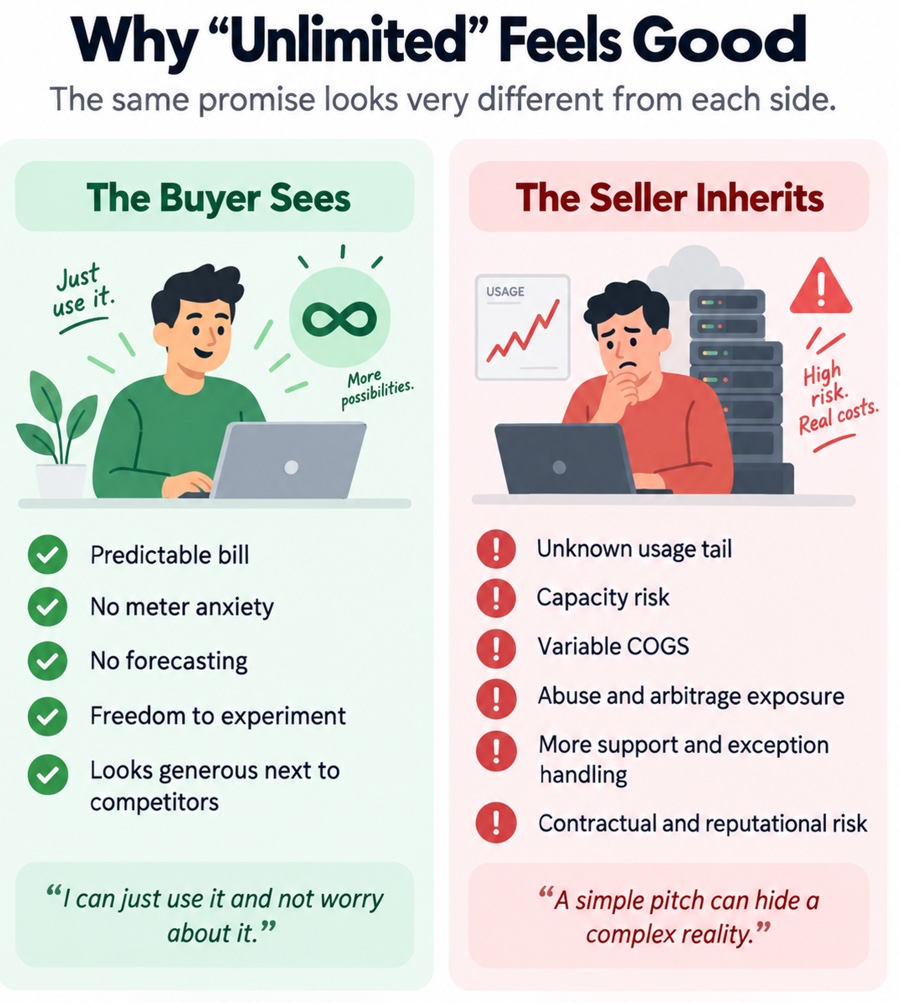
The unlimited claim has power in its simplicity. It’s a friction killer. Consumers and business busyers like it because they don’t have to think much about their capacity needs. Buyers don’t want to forecast seats, storage, API calls, or tokens when facing uncertainly themselves. “Unlimited” removes this anxiety. Price is known and the offer sounds generous next to anything with a meter. And at the buffet, I can try new things with zero risk even if there’s some waste.
The offer also does branding and sales work. It signals a product you don’t have to ration. On a pricing page it looks cleaner than a matrix of included units and burst rates. In a sales cycle it short-circuits the overage debate. The reality is the fine print sometimes means “unlimited” often isn’t. The argument here is why go through the gymnastics unlimited creates when digital products don’t behave like a buffet. A few rare users can keep eating, (computationally, commercially, sometimes legally), at almost no extra effort to themselves and very real extra cost and risk to you and your other customers.
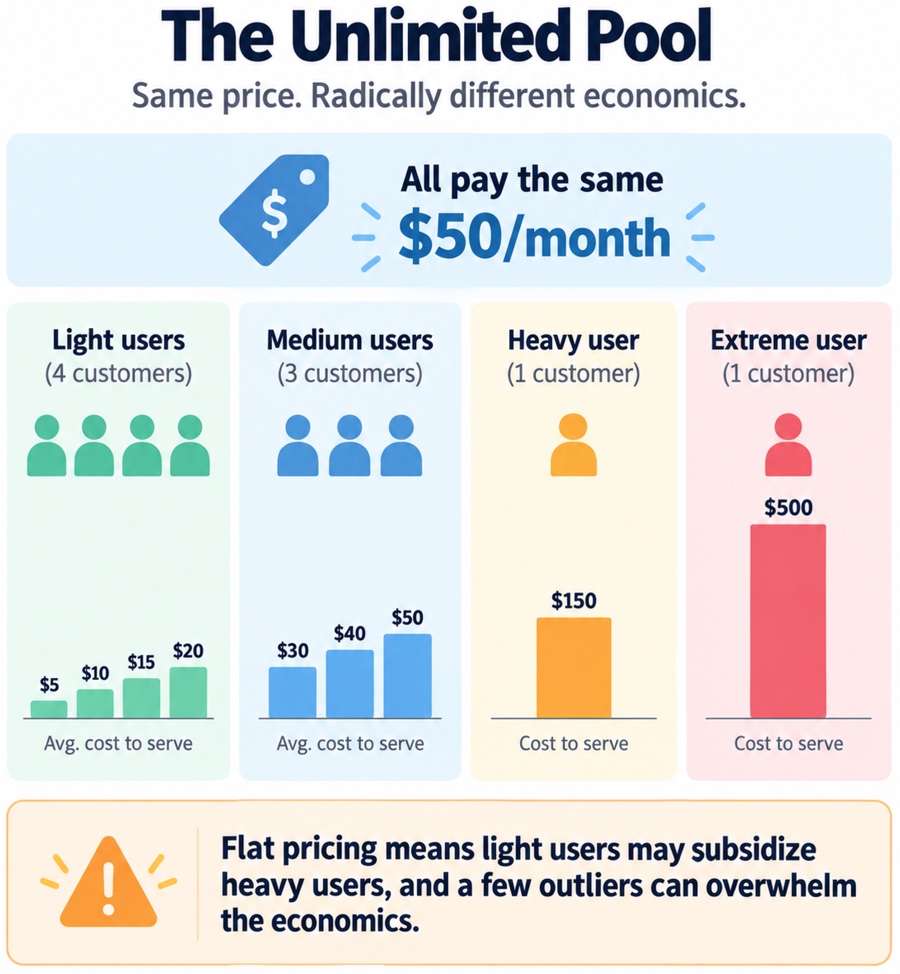
Is it possible for “unlimited” to actually be negative from the offer perspective as well? Some customers see this and think, “I only use so much of this, why should I subsidize everyone else?” There will always be friction around tiers. But this is different. Unlimited is a pooling offer. Light users pay a tax. Heavy users get a discount. Some light users notice and may opt out. One example: “My biggest problem with unlimited is that I don’t use much and just end up subsidizing the heavy users… I’ll still end up paying for other people to use data.” (Reddit) There’s plenty of these comments and this is just a small sample of folks saying it out loud vs. doing silent calculations.
Why The Pitch Itself Might Be Weak
Here’s some reasons why it’s not always the best offer idea. We’ll get to more functional reasons as well.
Adverse selection. All-you-can-eat plans attract those who use them hardest. The light users you wanted as cheap costs and stable margin maybe pick a cheaper competitor. Though you don’t want super low usage either because that’s going to churn. You’re probably best off with a balance. If flat-rate unlimited plans attract the customers with highest expected consumption, that’s fine if their usage is cheap to serve. But it’s dangerous when the customers most attracted to the offer are precisely the customers with the worst unit economics, especially if your costs change.
Fairness, not just math. Buyers don’t need a Cost of Goods Sold (COGS) model to dislike a pool. “Why am I paying the same as the person running this 24/7?” is enough.
Quality inference. In digital goods, “unlimited” can read as “this will get slow, throttled, or worse,” especially after seeing years of companies using the word “unlimited” walking it back. Microsoft ended unlimited OneDrive in 2015 after some users stored over 75TB, which was 14,000 times the average (story). AT&T paid $60 million to settle FTC charges that it throttled “unlimited” data customers (Axios). And MoviePass’s $9.95 unlimited plan ended in bankruptcy and its former CEO pleading guilty to fraud, after prosecutors said the “unlimited” price was a temporary marketing gimmick to inflate the stock (Quartz).
Serious-buyer distrust. B2B buyers may treat unlimited as a consumer slogan. They would rather see a number, an overage rule, rather than a promise they assume is fake. They could even have concerns about your longevity. No one wants to overpay. At the same time, no one wants key vendors going out of business. If a buyer thinks you have a lousy and risk-laden pricing model, how can they trust you as a vendor.
What Are Core Functional Problems?
Just a few abusers can ruin a system. It’s the one bad apple spoils the whole bunch cliché. Unlimited sounds like good marketing, but it’s a technical and legal liability quagmire. Too much free riding, (however you define “too much”), can damage systems in multiple ways, including impact on other customers. That’s not fair to you or them. And perhaps provoking emotional response from others who tire of supporting freebies. You can find such issues on Reddit when some paid users of products complain they’re overly supporting freemium free riders.
Let’s take a look at some main concerns.
- Creation of open-ended obligations. A monthly “unlimited” plan doesn’t create balance-sheet liabilities the way many other offers do because the obligation ends when the term ends. But other “unlimited forever” offers might, and even term subscriptions create inherited obligations when you might have to walk the promise back. For example, when Microsoft killed unlimited OneDrive, it had to give the heaviest users a 12-month grace period to migrate their data. That was a year of servicing a promise. That’s behemoth Microsoft. If you’re a medium size company, that kind of thing could sting. A small company? Such a liability might wipe you all the way out. (I have no specific list here. But it stands to reason. If you sell unlimited and your cost to serve moves with use, a handful of power users can erase the margin on everyone else. A small company might not get a second pricing cycle to fix it.)
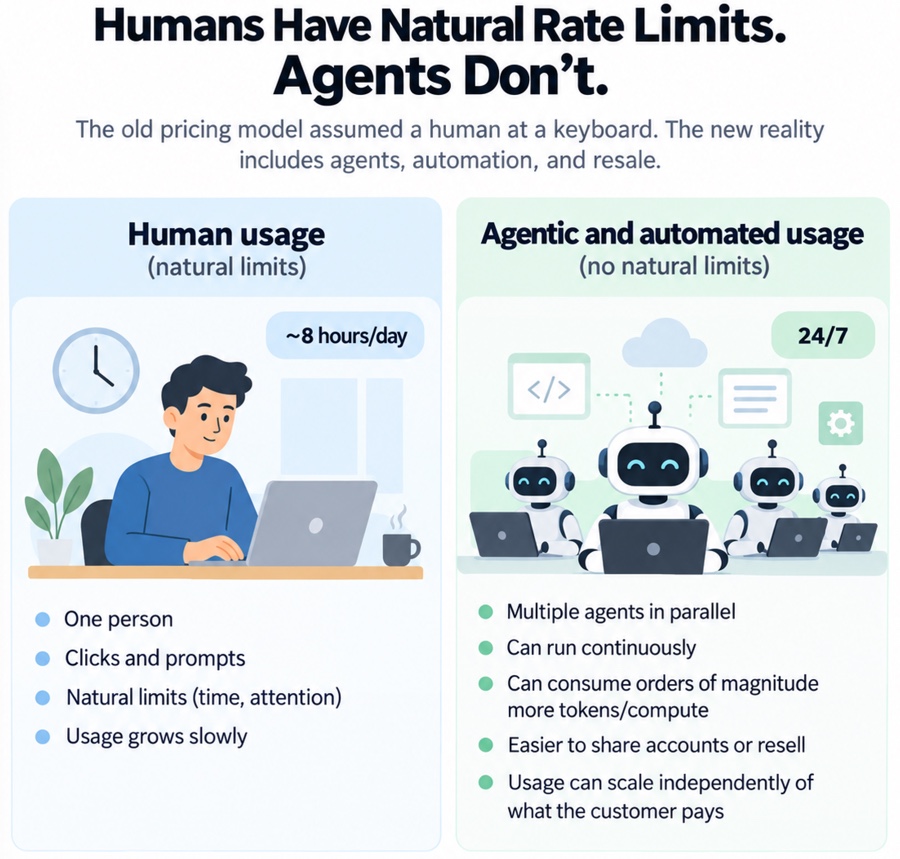
- General Abuse. This isn’t outright fraud, just usage you never intended: automation hammering your system around the clock, account sharing, scraping. When Anthropic added weekly limits to Claude, it specifically called out users running Claude Code continuously in the background 24/7. A person at a keyboard has natural limits. A script doesn’t, and “unlimited” is an open invitation to write one. What’s the hottest topic right now? Agentic, right? What happens when every script jockey out there starts pointing bots at unlimited plans based on your assumption that only 20% of users would get to high usage levels.
- Using the product for other commercial purposes. The personal plan that all of a sudden becomes someone else’s business. Account resale showed up in the earlier Claude episode. People were sharing and reselling access to subscription accounts. Someone wrapping your flat-rate product and selling it onward isn’t a heavy user; they’re an unlicensed reseller running their COGS through your pricing page. “Unlimited” makes that arbitrage trivially profitable. Everyone out there has gotten fairly sophisticated. Even without intentional fraud, if you leave open a legitimate door for arbitrage, someone is likely to use it.
- Use of the product for illegal purposes. Unlimited storage attracts pirated media libraries. Unlimited messaging or email attracts spammers. Unlimited API calls attract people probing systems they shouldn’t. You don’t just get infrastructure cost, you get abuse, complaints, and law-enforcement requests. This is why the ToS section matters. You need the hook to act, and “unlimited” makes the bad actor harder to distinguish.
- Heavy outliers causing other customers to subsidize them as freeriders. Every flat-rate pool has an engaged-usage curve, and that’s fine. That should be priced in. This is about the extreme tail. In the OneDrive case, the top users hit 14,000 times average usage. Nobody prices a pool for that, which means everyone else is paying for it, and some of them eventually notice.
Driving Home The Main Point…
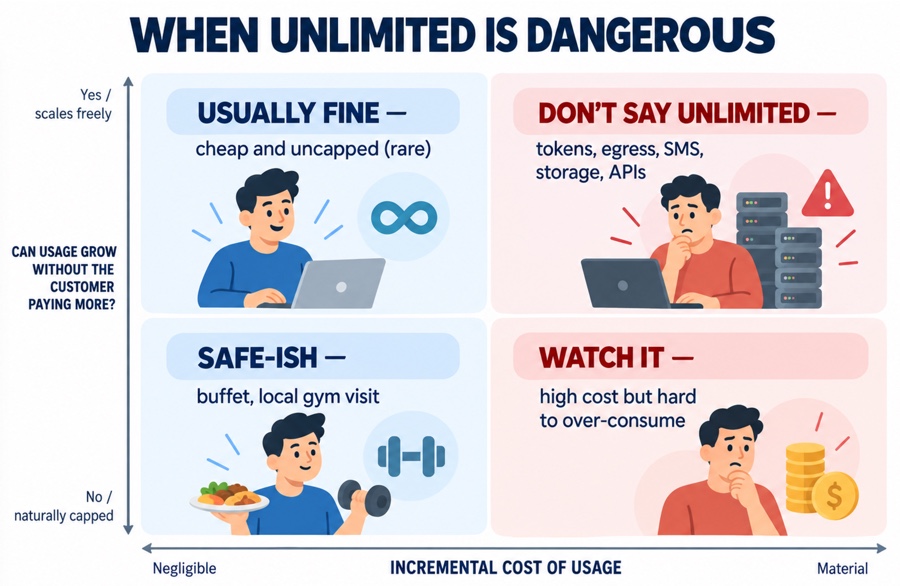
Unlimited becomes dangerous when the thing being made unlimited is also a meaningful cost, capacity, or risk driver and customer consumption can scale independently of what the customer pays. And any guardrails you try to put in via Terms of Service are really just sketchy ways to get out of a promise you shouldn’t have made.
And perhaps even worse, your worst unlimited customer doesn’t have to be doing anything wrong to damage your business.
What Are Some Part-way Solutions
I’ll offer these, but first I’m going to tell you why they don’t thrill me. They’re halfway. They can leave open significant risk. Questions like “what is abuse” are open to interpretation. If you say “unlimited” usage, but have a general ToS policy about abuse. Then you set an internal reporting flag for usage over X. At some point you look and determine there’s abuse. Can’t that customer dispute the determination or challenge your enforcement? You’re using numbers anyway. So what you did was create ambiguous rules and product alerts just so you could use a single word in marketing that seems great, but maybe always isn’t. All that said, here are some options if you simply must hold out an “unlimited” offer of some kind.
- Terms of Service about abuse. A ToS clause is necessary, but not sufficient. It gives you a legal hook for what you can maybe claim as clear abuse, scraping, resale, illegal use, and obvious exploitation. It does not stop the well-meaning whale who is “just using the product,” and it does not help the other customers who are already paying for that whale. And it creates a monitoring and management problem you wouldn’t otherwise have. You still need ToS as the backstop though. Define acceptable use, reserve the right to rate-limit or reprice extreme accounts, prohibit commercial wrapping of a personal plan, and say you will cooperate with lawful process. Then pair it with something operational, like monitoring, an upgrade conversation, or a published fair-use threshold. Otherwise, you will meet the clause when you’re already angry, the customer is already entrenched, and the exception process is already expensive.
- Fair-use language with no operating definition. “Reasonable use,” “normal business use,” “not excessive.” Fine as a placeholder. Weak as a system. If nobody can say what the number is.
- Manual exception handling. An AE, CSM, or founder can ask the heavy user to “cut it back,” offer comps a month, or cut a one-off deal. That can save a relationship once. As a process it doesn’t scale, and it trains customers that noise gets a discount, and leaves no record of what “unlimited” actually cost.
- Silent throttling. You keep the word on the pricing page and slow the account when it hurts. Sometimes that’s the least-bad containment move. It is still a part-way solution because the customer bought a promise you are now breaking without a published path, which is how you get chargebacks, public threads, and “they lied” narratives. And yes, maybe also legal problems. We’ve seen this movie. It hasn’t had good endings.
- Account-level rules that are social, not commercial. One account per person, no sharing, no bots, no resale. Useful. Incomplete. Identity rules catch some abuse and miss the legitimate power user who is simply expensive. You still need a product and pricing answer for that person.
What are Better Solutions
You don’t need “Unlimited” as the pitch to demonstrate generous plans. Ridiculously large limits that clearly no one will reach still make a good pitch. And yet protects you from abuse. You might be thinking, “So what? The incremental cost of a few outliers for some bandwidth and hard drive space should be manageable.” Maybe. But it’s really just a gaping open hole with unknown downside. If you’re offering things like AI inference tokens? That might be another problem. Or anything where you can’t judge your own variable costs that well.
Have you noticed how often “unlimited” AI usage ends up acquiring qualifications? In 2025 alone, Anthropic added weekly rate limits to Claude plans specifically to curb users running Claude Code 24/7 (TechCrunch) including account sharing and resale of access, and Cursor abandoned its “unlimited slow requests” model and reinstated request caps after the economics broke (their own forum explanation). These are sophisticated pricing teams with real-time usage data, and even they couldn’t hold their word. Bots and agents are getting easier for everyone. It’s not just a person at a keyboard pounding on your system anymore.
A few patterns can work as well or better than a raw “unlimited,” and they still let you sound generous:
- Generous included allotment plus overage. Sell big buckets, but not infinity. Most customers never see the overage line. The ones who do for real maybe become a pricing conversation instead of an incident.
- Soft caps and fair-use language that you actually operate. A ToS clause nobody enforces is just a future argument. Define intended use, watch the tail of outlier usage, and have a human path before you throttle or cancel. Abruptly throttling a business customer can create contractual disputes, customer claims, and very real operational damage; another reason the actual limits should be defined before the customer depends on the service.
- Rate limits instead of lifetime volume. Concurrency, requests per minute, seats in use, and similar gates protect the system without pretending the customer will never grow. Power users will feel a speed bump, but not a bait-and-switch. It’s interesting to see what’s going on in the mid-2020s with AI pricing. We’ve had variable pricing issues before with APIs and such. But this time? Things seem to be changing with higher velocity that’s hard to plan around.
- Credits that refresh. Monthly or annual credits die or reset. That avoids the gift-card / points-expiration style liability you create when “unlimited” is read as a perpetual claim.
- Separate personal, commercial, and reseller SKUs. If someone is wrapping your product and selling it onward, that’s not “a heavy user.” That is a different product. Price and contract it that way. Or dis-allow it. Or make it part of your product.
- Hard technical limits with a clean upgrade path. Especially for variable-cost lines like inference tokens, SMS, enrichment APIs, egress, support hours. “Unlimited” is just an unpriced COGS surprise. Put the limit in the product, put the next tier next to it, and make the jump obvious.
- Watch the tail on purpose. Instrumentation is part of the offer. Alert internally when an account is becoming a problem. Reach out with a plan change before other customers are subsidizing them and before you have to be the bad guy.
Are There ANY Times Unlimited Works?
Clearly I have a point of view here. And I’ll maintain my assertion. But fairness demands at least a few caveats.
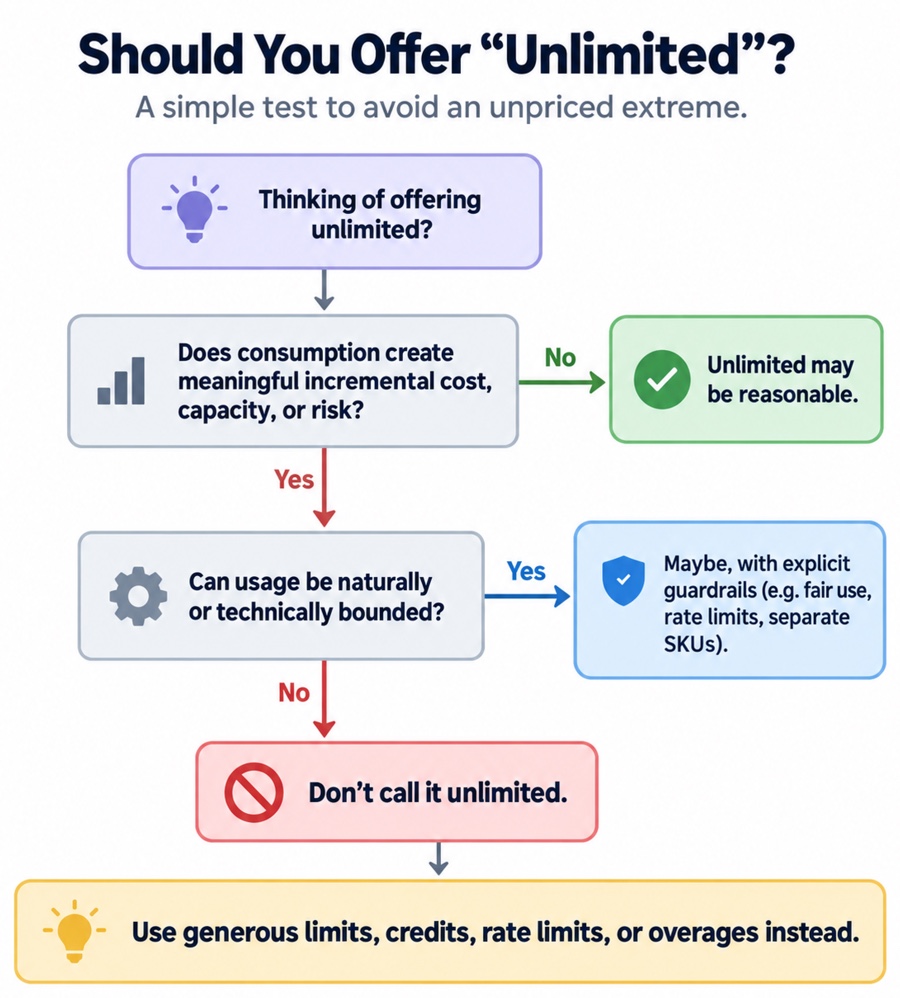
Maybe “unlimited” can work if the thing being unlimited has very well-known, negligible incremental costs. Or if consumption is naturally constrained somehow. Perhaps a large company that can afford potential issues wants to start with it, even knowing they might change it later. It can also work if you’re confident extreme usage won’t create meaningful capacity, support, margin, or abuse problems. It seems to be popular with mobile carries, at least for voice, maybe some gym memberships and similar. And maybe Unlimited works if your Go To Market just seems to scream that’s what you have to do to break out. It can even work. Just be ready for what might be consequences, which can apparently range from success, to expensive re-work, to legal problems. Your call.
In spite of that small nod to the other side of my own argument, I still maintain the basic assertion. In many digital products, the marketing benefit of saying “unlimited” simply isn’t worth the additional economic risk, monitoring, policy, exception handling, and contractual gymnastics it can create.
The test is this: If a handful of outliers can wreck margin, capacity, legal exposure, or everyone else’s experience, you do not really have an unlimited product. You have an unpriced extreme. And it’s one that may eventually force you to limit usage, change the deal, or break the promise that made “unlimited” attractive in the first place.