Bonus Hands On article for the product manager’s guide to digital connectivity series.
tl;dr
Unit Economics, ROI and P&L for Product Leaders
“API-first” is becoming another default for a lot of product teams, perhaps especially with AIs and agents potentially consuming data delivered through such channels. While APIs may have started more as internal plumbing, they’re more product-like than ever.
This has serious impact on product work. Product managers spend a lot of time connecting behavior to product metrics. Conversion. Engagement. Retention. Task completion. Adoption. The next level is connecting these pieces to financial outcomes, both cost and revenue. So we’re going explore that.
This is the idea behind Productify’s P&L guide for product leads. Growth metrics and financial impact should be understood together. A feature that increases engagement but damages margin may not be working economically unless that tradeoff is deliberate and justified elsewhere. A feature that costs more to serve but creates more revenue, retention or risk reduction may be a terrific investment.
APIs can sometimes make this relationship more visible.
The business questions are what it costs to create a successful customer outcome, what that outcome is worth, and whether the economics get better or worse when the product wins.
Stop here if you like. You can skip the rest of the article as this was as the main point. Everything that follows is details. If you want a sample spreadsheet to start building your own model, see this link to a GitHub Repository for a copy: API Product Unit Economics Model
Here We Go
Still here? Great. Diving in then…
Let’s say a customer clicks a button. Behind it, your product might call a mapping service, an identity provider, a fraud API, an AI model and a notification platform. Those services may charge by call, transaction, token, message or another unit. Individually, maybe none of the charges look large. Even the total cost may seem worth it when it looks good on the feature checklist. Then something potentially tragic happens. There’s great success for the feature! At least in terms of usage. But it turns out this usage success is actually value destructive at scale.
This is a scenario when the API bill becomes part of a product decision, likely with finance pressing the matter.
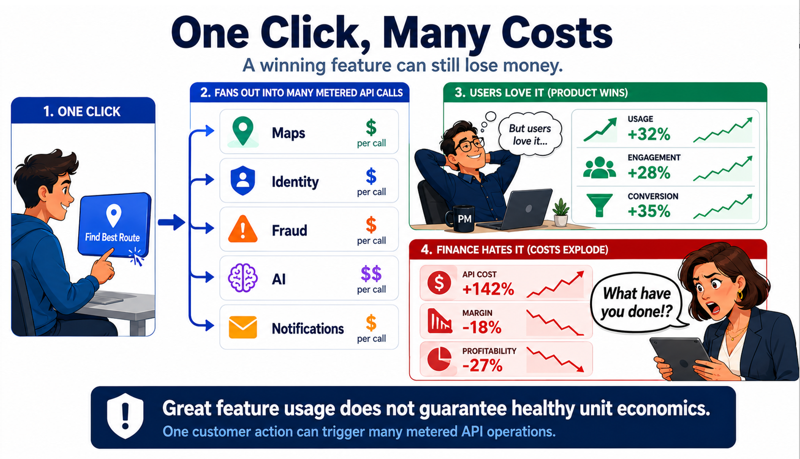
Eventually Every Product Gets Down to Unit Economics
I’ve had arguments about this, but I’ll stick by this assertion. Yes, it may be the case that internal tools, compliance features, public goods, and prestige bets can be justified on overall portfolio value logic. For awhile. They still have a cost per unit of outcome, but a company can choose to fund them from other units. However, the economics don’t disappear. They just move temporarily. And APIs can be problematic. Once early phase subsidies for “growth at all costs” runs out, the product has to stand on contribution. If contribution is negative and stays negative, more volume just loses more money. Scale doesn’t rescue a product that loses money on every order. (Yes, I know. This can last awhile in times of extreme exuberance; be it original dot com or orbital AI. Still, most of us don’t – and shouldn’t try – to get away with such extreme spending for too long.) This is why the idea is useful for PMs as well as finance. Someone has to look at dollar flows before tiny costs (API calls, inference tokens, shipping, support minutes) compound into a bill the P&L cannot carry.)
You don’t need to own the company P&L to think this way. But if you want your product to succeed, someone had better be. If you ever want to own a larger piece of your business, it might as well be you. A senior PM or product lead may never see every corporate allocation or accounting line. That’s fine. That doesn’t prevent the product team from building a useful economic view of its product area. Maybe this isn’t the product lead at all, but a team member on finance working with product. Doesn’t matter. As long as someone takes a look at the actual dollar flows before seemingly tiny API call costs multiply into untenable costs; whether that’s as a consumer of APIs or as a seller that needs sensible market pricing.
So. Unit Economics. At some point the business has to answer…
What does it cost us to create one useful unit of value, and what do we get back?
Obvious business, right? Simple enough, right?
The units to measure will differ. It might be one customer, order, shipment, quote, completed support case, document processed, identity verification, AI-generated task or another successful business outcome.
The FinOps Foundation’s Unit Economics framework applies this idea to technology spend. Raw cost becomes more useful when related to business output. CloudZero similarly describes unit economics such as cost per customer, transaction, API call or feature. At a super high level you can just use all organization level costs, but this might not be very satisfying and would be more challenging with more than one product involved.
Units matter because total spend can be misleading. If API spend doubles while successful transactions triple, API cost per successful transaction has fallen. If API spend doubles while useful customer output rises only 10%, cost per unit of value has increased substantially. That can signal extra API calls, retries, more expensive workloads, vendor pricing changes, or other deterioration in the unit economics. You’re trying to figure out the relationship between costs and useful output.
Total spend tells you how big the bill is. Unit economics tells you whether the bill makes sense to allow it to continue to occur.
Years ago I worked on a product that was really effective search arbitrage.The margins were garbage. But they were still positive. Even in the pennies, that’s a bell you can ring all day long, if only you can find the volume. Which sometimes you can’t. There’s more than one reason margin matters, but this is one of them.
If our product is something completely different, though, the relationship may be harder to trace. A mapping API might help a delivery product reduce miles driven. A fraud API might reduce losses rather than create revenue. An AI API might power a feature that improves conversion or retention. A communications API might make onboarding more successful. In those cases, the relevant output isn’t necessarily something being resold. It may be a transaction completed, a customer retained, labor avoided, risk reduced, or simply a product capability customers are willing to pay for as part of a larger offering.
Here’s the key point…
It can be challenging to discuss these issues because we have to keep straight where we’re a consumer and where we may be a provider or supplier. And if we’re a supplier, we need to understand how those costs ultimately connect to revenue or another form of economic value. Some costs may eventually be classified or allocated as overhead in the company’s formal accounting. The challenge is not to let that accounting treatment obscure the tactical product economics underneath it.
Start With the Customer Outcome, Not the API Call
Suppose a vendor charges $0.005 per call. That sounds like basically nothing. But customers don’t really want to buy API calls. They buy outcomes. At least, eventually that’s what their people will be seeking. Isn’t that what you do when you’re considering products and services to buy?
Consider that for APIs, a single apparent customer action may require a lookup, a verification, an enrichment of some sort, maybe an AI model call, and likely some kind of notification.
Here’s a fair first principles type question…
What does getting one successful customer outcome require our systems to do?
The individual API calls are the bill of materials (BOM) underneath that outcome.
The AI-Native PM framework makes this point particularly well with “cost the task, not the call”. The principle works beyond AI. A workflow can make each individual call cheaper while still becoming more expensive if it now requires more calls, retries or failed attempts. (I don’t really want you to leave, but do take a click on that last reference; it’s worth it. Open it in a new window and save for later if you like.)
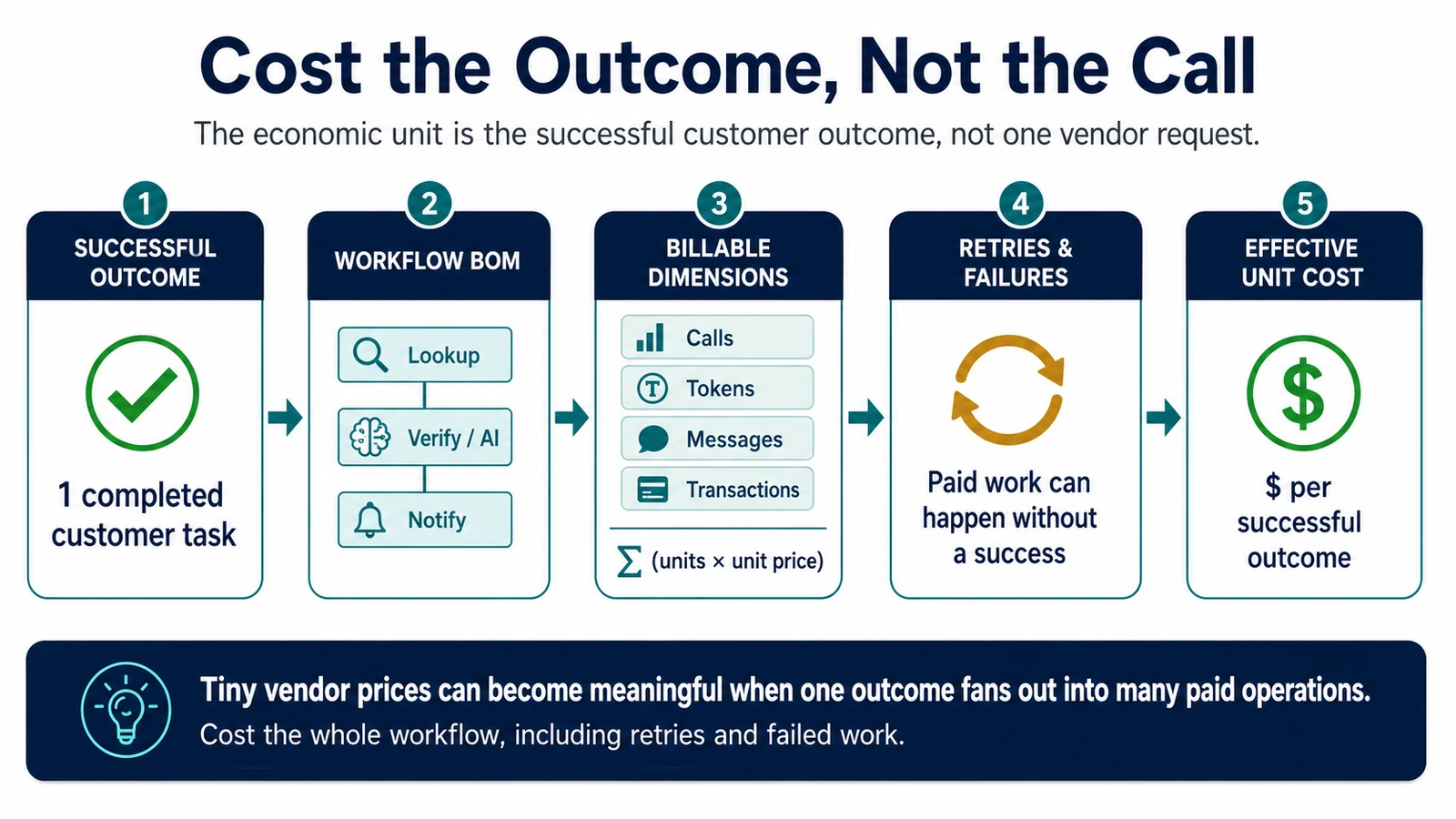
Failed Work & Freemium Still Costs Money
Suppose 100 customers start a workflow. Ninety complete it successfully. Ten fail or abandon it after the system has already consumed paid services. The business still pays for the failed work. That cost belongs in the economics of the successful outcomes. The same applies to retries, timeouts, unsuccessful verification attempts, abandoned AI tasks, duplicate calls and quality-control steps.
This is why cost per successful outcome can be much more revealing than cost per API call. A technically efficient component can sit inside an economically inefficient workflow. You might look at the successful path and find that it’s been optimized extremely well. The problem is that too many customers start the workflow, consume paid API services, and then fail or abandon it before creating any value. The API calls are cheap. The successful outcomes aren’t. Suppose each attempt uses $0.20 of API services. That might seem inexpensive for your particular task. But if 1,000 people start and only 250 finish successfully, you spend $200 to produce 250 useful outcomes. Your real API cost is $0.80 per successful outcome, not $0.20. This is why “We optimized the execution path” is not the same thing as “we optimized the economics of producing an outcome.” It’s also why I personally have never really liked the idea of so-called “North Star” metrics. I understand the value they might provide sometimes. But the reality is that often you really have to look at drivers below the surface. I’d agree that ridiculously cluttered dashboards with every metric are also bad. So the answer is to think about the in-between and just make sure whatever numbers your using honestly reflect what’s healthy or not.
And obviously, for Freemium or trial type services, the cost of free users has to be covered somewhere, whether by paying customers, advertising, lead generation, investment capital or another funding source. This opens up other marketing questions regarding offering prices. That’s out of scope here, but just consider for a moment your own buying behavior. Don’t you look for reasonable costs for yourself? Do you resent it if you’re paying for what you perceive as too many free riders? It’s ok to offer whatever you want. But you should be clear within your own models that these are explicit choices.
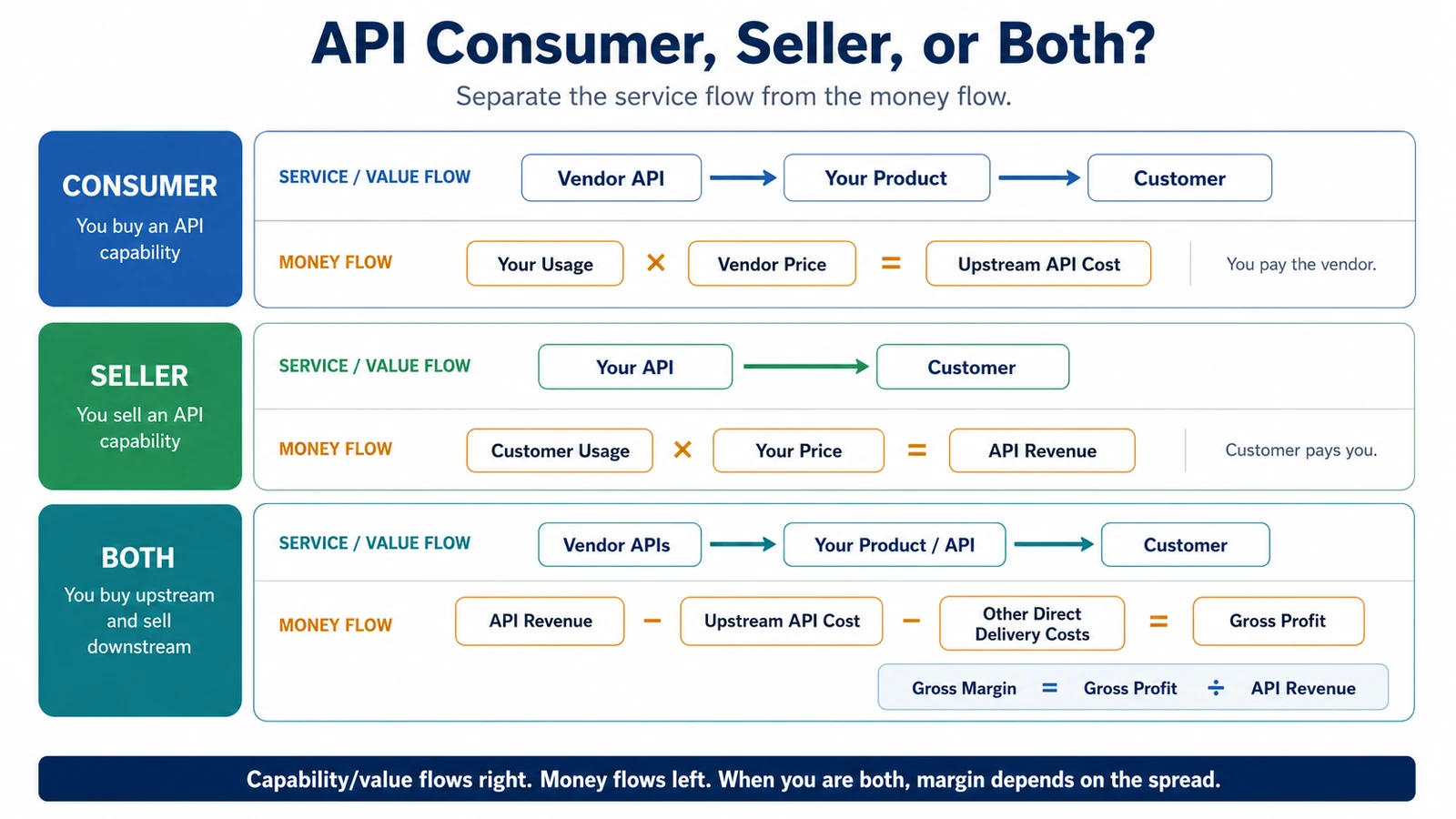
Are You an API Consumer, Seller, or Both?
Before doing the math, determine which side of the API economy you’re on. These days, a digitally native product can easily be both to varying degrees. If APIs are “just” inputs into some broader product or production process, then the economic question starts to look more like a traditional contribution-margin problem. How much revenue remains after the variable costs required to deliver the finished product? Broader value questions such as retention, strategic capability or risk reduction can then sit alongside that contribution-margin view. API unit economics are often a more granular version of the same basic analysis. One difference may simply be the scale involved. Unit costs can be tiny fractions of a cent, while usage can reach millions or billions of transactions.
When You Consume APIs
Your product buys capabilities from somebody else. Maps, payments, identity, communications, search, financial data, AI inference, fraud detection and so on.
Product questions might include:
- What is the vendor’s billable unit?
- Which customer behavior drives usage?
- How many units does one successful product outcome require?
- Do retries, polling, background refreshes or failures multiply usage?
- Are power users dramatically more expensive than average users?
- Should expensive usage affect tiers, limits or pricing?
- What happens if the vendor changes price?
- What are the usage / billing tiers?
This problem is not new. digitalML’s older API Product Management KPI worksheet explicitly included third-party API ROI, budget usage, ownership and cost per call.
When You Sell APIs
Now you need to determine what customers should pay for and whether the price supports the economics underneath it. API pricing strategy is its own huge topic. Clearly, we’re touching on some aspects, but others have already written up solid intros. So I’m just going to add some references to that area in particular at bottom in the See Also section. API monetization seems to be one of those “things” lately in the mid-2020s. This might be partly because more are using them internally and thinking, “What else can I get out of this resource I’m producing.” Or maybe it’s just the whole ecosystem is more set up to consume such things now.
All of this might mean pricing by call, transaction, token, record, usage tier, subscription allowance or committed volume.
The important question is:
Does downstream price cover the cost of delivering the API while leaving the margin we need?
I’m already too deep here and that’s why there’s references below in See Also. So I’ll wrap this up with this admittedly overly simple summary.
Cost tells you what the service needs to recover if it is expected to be economically self-sustaining. Market alternatives constrain what customers will accept. Customer value and willingness to pay help determine what the market may support. The pricing unit determines whether revenue scales sensibly with usage, cost and value.
Then you choose whether that unit is a call, transaction, token, record, GB, successful outcome, revenue percentage, subscription allowance, credit, or something else.
You Are Both Buyer and Seller of API Services
This is increasingly common.
Your company may buy third-party capabilities and then expose a combined capability through its own API.
Now there’s two economic layers:
Upstream unit cost – what suppliers charge you.
Downstream value capture – what customers pay you.
If upstream cost scales directly with usage while downstream revenue does not, the economics can deteriorate as customers use the product more. This might be complicated to calculate if there’s multiple inbound and outbound data types that are also getting billed at varying tiers.
Your most engaged customer can become your least profitable customer.
Product Metrics Need a Financial Translation Layer
The Productify article is useful here because it treats product growth and financial impact as two sides of the same decision.
We already have product metrics. The next question is what they do economically.
| Product metric | Financial question |
|---|---|
| Active customers | How many units must we serve? |
| Actions per customer | How much usage-driven cost do customers create? |
| Completion rate | How much paid work actually produces value? (And by value, in this case we’re talking about actual economic value. That is, dollars.) |
| Retry rate | How much spend is recovery or waste? |
| Cache hit rate | How much vendor consumption do we avoid or could we avoid? |
| Conversion uplift | What incremental revenue might the feature create? |
| Retention improvement | What is the potential lifetime-value impact? (Always challenging to calculate because you need some idea of churn, but you should have a baseline for this anyway.) |
| Support reduction | What labor might be avoided? |
| Fraud reduction | What expected losses might be avoided? |
| Power-user distribution | Are averages hiding expensive segments? (This is one challenge with “North Star” metrics. There may be cohorts hiding in averages that very much skew results; either or both for consumption or revenue.) |
Not every benefit can be cleanly monetized, but that is no excuse for fake precision or for treating unit economics as somebody else’s problem just because attribution is hard. While modern analytics theoretically let us measure everything, granular modeling can become overwhelming. Approximating average operational costs is fine, provided you don’t sweep seemingly minuscule variable costs under the rug. Fractions of a cent add up fast across millions or billions of transactions, especially when usage patterns shift unexpectedly and spike. The point is that packaging and subscription tiers change how a business captures value, but they don’t alter the underlying cost behavior. Leaving aside fixed overhead, if a single transaction loses money on a purely variable basis, doing millions more of them just scales the loss.
Let’s Get Back to Business Basics
Let’s talk fixed vs. variable costs.
With regard to Application Programming Interfaces (APIs), fixed costs are predictable, flat subscription fees paid regardless of how many requests you make, while variable costs generally increase with usage based on the number of API calls, tokens, messages, data volume or another billable unit. Tiering, minimum commitments and volume discounts can make that relationship nonlinear.
Some Fixed Costs for APIs
- Definition: A set monthly or annual price for API access that does not change based on your application’s traffic or usage level.
- Examples: A flat-rate subscription tier (e.g., $99/month for up to 50,000 requests) or dedicated server allocation fees.
- Characteristics:
- Easy to budget and forecast.
- Risk of overpaying if your app has low usage. Basically, when you spread that fixed cost across however many useful units you actually produced or sold, your unit economics obviously change. So in an odd way, while the total cost remains fixed, its effective cost per unit varies with usage. The less you use the service, the more expensive each unit effectively becomes. (And yes, I’m aware this does not make it a “variable cost” in the finance/accounting sense. I’m talking about the practical product economics here.)
- Risk of hitting strict rate limits or overage penalties if usage spikes past the tier limit.
Some Variable Costs for APIs
- Definition: Expenses that fluctuate with how many API calls, queries, tokens, messages, or gigabytes of data your application consumes. The relationship may be linear, tiered or discounted depending on the vendor’s pricing model.
- Examples: Pay-as-you-go pricing models (e.g., $0.002 per request for AI and mapping APIs).
- Characteristics:
- Highly flexible; you pay only for what you use.
- Harder to predict month-to-month.
- Risk of unexpected financial bills if traffic surges or a coding bug creates an infinite loop of requests.
Even with fixed cost subscriptions, your actual usage can often still be translated into an effective cost per call, transaction, customer or other useful unit.
From the producer side, managing API unit economics is about protecting your Gross Margin. Because you’re providing a technical service that scales dynamically, the question is whether the revenue associated with a unit of customer value acceptably exceeds the cost of delivering that unit.
Establishing the Unit Metric
To manage unit economics, you need a defensible view of the direct delivery costs caused by serving the product. For this model, treat the infrastructure required to fulfill customer requests as delivery COGS (Cost of Goods Sold) or direct cost-to-serve. (compute, database/storage activity, network egress and third-party upstream APIs.) Finance may classify some items differently in the company’s formal accounts, and Finance owns that policy. Finance might fully own all of this. Part of the point here from a product perspective, is you just thinking about things in this way, ideally working closely with your financial partners.
A base simple API-oriented unit-cost model might look like:
Cost per unit = (Compute + Database + Network egress + Third-party upstream APIs) ÷ Total successful business units
The denominator does not have to be API requests. In many products, a successful order, shipment, verification, task or customer outcome is a more useful economic unit. You get to define these units, but not arbitrarily. A useful unit should correspond to a real business outcome or value proxy and be measured consistently. Remember our goal here isn’t an accounting solution per se. It’s just trying to get to a simple answer to the question, “Is what we’re doing financially feasible and value sustaining for the company.” Because if it’s not, you can create all the value you want for your customers and the marketplace, but that’s not really useful if you’re out of business in a handful of months.
Breaking Down the API Unit Cost
- Compute: The server or serverless execution cost (e.g., AWS Lambda, EC2) to process the request.
- Database / Storage: Read/write costs and storage IOPS required to fetch or log data.
- Network Egress: The cloud provider fees for moving data out of your data center to the client.
- Upstream APIs: If your API wraps around another service, such as an LLM provider or payment gateway, this can become a major direct variable cost.
You’ll likely not have any of these numbers without getting help from your CTO, Engineering, Finance, FinOps, or whoever manages the underlying services. If product-level P&L isn’t formally your responsibility, they may reasonably ask why you need them. And in some organizations, the numbers may not yet exist in the form you’re asking for. Finance may know the vendor bill while Engineering knows which systems generated it, without anyone having connected those costs back to a particular product outcome. So you may need to walk softly here and suggest that everyone partner to figure out both the numbers and who should ultimately own them.
This gets to what I’m suggesting in general as a theme here:
The economic information needed to manage a product often sits across organizational boundaries. And it’s possible nobody has previously needed the answer at this level of granularity. But can you see at this point why it’s likely a good idea to do so, regardless of who ends up responsible?
Build a Product-Level Management P&L
This isn’t necessarily for finance, though it’s another area where you probably would do well to get help from your finance counterpart. This isn’t meant to replace your company’s accounting requirements. Everything eventually backs into those, but formal balance sheets, income statements and corporate allocations do not necessarily give Product the operating view it needs to manage a particular business or feature. The levers are lower down.
The goal here at a high level is really simple. For the thing I’m making, do I understand the costs, and can we capture more value from it, in one way or another, than those costs consume? This may seem like the simplest “Is this profitable?” question in the world. But it can get obscured quickly when costs are folded into general infrastructure, shared resources or broad departmental line items. If you’ve ever worked for a large corporation or on a project that had shared resources, this is likely intuitively familiar.
There are two different questions here.
Accounting view: Where does Finance formally record this expense?
Product economics view: Which product activity caused the expense, and what value did it create?
Product should not be trying to invent accounting policy. Besides likely being out of scope and quite possibly annoying our finance people, it’s not our expertise anyway. The argument here is simply that we should make sure what we’re building actually has economic value. Depending on the nature of the service and company policy, API and cloud costs may be recorded in different financial-statement categories. Finance owns this area.
But Product can and should maintain a management view that attributes cost to a product, feature, workflow, transaction, customer, segment or outcome. Your finance counterpart will ideally be happy you’re paying attention. Though possibly not if they just don’t like you poking around in their numbers. It depends. They may appreciate the perspective and the help, or they may effectively say, “I thought you were here to ship features.” It depends on the boundary layers in your shop, and your company culture.
A Simple Product-Level Management P&L
At its simplest, the management view can look like this:
Product revenue
− API and other variable delivery costs
− other direct support and infrastructure costs included in the product cost-to-serve view
= Product-level management gross profit
And:
Product-level management gross margin = Product-level management gross profit / Product revenue
Then, where it is useful for investment and roadmap decisions:
Product-level management gross profit
− Product and Engineering operating investment attributed to the product
= Product contribution
This is a management P&L, not necessarily the company’s official external or accounting P&L. Finance still determines where expenses formally belong and how shared costs should be allocated.
The point of this view is different. It forces Product to connect roadmap decisions to economic consequences. If a new capability increases revenue but adds even more delivery cost, that should be visible. If it increases operating cost but produces substantially greater revenue, retention, efficiency or risk reduction, that should be visible too.

Gross Margin Can Become a Product Metric
A recent Mind the Product article on financial metrics for PMs describes an AI search feature where growing usage increased inference costs and pressured gross margin. The author’s response was to make COGS efficiency part of roadmap review. The article’s closing line was great, “Stop showing stakeholders a roadmap of tickets. Start showing them a roadmap of returns. That shift is how product managers move from the feature factory to the executive conversation.”
The broader principle matters more than the AI example. If Product controls decisions that materially change cost-to-serve, margin can be partly a product outcome.
Product choices determine whether data is cached or purchased again, the system polls or waits for an event, every task uses the premium provider, an agent can make an open-ended number of calls, what features are available on various plans. And there’s probably more.
Those are experience and architecture choices with financial consequences. Yes, of course we need to focus on customer needs, satisfaction and delight. And maybe research or sales says this thing or that thing is needed. But for some things these days just slapping the ticket into a workflow system or vibing it into code might be a margin destructive action. As fast as things are moving lately, we can create great stuff, but also create a lot of damage.
ROI Means Asking What the API Actually Buys Us
Cost reduction is not the objective. Value creation is. Once upon a time, I worked for a startup where some of us product folks were like children with parents who had very different styles. Finance Parent tended to be more on the cost-containment side, which often felt like the “no” parent. CEO Parent was more willing to say maybe that risk is worth taking, which often felt like the “yes” parent.
Why? Because Finance has a legitimate job to do around control, downside, cash, and making sure the economics actually work. The CEO has a different job. Meaningful opportunity usually requires accepting some risk, and somebody has to decide when the potential upside justifies it.
Product sits somewhere in the middle. The goal is not to minimize API spend. It is to understand what the spend buys us and whether the expected value is worth the cost and risk.
A large API bill can be a very good investment if it creates enough incremental revenue, improves conversion or retention, reduces labor, avoids fraud or risk, accelerates market entry or enables a strategic capability. A small bill can still be a bad investment if the product produces little useful value.
For each material API dependency, Product should be able to articulate the value hypothesis:
- What business outcome does this capability enable?
- What happens without it?
- Does it create revenue?
- Does it improve conversion or retention?
- Does it reduce labor?
- Does it reduce expected losses or risk?
- Does buying it let us ship much faster than building it?
“ROI expense” is not a formal accounting category. It is a management lens that asks whether the attributed spend creates enough value to justify itself.
I worked on another project long ago where a significant API spend was required. Not optional. Required. It was the only practical way to enable a core feature. The risk was that the product might not generate enough revenue to cover the additional cost, at least for some period of time. The spend was ultimately seen as too expensive, which is a perfectly legitimate decision to make. In any case, the spend didn’t happen. Neither did that particular product.
The experience reminded me of the old line: “A ship in harbor is safe, but that is not what ships are built for.”
The point? I’m not saying every API cost decision, or any other product investment, necessarily requires an obvious and immediate ROI. Eventually there needs to be economic value, of course. But in the short term, especially for startups and new products, pursuing opportunity can involve serious risk. Maybe even product-ending or company-ending risk.
The point here isn’t to eliminate those risks. It’s to understand where they are, what you’re paying to take them, and what you believe you’re getting in return. I suppose we could sum this up by saying the model is there to make the bet visible, not to prevent the company from making bets.
The Hidden Multipliers Are Where the Surprises Live
The quoted vendor price is only the start. Here’s some areas where all of a sudden things can stretch assumptions.
- Retries: Good resilience can increase billable volume.
- Polling: Checking every 30 seconds can be more expensive than receiving an event only upon changes.
- Background Work: A customer may use a feature once a day while the backend refreshes it every hour.
- Fan-Out: One customer action can call several services.
- Branches: Only some workflows may need an expensive verification or enrichment step.
- Agentic Behavior: An AI agent may dynamically decide how many tools or model calls a task requires.
- Failure: The system can spend money before the customer ever receives value.
- Heavy Users: Average usage can hide customers or segments that cost 10x or 100x more than normal.
- Vendor Pricing: Your economics can change even when your own product does not.
Model the Scale Before “Success” Models It for You
A single forecast is not enough. At minimum, look at several cases.
- Base Case – what you currently expect.
- Growth Case – more customers and usage, potentially with volume discounts or better infrastructure efficiency.
- Heavy-User Case – similar customer count but substantially higher usage and retries.
- Vendor Shock – what if a material provider raises prices 20% or 30%?
- Efficiency Case – what if caching improves, retries decline or work can be routed to a cheaper provider?
The question is not whether total cost grows. A successful product often costs more in total to operate. The question is “Does cost per successful outcome, per customer or per dollar of value improve or deteriorate as the product scales?”
The Marketing Packaging and Gotchas
Even if you charge customers a flat, fixed subscription fee, your infrastructure costs may still accrue on a per-call, per-token, per-message or other usage basis. That can dilute or completely destroy your gross margins if heavy use grows faster than the revenue associated with it.
From a producer’s perspective, selling a fixed subscription means your revenue may be relatively fixed while your cost remains variable. This dynamic turns your unit economics into a balancing act.
Designing Monetization to Match Infrastructure Costs
If your billing structure is disconnected from your technical architecture, a single heavy user can turn your unit economics negative. Producers therefore often try to align pricing and packaging with the resource consumption and customer value underneath the service.
| Pricing Model | How it Protects Unit Economics | Best Used For |
|---|---|---|
| Strict Usage-Based (Metered) | Helps revenue scale with metered usage. It works best when the billable unit reasonably tracks both customer value and delivery cost. | Data pipelines, communications, payment processing and other services with measurable usage units. |
| Dynamic / Token-Based | Prices by consumed units such as input/output tokens rather than a flat request. This ties charges more closely to variable consumption, but does not by itself guarantee positive margin. | Generative AI and LLM platforms. (Can be very challenging to assess actual costs for value.) |
| Hybrid Tiered | Combines a base allowance with tiers or overage pricing, giving customers some predictability while allowing revenue to expand with heavier usage. | B2B SaaS and API products with recurring access plus variable consumption. |
The “Negative Margin” Danger Zone
When you sell a fixed subscription, your Gross Margin per Customer can degrade as usage rises.
Customer Gross Profit = Revenue - [Total Billable Usage × Cost Per Unit]
If a customer pays a fixed $100 per month, and your infrastructure cost is $0.002 per call:
- If they make 10,000 calls: Your cost is $20. Your gross profit is $80 (80% margin).
- If they make 50,000 calls: Your cost is $100. Your gross profit is $0 (0% margin).
- If they make 100,000 calls: Your cost is $200. You are losing $100 on that customer (-100% margin).
Because software usage can scale very quickly, a single client with an inefficient script or an unthrottled loop can rack up 100,000 calls in a matter of hours, turning a profitable customer into a financial liability.
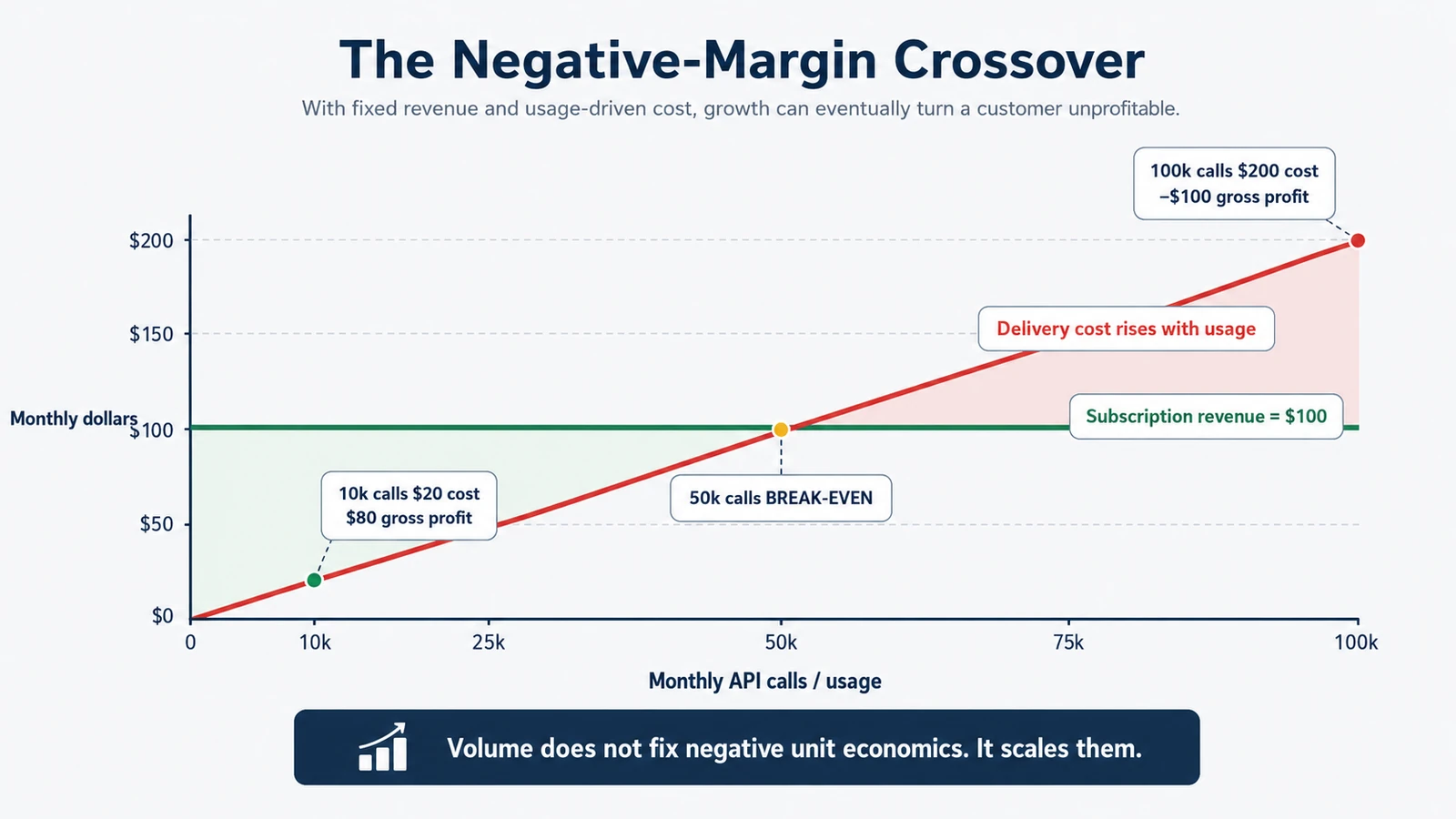
History tells us there will be customers all along the usage curve, including some outliers. Very low usage can be a retention warning because it may indicate that customers aren’t getting much value, or haven’t figured out how to capture it yet. At the other extreme, very heavy usage can become an immediate economic problem when variable delivery cost grows faster than the revenue associated with the customer.
Some of those heavy users will simply be legitimate power users. Others may be caused by bad automation, runaway scripts, compromised credentials or behavior that falls outside the intended use of the service. And some may deliberately try to extract far more value from a fixed-price plan than the provider intended, perhaps through resale, scraping or other forms of capacity arbitrage.
This is one reason “unlimited” rarely means literally without boundaries. A company may market a plan as unlimited while still imposing fair-use, acceptable-use, rate-limit or anti-abuse provisions in its terms. Those provisions can give the provider a way to throttle, reprice or terminate usage that falls outside the intended service model.
Where those boundaries sit is ultimately a product, pricing, legal and marketing decision. It’s an unfortunate complication, but pretending the edge cases won’t exist is usually worse.
Tactics Producers Can Sometimes Use to Protect Fixed-Subscription Economics
To prevent fixed subscriptions from breaking your unit economics, API producers can design structural boundaries into their product and architecture:
- Fair Use Quotas: Many B2B APIs marketed around fixed subscriptions still impose explicit or practical usage boundaries, such as “Includes up to 50,000 calls/month.” Beyond the allowance, customers may face overage fees, throttling, plan changes or another commercial limit.
- Rate Limiting: Per-minute or per-second throttling can protect infrastructure from accidental loops, abusive traffic or sudden bursts. Rate limits should be designed around customer needs as well as cost and reliability, rather than treated only as a billing mechanism.
- Tiered Value Metrics: Instead of gating only by generic “calls,” producers can tie tiers to metrics that better track customer value or resource consumption, such as connected monthly active users, transactions, records processed or total gigabytes transferred.
- Asynchronous Offloading: Resource-heavy work can sometimes be moved out of the synchronous request path and processed in background infrastructure, where the provider may have more flexibility to batch, schedule or otherwise optimize execution costs. A
202 Acceptedresponse can be part of such a design, but it does not itself determine how or where the work runs.
Product Has More Levers Than Vendor Negotiation
Once the unit economics are visible, the roadmap itself becomes part of cost management. This isn’t strictly about cost accounting. It gets into product and architectural tactics that can change what each useful unit costs to deliver.
Product and Engineering can consider things like caching, batching, replacing polling with events, routing simpler requests to cheaper providers or models, gating features by plan, usage limits, and others.
Some of those levers deserve a little more explanation:
- Advanced Caching: Tools such as Redis or edge-native caching can intercept repetitive requests. Serving a response from cache can avoid repeated backend compute, database work and upstream API consumption, materially lowering marginal cost when the use case allows it.
- Hybrid Routing & Architecture: For AI/LLM products, simple tasks may sometimes be routed to less expensive models while premium models are reserved for work that actually needs them. Similar routing ideas can apply to other vendor capabilities.
- Commitment Discounts: Cloud savings plans, reserved capacity or negotiated volume commitments can lower the cost numerator in the unit-cost equation. They can improve margins without changing the customer experience, though they introduce their own forecasting and commitment risks.
Build versus buy still needs to include engineering cost, maintenance, reliability, compliance and opportunity cost. The absence of a third-party API bill does not mean the capability is free.
Cost Attribution Needs Telemetry
The spreadsheet is a model, but production data is evidence. Over time, useful cost dimensions may include product, feature, workflow, customer, segment, plan, vendor, endpoint, model, successful/failed outcome and request source.
A sensible maturity path is:
- Know total vendor spend.
- Know vendor usage volume.
- Know which product or workflow drives the usage.
- Know cost per successful outcome.
- Know cost by customer or segment where useful.
- Connect those costs to revenue or another defensible value measure.
- Use the result in roadmap, architecture, pricing and vendor decisions.
You do not need Step 7 before you begin Step 1.
Companion Spreadsheet: API Unit Economics & Product P&L Model
A first working spreadsheet model has now been built for this article. Warning: this example would not survive contact with a real vendor contract. It skips usage tiers, volume discounts, committed spend, overage rates, and separate input/output token prices. The main product case is a happy path. Margin stays positive even when usage or vendor price gets worse. The separate Crossover tab is the exception. That is, the flat-subscription story that does go negative. Treat the file as a learning tool. Play with it and adapt it. If you need this for a real product, build a fuller model with your finance colleagues.
Link to GitHub Repository for copy of spreadsheet: API Product Unit Economics Model
All sample numbers are intentionally fictional. The value is the model structure. Still, it’s not complete. It doesn’t deal with complex pricing tiers, (either what you’re buying or what you’re selling). If you want to add those in, you”ll have to add a tab or two and do so.
The workbook contains:
- Executive Summary – API cost per action and successful outcome, delivery cost per customer, gross margin, ROI and API spend.
- API Catalog – pricing units, variable prices, fixed fees, free allowances, ownership and attribution.
- Workflow Model – execution probability, calls, retries, cache hits, billable units and expected cost for each step.
- Unit Economics – cost per action, successful outcome and customer plus a value/ROI view.
- P&L Bridge – revenue, API/service cost, other delivery cost, gross margin and management contribution.
- Scenarios – base, growth, heavy-user, vendor-shock and efficiency cases.
- Crossover – This tab shows a negative margin crossover example. This is how a flat subscription plus per-call cost turns a “successful” heavy user into an unprofitable one. It makes the break-even volume visible so product can put a cap, overage, or plan gate there before finance finds it on the bill.
- Seller Economics – downstream pricing, upstream API cost, free-tier exposure and margins if you also sell an API.
- Sources – the frameworks used to shape the model.
It is not intended to replace Finance’s formal financial model. It’s a product decision model.
Questions for an API-Dependent Roadmap Decision
A meaningful product review should eventually be able to answer:
- What customer or business outcome are we creating?
- What is the right economic unit?
- Which external services participate in one successful outcome?
- What does each service charge for?
- How many billable units does one outcome require?
- What do retries, failures, caching, branches and background work do to the cost?
- What is cost per successful outcome?
- How does it vary by customer or segment?
- What revenue, retention, labor savings or risk reduction does the capability create?
- What happens to margin as usage grows?
- What happens under heavy-user behavior or a vendor price increase?
- Can product or architecture decisions improve the economics?
- Should usage affect packaging, pricing or limits?
- Are we the API consumer, seller or both?
Again, the goal is not to turn product managers into accountants or FinOps engineers. It’s to recognize that product decisions create economic behavior. The five-thousandths-of-a-dollar API call is not the real business question.
The business question is what it costs to create a successful customer outcome, what that outcome is worth, and whether the economics get better or worse when the product wins.
See Also
- Guide to P&L Management for Product Leads — Productify
- The 3 Financial Metrics Every PM Needs on Their Scorecard — Mind the Product
- API Product Management KPI Worksheet — digitalML
- Unit Economics — FinOps Foundation
- Unit Economics — CloudZero
- The API Metrics Every SaaS Team Must Track — CloudZero
- The Bill of Materials: Cost the Task, Not the Call — AI-Native PM
- The Financial Blind Spot That Gets Product Managers Fired — Product Coalition
- The $113 Threshold for OpenAI-Powered Products
API Pricing Strategy
- API call pricing: How businesses calculate and manage API costs (from Stripe)
- Usage-based pricing strategy for SaaS: How to pick a metric, package your offer, and migrate without churn (from Stripe)
- What’s the Best Way to Determine the Price of an API? (from Moesif)
- What You Need to Know About API Pricing in 2026 (from Moesif)
- 8 Types of API Pricing Models (from Zuplo)
- API Pricing Plans, Phases, and Rate Cards Explained (from Zuplo)
- Usage-Based vs. Outcome-Based Pricing for APIs (from Moesif)
- How to Build an Internal Chargeback Model for Your API and AI Usage Using Moesif