
As a non-finance person who’s done work in crypto, I’ve come across something I think worth sharing from a product perspective. Part of what we do as product managers is look around corners. We can’t help it. We try to understand what happens when systems interact, dependencies change, and something in one place creates unintended consequences elsewhere. One thing we learn is that optimizing one part of a system doesn’t necessarily optimize the whole thing. In fact, sometimes making one aspect tremendously successful can create unintended consequences elsewhere. That’s especially interesting when the products themselves start becoming part of critical infrastructure. And that’s what’s increasingly happening with stablecoins.
What interests me here is there are three worlds that don’t seem to get discussed together in general business or product management circles. These are: government fiscal policy, traditional banking, and digital assets. There’s increasing attention in specialized finance research. But I suspect most general businesspeople and even product folks working in the space don’t necessarily encounter this info. And there’s dependencies emerging that I don’t think get enough attention.
Most people still think of stablecoins as “crypto stuff” and U.S. debt as “government economics or politics.” But what happens when growing worldwide demand for digital dollars also creates demand for U.S. government debt? And what happens when that same process shifts funding away from traditional banks or creates new channels through which financial stress can spread? That’s what I want to explore. Not as a prediction of an impending crisis, but as a series of connections that I think deserve more attention, especially among those who create products or services in this area. So I’m going to try to untangle this.
What prompted me to write this was this post from famed investor Ray Dalio called The Numbers Behind the Bond Bear Market. Some aspects may be disturbing. This article might be as well. Personally, I’m an optimist. However, some of what I’m going to present suggests some potential storm clouds. Maybe not. Either way, it’s worth understanding the connections to have a sense of which way things can lean as we see trends in one place put pressure in other areas. In any case, here we go.
Connecting the Dots
I’m going to try to connect some dots. Think of the conclusions here as my assertions, not necessarily anything I’m claiming as absolute truth.

Dot 1: The Government’s Supply & Demand Problem
Traditionally, U.S. Treasury debt has attracted enormous demand from domestic and foreign investors, including commercial banks, pension funds, investment funds, private investors, and foreign central banks. Countries like Japan and China have been important holders. But the picture is changing. China, for example, has substantially reduced its Treasury holdings over time. Other countries and private investors continue to buy, however, and aggregate foreign holdings haven’t collapsed. The more interesting concern may be how much debt the U.S. needs to issue, at what maturities, and what yields investors will demand to keep absorbing it. That distinction matters. A Treasury market can continue attracting plenty of buyers while the government still faces higher borrowing costs. That’s for the obvious reason that investors don’t simply decide whether to buy government debt; they also decide what return they require for holding it. The U.S. might successfully sell every bond it offers, but at increasingly higher yields. And if the government is issuing more debt at the same time, those higher rates can become especially consequential. (See Treasury’s Major Foreign Holders of Treasury Securities.)
To adapt, the U.S. Treasury seems to be shifting it’s strategy lately. According to the Government Accountability Office, Treasury bills increased from 13% of marketable debt in 2014 to approximately 22% in 2025, reflecting changing borrowing needs and investor demand. (See the March, 2026 GAO summary report Federal Debt Management or go straight to the full report “Shifts in Composition” section.) The Treasury finances government operations using a mix of bills, notes, and bonds. In periods of large deficits and changing market conditions, the mix of new issuance can shift, including greater reliance on short-term bills, which it seems to be doing. What I find interesting is that stablecoins are emerging as a source of demand concentrated in these very short-term instruments. They can potentially make that part of the market more attractive and easier to finance. Check out what the Federal Reserve Band of San Francisco has to say in Stablecoin Issuers’ Growing Appetite for Treasury Securities.
Wild Things
Want to know the really wild part? At least, the part that makes my head spin a bit? These are financial obligations that might never be redeemed. Ever. Most loans come due. Most gift cards expire. Etc. etc. But a minted stablecoin for which an issuer is just holding funds in reserve? There’s a potentially powerful economic dynamic here. The stablecoin issuer has an ongoing redemption obligation, but no predetermined date when that obligation must be settled. As long as tokens remain outstanding, their backing can remain invested, although individual reserve securities will mature and need to be replaced. The tokens can change hands thousands of times without anyone redeeming them with the issuer. Meanwhile, the issuer can continue earning income on the reserve assets backing those outstanding tokens.
But there’s a fascinating catch… Indefinite circulation doesn’t mean permanent funding. The issuer must remain prepared for redemptions, potentially on very short notice. Circle’s USDC terms, for example, provide qualifying customers with redemption rights and describe how the underlying reserves support those obligations. That’s an unusual arrangement. It’s a potentially long-lived source of reserve demand backed by liabilities that holders may want redeemed on very short notice. In normal times, it could create remarkably persistent demand for short-term government debt. But in a crisis, those same redemption rights could cause that demand to reverse abruptly. Meanwhile, there’s also a distinction between the issuer and the Treasury. The stablecoin doesn’t mature, but the T-bills backing it do. The issuer can reinvest the proceeds of maturing bills into new ones as long as the stablecoin liabilities remain outstanding.
So the question isn’t merely how much stablecoin issuers buy. It’s how stable that source of demand really is when conditions change. Now, I know what you might be thinking. Ordinary bank demand deposits also have no fixed maturity and may remain outstanding for decades while being withdrawable on demand. True enough. However, what makes stablecoins particularly interesting is the combination of ongoing circulation, usage, redemption-on-demand characteristics, and reserve portfolios heavily oriented toward short-term government securities. It also may be true that banks and money-market funds have long transformed redeemable liabilities into investments. Stablecoins simply create another version of that relationship, with different reserve requirements, customer behaviors, and possible transmission channels. What’s different here is the connection to digital-product adoption. Stablecoin holders may be using a payment or settlement product, not making an investment decision about U.S. government debt. Nevertheless, their collective behavior can influence the Treasury market.
Anyway… Back to our story…
A Quick Note on the Fed: Quantitative Easing (QE) involves the Federal Reserve purchasing securities, adding reserves to the banking system. Quantitative Tightening (QT) generally works in the opposite direction, reducing the Fed’s securities holdings, often by allowing assets to mature without fully reinvesting the proceeds. QT can increase the amount of Treasury debt that private-sector investors must absorb, although the actual market effects depend on Treasury issuance, the Fed’s operations, and other investors’ behavior. Stablecoin issuers are one increasingly significant source of demand in this broader market. To me, QE and QT still seem a bit like magic. The Fed can create or extinguish bank reserves electronically. Quite a neat trick. The creation and destruction of “That which is money” with just a few keystrokes on a computer. But I digress… the point is, stablecoin issuers are an interesting new sort of buyer.
Dot 2: Enter the “Structural Buyer” (Stablecoins)
The Treasury already has an enormous established market for short-term debt, including money-market funds, banks, and institutional investors. But another category of buyer is becoming increasingly interesting. Enter stablecoin issuers like Tether and Circle. The interesting thing about these buyers is that demand for their products can translate into additional demand for the assets they hold as reserves. In other words, someone buying digital dollars for use in crypto markets, international payments, or other applications may indirectly be supporting the market for U.S. government debt.
What are stablecoins again? Here’s a one sentence description: A stablecoin is a digital cryptocurrency whose value is pegged to a stable reserve asset; most commonly the U.S. dollar so we combine the speed and accessibility of blockchain networks with the price stability of traditional money. (It doesn’t have to be the U.S. dollar, but at least for now, it typically is.) If you want more in-depth on this, see Part 1: Stablecoin Flavors – What Are You Holding?
In a simplified example, when a customer buys, (or in this case mints), $1 of a dollar-backed stablecoin, the issuer receives $1 and assumes an obligation to redeem that token according to its terms. It must maintain appropriate backing, but it doesn’t necessarily buy a Treasury bill with that particular dollar. Its reserves may include cash, bank deposits, Treasury bills, qualifying repurchase agreements, and government money-market instruments, depending on the issuer and applicable rules. There’s another distinction worth making. Buying an existing stablecoin from someone else on an exchange doesn’t necessarily cause the issuer to receive new dollars or acquire new reserves. The relevant change occurs when the amount of stablecoins issued and outstanding increases. (I’ve written about how this happens in detail in a 2025 article: How Does Fiat Become Cryptocurrency?)
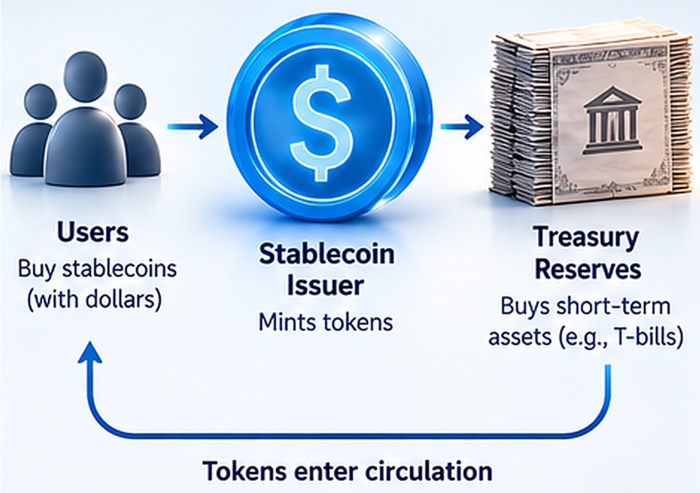
Stablecoin companies must hold ultra-safe, liquid assets to guarantee that users can redeem their digital tokens 1:1 for real dollars. As a result:
- Stablecoin issuers collectively hold over $150–$200+ billion in U.S. Treasury debt. And this is likely to grow. This is just an opinion. But I think we’ll continue to see growth here as more folks move to crypto rails, even if mostly for institutional transfers. Now ok, ~$200 billion is maybe meaningful at the short end of the curve but small overall. Money market funds (~$8 trillion assets) absorb a lot of supply, and so on. Still, this has been growing fast and that’s the point here. It’s not about today. It’s about trajectory and trying to assess potential cascade type issues. And it’s not primarily about today’s size. It’s about whether a product category that started as a crypto settlement tool is wedging its way into becoming critical market infrastructure whose failure modes now touch traditional funding markets.
- Stablecoin issuers now hold more U.S. short-term debt than entire sovereign nations like Germany or South Korea. (All since just 2014, although the real growth explosion is really just since 2020. See History of Stablecoins: From BitUSD to the $260 Billion Market.)
- Stablecoin issuers are structural, relatively price-insensitive buyers of reserve assets. When new fiat-backed stablecoins are minted, issuers need corresponding backing regardless of whether Treasury yields happen to be attractive. They aren’t necessarily required to purchase T-bills specifically, but those securities are a major component of reserve portfolios. Consequently, growing stablecoin issuance can create additional Treasury demand driven by the issuer’s reserve obligations rather than by conventional investment decisions and conditions.
This Is No Longer Just a Theoretical Relationship
Here’s where this becomes especially interesting. Researchers at the Bank for International Settlements have studied the relationship between stablecoin demand and short-term Treasury yields. (See Stablecoins and safe asset prices.) In an updated study examining data from January 2021 through March 2026, they found that an inflow of approximately $3.5 billion into stablecoins reduced the yield on three-month Treasury bills by around 4 basis points within ten days. The effect was concentrated in short-term securities, with little spillover into longer maturities.
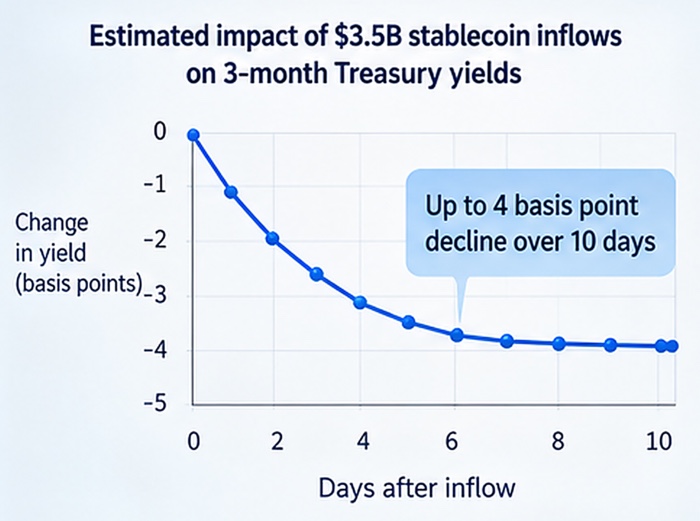
Four basis points (A basis point (bps) is one-hundredth of a percentage point) might not sound like much. But in a market where governments borrow and refinance trillions of dollars, even small changes in financing costs can matter. We shouldn’t take that result and simply multiply it across the entire national debt, of course. Still, it demonstrates something important: demand for stablecoins is no longer just a crypto-market phenomenon. It’s measurable in conventional government debt markets. And there’s another wrinkle. The researchers found that the impact was stronger when Treasury-market intermediaries were under stress. For example, banks hold Treasuries for interest income, liquidity, and collateral, while securities dealers buy and temporarily hold them to facilitate trading. When these institutions become financially constrained or reluctant to take on more securities, additional demand from stablecoin issuers can have an outsized effect on Treasury prices and yields. Let’s note that banks and dealers aren’t obligated to absorb unlimited Treasury debt. They do so because it serves their financial and business interests. Their willingness and capacity change with market conditions. Stablecoin issuers, by contrast, have a structurally driven need to maintain reserve assets as their token issuance grows. That distinction is what makes them such an interesting emerging source of Treasury demand. (Or at least I think so and others seem to be increasingly studying this.)
This is the sort of connection that interests me. A person deciding to hold digital dollars may have no interest whatsoever in U.S. fiscal policy. Yet collectively, those decisions can influence the pricing of government debt. As mentioned, I look at these things from a product manager’s perspective. So how seemingly separate things relate or cascade in what might not always be intuitively obvious ways is of interest.
A Product Perspective
Here’s another way to look at this from a product perspective. A stablecoin issuer wants adoption, liquidity, trust, and ultimately a sustainable business. The U.S. Treasury wants reliable financing at reasonable costs. Banks want deposits and lending relationships. These are three different sets of objectives, and nobody is necessarily managing the system as a whole. (Though ok, yes, that’s suppose to be the purview of regulations and laws and these are still nascent.)
Yet success for one participant can change the operating conditions for the others. It’s a fascinating example of how product-market fit, at sufficient scale, can produce consequences far outside the product’s intended market.
Dot 3: Are We Trading Cheaper Financing Today for Greater Dependence Tomorrow?
On the surface, this looks like a win-win. The world gets more access to digital dollars, stablecoin issuers earn income on their reserves, and the U.S. benefits from additional demand for government debt. This does concern other countries. As I’ve referenced before in my article on De-Dollarization Risks from Crypto and AI others are concerned with U.S. crypto mercantilism. (See Cryptomercantilism vs. Monetary Sovereignty-Dealing with the Challenge of US Stablecoins for the EU.) This is its own potentially massive subject of concern. It’s part of this story, but we’ll skip digressing into it for now.
But there are several complications worth considering…
First, the demand is concentrated at the short end. Stablecoin reserve portfolios tend to favor highly liquid, short-duration assets such as Treasury bills. This helps finance short-term government borrowing but does relatively little to directly support demand for 10-year or 30-year securities. The BIS research I mentioned earlier supports that distinction. Oh, and we really only have look back just a few years to see what unfortunate choices that led to the fall of both Silicon Valley Bank (SVB) and Silvergate.
Quick digression / story: Remember what happened to Silicon Valley Bank and Silvergate in 2023? Both suffered severe liquidity pressures, and both had to contend with losses on securities as customers withdrew funds. SVB had invested heavily in longer-duration securities whose market values fell as interest rates rose. Silvergate faced enormous withdrawals from its crypto-related deposit base and sold assets at losses. Those episodes illustrated an important lesson: even highly creditworthy securities can create serious liquidity problems when their market values fall and you need cash immediately. Stablecoin issuers face a similar potential mismatch between redeemable-on-demand liabilities and their reserve investments. Short-term Treasury securities reduce that exposure because their prices are generally less sensitive to interest-rate changes and they mature relatively quickly. In fact, the GENIUS Act’s reserve framework generally limits directly held Treasury securities to those with 93 days or less remaining until maturity. That’s not necessarily proof the law was written in direct response to SVB or Silvergate, but it’s consistent with the risk-management lesson those failures reinforced.
Second, more buyers don’t necessarily mean stronger underlying fiscal conditions. Additional stablecoin demand may help lower short-term borrowing costs, but it doesn’t reduce the government’s spending obligations or automatically solve its structural deficits. In fact, cheaper financing can sometimes reduce the immediate pressure to address longer-term problems.
Third, the composition of buyers matters. The Treasury has always depended on a diverse collection of investors, each with different motivations. Stablecoin issuers add another source of demand, but one increasingly connected to digital-asset adoption and redemption behavior. If that market grows substantially, its inflows and outflows could become more important to short-term Treasury conditions.
Fourth, short-term borrowing carries refinancing exposure. Treasury bills must be repaid or rolled over relatively frequently. If the government comes to rely more heavily on short-term financing, changes in interest rates can flow into its borrowing costs more quickly than they would with long-term fixed-rate debt.
I’m not saying stablecoins are hiding a collapse in traditional Treasury demand. I can’t support that claim. But they do raise a different question. Could a new and potentially volatile source of demand make short-term Treasury financing cheaper in normal times while introducing additional dependencies in periods of stress? I’d somewhat written about these issues before as well in Hidden Stablecoin Trade-Offs and we can maybe couple that with another concern about Will RWA Tokenization Growth Increase Systemic Risk?. Though I think the RWA risk is perhaps lesser as adoption has been slow for all manner of reasons.
One More Distinction: Buying Debt Isn’t Always Financing New Debt
There’s also a distinction worth making. When an issuer buys newly issued Treasury debt, it is directly participating in the financing of government borrowing. But when it buys an existing Treasury bill from another investor, that money goes to the investor selling the security, not directly to the Treasury. So how does that help the government? By increasing demand and liquidity in the Treasury market, secondary-market purchases can support prices and lower the yields investors require, which can improve the terms on which the government issues new debt.
That’s why I believe it’s fair to say stablecoin growth can help finance U.S. government borrowing, even though not every stablecoin purchase results in new cash going directly to the Treasury.
Dot 4: The New Systemic Risks
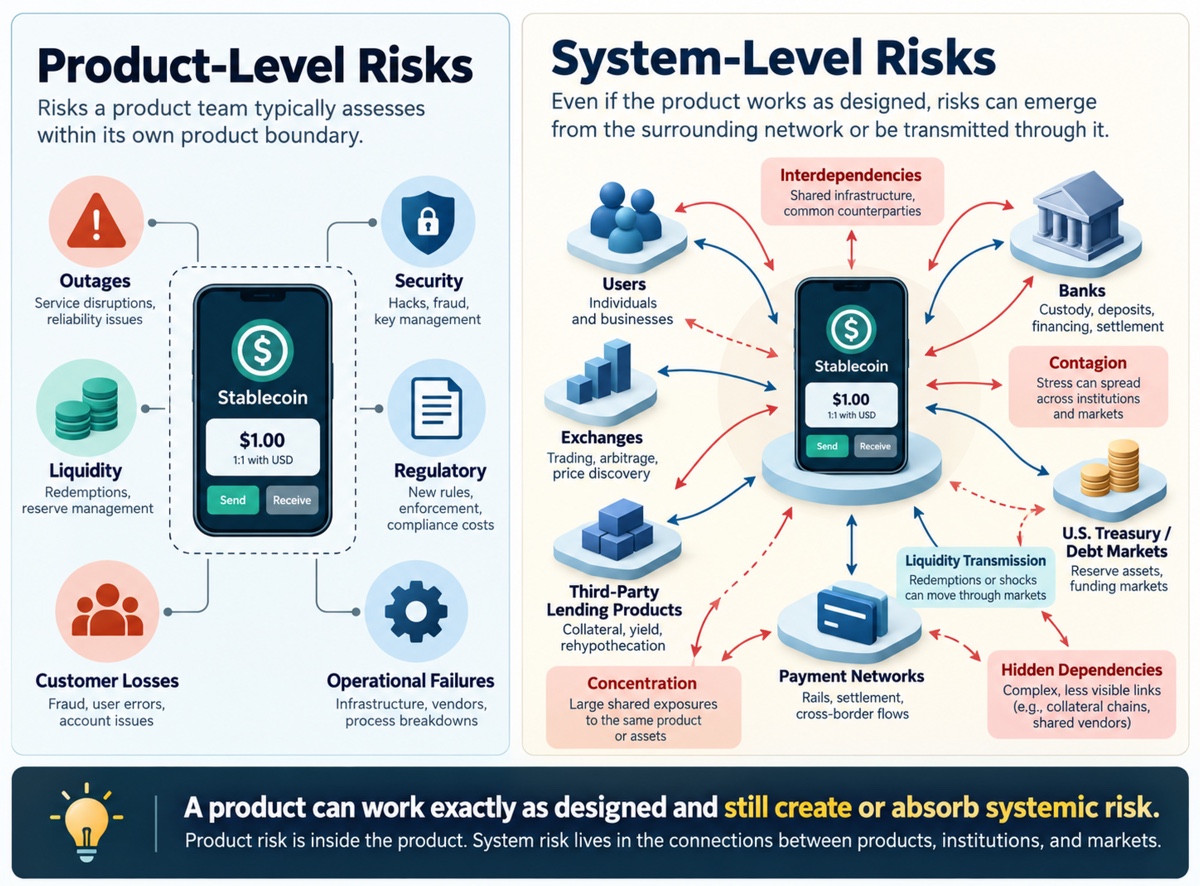
From a product-management perspective, there’s an important distinction here. We normally assess risks to our product. Such as outages, security breaches, liquidity problems, regulatory exposure, and customer losses. But as products become interconnected, there’s another question. What risks does our product introduce into systems that depend on it, or that it increasingly depends upon?
A stablecoin can work exactly as designed and still participate in a larger chain of financial dependencies that creates risks nobody intended. Conversely, a problem elsewhere in that chain can affect a perfectly well-managed stablecoin. That’s the sort of system-level risk that can be easy to overlook when everyone is focused on their own piece.
This arrangement isn’t just a quirk of accounting. It introduces genuine systemic risks across both digital and traditional finance:
- The “Fire Sale” Threat: What happens if a major stablecoin experiences a crisis of confidence and large numbers of holders attempt to redeem their tokens? In principle, issuers maintain liquid reserves precisely to handle redemptions. Treasury bills are generally highly liquid, and some can simply mature and provide cash. Issuers may also hold cash or other assets that can be used for redemptions without selling securities. But if redemption demands become unusually large or rapid, an issuer may have to sell substantial amounts of reserve assets. And if several issuers or related institutions experience stress at the same time, those sales could put pressure on short-term Treasury markets. The risk isn’t that a stablecoin redemption automatically causes a Treasury crisis. It’s that a market originally developed for digital payments could become another channel through which sudden demands for liquidity propagate into the traditional financial system. In fact, the more stablecoins become integrated into global financial infrastructure, the more important it becomes to understand what happens when those flows reverse.
- The “Shadow Bank” Loophole: Under the GENIUS Act, covered payment-stablecoin issuers are prohibited from paying holders interest or yield simply for holding their stablecoins. But the situation becomes more complicated once the tokens circulate outside the issuer. Exchanges, lending platforms, and DeFi protocols may offer opportunities to earn returns by lending stablecoins, supplying liquidity, or participating in other financial arrangements. Depending on the structure, these activities introduce credit, counterparty, liquidity, collateral, or smart-contract risks. And unlike an ordinary FDIC-insured bank deposit, a stablecoin balance or lending position generally doesn’t come with deposit insurance. This is where I think the shadow-banking comparison becomes more deeply interesting. The stablecoin issuer may be maintaining its reserves properly, while entirely separate institutions are constructing additional layers of lending and leverage around the tokens. The result could be a growing ecosystem of financial activity with some of the economic characteristics of banking, but different rules, protections, and failure mechanisms. There’s nothing automatically wrong with this. But we should be careful about assuming that because the underlying stablecoin is fully backed, every product built on top of it is equally safe.
And I wonder how many ordinary customers really appreciate these differences. A bank offering a negligible return on deposits isn’t terribly appealing when someone else advertises much higher yields on digital dollars. It’s not hard to imagine more consumers moving in that direction without fully appreciating where the additional return comes from or which protections they’ve surrendered. - Commercial Bank Depletion: Here’s another potential consequence. What happens if significant amounts of money move from traditional bank deposits into stablecoins? Part of the reason for laws restricting stablecoin yield are expressly to protect bank deposits. Banks rely heavily on deposits as a source of funding for loans and other assets. If customers shift money elsewhere, banks may face higher funding costs or need to change how they finance lending. But this isn’t as simple as saying every dollar entering a stablecoin disappears from the banking system. Depending on where issuers place their reserves and how Treasury securities are purchased, funds may reappear as deposits at other banks or move through other parts of the financial system. That might sound reassuring, but it raises an additional concern: the funding may not return to the same institutions, and it may not have the same characteristics. A relatively stable retail deposit at a community bank is not necessarily equivalent to a large institutional deposit at a money-center bank. A shift in funding composition could disadvantage smaller banks, increase their borrowing costs, or make it more difficult to support local lending. So the concern isn’t necessarily that stablecoins drain money out of the banking system altogether. It’s that they may change where the funding resides, how stable it is, and which institutions can access it. What’s holding people back here? It could be we’re just still in early adopter, early majority phases for this part of the market. And many may justifiably be making choices of apparent safety and security over the potential for yield. We’ll see how it goes.
The practical question for product teams is whether a stablecoin offering is mainly competing for payment utility or for deposit-like balances. And whether the funding that leaves a community bank reappears somewhere that still supports the same real-economy lending. - Concentration Risk: A New Kind of Financial Dependency. There’s one more dimension to this that concerns me, and that’s concentration. Much of the stablecoin market is dominated by a relatively small number of issuers, with Tether and Circle accounting for a substantial share of dollar-backed stablecoin activity. Concentration isn’t inherently bad. In fact, large issuers may benefit from scale, professional reserve management, and stronger operational infrastructure. But think about what happens as these companies become increasingly important buyers of short-term government debt, providers of digital-dollar liquidity, and infrastructure for other financial products. A problem at one institution might no longer be contained within the crypto ecosystem. It could affect exchanges, payment companies, counterparties, and traditional financial markets. There is a paradox here. The more successful stablecoins become at integrating with the existing financial system, the less isolated their risks become. This isn’t unique to stablecoins. Financial history is full of examples where concentrated intermediaries provided tremendous efficiency and liquidity right up until their problems became everyone else’s problems. Back in 2008, when Lehman Brothers failed, I was working in a building with a good view of the downtown NYC financial area. I remember the day it happened and discussing it with some of my colleagues. We were surprised government didn’t intervene sooner. I don’t know this. I’m not sure if anyone does. But maybe government folks were thinking, “ok, well, it’s just one.” But it quickly became an “oh s$#%” moment and scramble to contain contagion. There’s the old joke about “If you owe the bank $100,000 and can’t pay, you have a problem. If you owe the bank $1 billion, the bank has a problem.” If some as yet unknown issue crops up with one of these major players, is it potentially systemic?
I’d somewhat written about these issues before as well in Hidden Stablecoin Trade-Offs and we can maybe couple that with another concern about Will RWA Tokenization Growth Increase Systemic Risk?. Though I think the RWA risk is perhaps lesser as adoption has been slow for all manner of reasons.
In product terms, the issuer’s reserve design and the third-party products built on top of the tokens are separate surfaces with different failure modes. Users may experience them as one thing.
But Isn’t This Also a Good Thing?
Before concluding, I think there’s a reasonable argument on the other side. Stablecoins may be genuinely useful financial infrastructure. They make dollar-denominated value easier to transfer across some borders and networks. They can facilitate payments and settlement, and they create another way for people around the world to access digital dollars.
From the U.S. government’s perspective, there’s also something potentially attractive about growing global demand for dollar-backed assets. If stablecoin issuers buy more Treasury bills, that can support demand for government debt and potentially lower borrowing costs. And this isn’t entirely speculative. BIS researchers have found measurable effects on short-term Treasury yields.
So perhaps we should welcome all of this. A growing market for digital dollars could strengthen the dollar’s international role while providing new financing demand for U.S. government debt. But that brings me back to the original concern. What looks beneficial when examining the government, banks, or digital assets individually might look more complicated when examining all three together. While researching this article, I found a June 2026 BIS paper that modeled exactly this kind of tradeoff. (See The macroeconomics of stablecoins.) The researchers identified two competing economic effects: a fiscal benefit from greater Treasury demand and a potential contraction in lending as stablecoins compete with bank deposits.
In their model, the lending effect slightly outweighed the fiscal benefit over the long run. But the outcome depended heavily on regulatory design, foreign demand, and other assumptions. It wasn’t a prediction that stablecoins would inevitably damage the economy. That’s an important distinction. I’m not arguing that stablecoins are inherently bad. I’m suggesting that their benefits and risks may arise in different parts of the financial system, at different times, and for different participants.
And perhaps that makes the complete tradeoff harder to recognize.
The Bottom Line
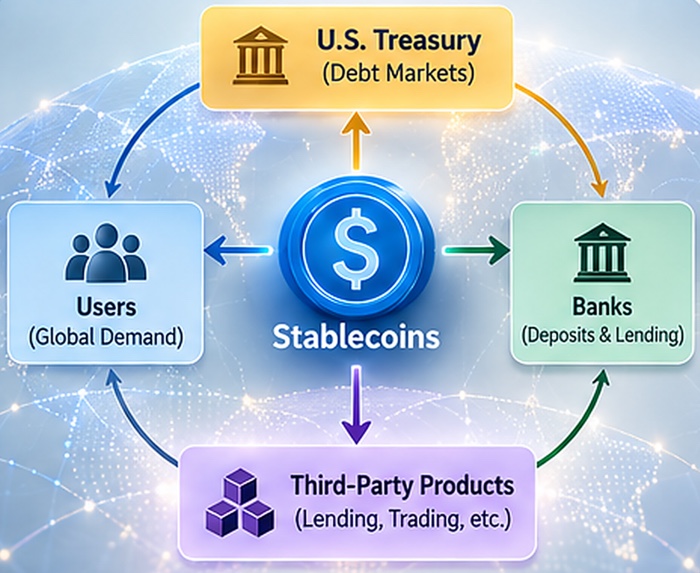
Stablecoins are no longer just crypto vehicles. They’re becoming increasingly connected to the infrastructure of traditional finance, including the U.S. Treasury market. And there lies an interesting tension. Global demand for digital dollars can create additional demand for U.S. government debt, potentially lowering short-term borrowing costs. That sounds like a good thing, (if you’re the U.S. anyway), especially at a time when the United States faces substantial deficits and refinancing requirements.
But the same development may also redirect funding among banks, create new concentrations of financial power, and introduce additional channels through which liquidity problems in digital markets can affect traditional ones. These aren’t necessarily reasons to reject stablecoins. And I’m certainly not suggesting that they’re about to bring down the Treasury market. What concerns me is the growing interdependence of these systems, particularly when the benefits of a financial arrangement appear in one place while its risks accumulate somewhere else.
We’ve seen versions of this before. Not necessarily with stablecoins or even with the same financial mechanisms, but with innovations that make individual transactions easier or cheaper while creating dependencies that become apparent only under stress. Technology doesn’t necessarily eliminate financial risk. Sometimes it moves the risk, changes who holds it, or makes it harder to recognize.
So here’s my question: Are stablecoins primarily strengthening the global dollar system, or could they also be creating a new layer of shadow-banking dependencies that we don’t yet fully understand?
I suspect the answer is some of both. What I’m less certain about is whether we’re giving enough attention to how the pieces fit together. For those of us that might be crafting products at any place along this value chain, it’s probably worth thinking about the larger picture and if there’s any guardrails we might want to consider.
Research References
- BIS — Stablecoins and Safe Asset Prices (2025, subsequently updated). Evidence on stablecoin flows and Treasury yields.
- BIS — The Macroeconomics of Stablecoins (June 2026). Modeling fiscal benefits and bank-lending tradeoffs.
- BIS — Are Stablecoins and Bank Deposits Substitutes? (October 2026). Evidence of competition between stablecoins and deposits.
- GENIUS Act — Public Law 119-27 (July 2025). Legal framework for reserve backing, eligible investments, and issuer restrictions.