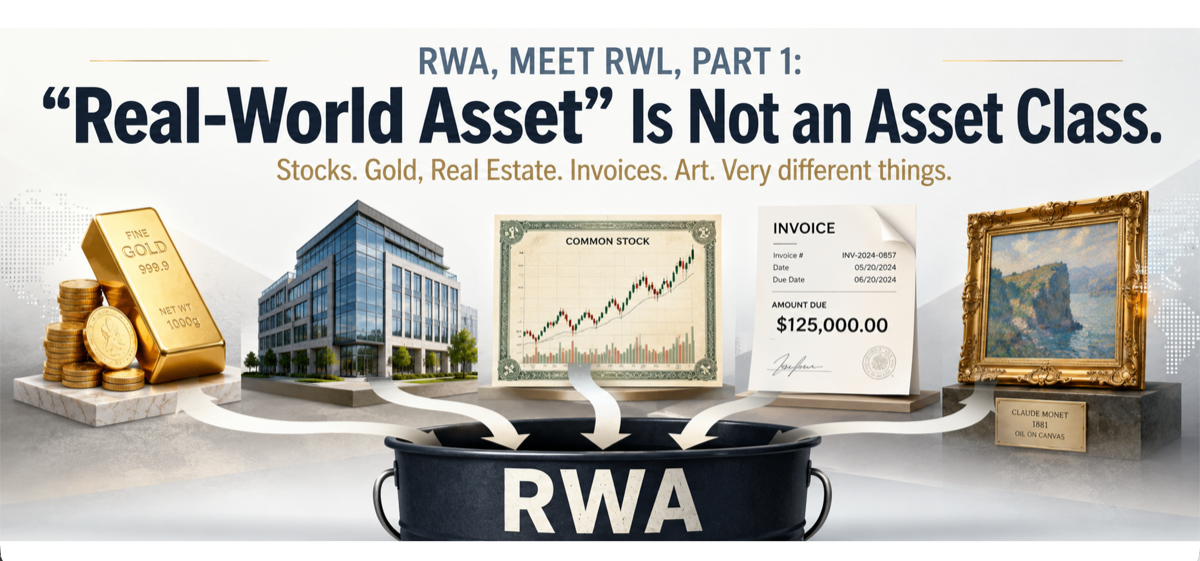
Part 1 of 6 in “Real World Assets (RWA), Meet Real World Lies (RWL): Knowing What You Own in the Tokenized World,” a series about what tokenized assets represent, how information about them reaches the blockchain, and why none of this eliminates the need for trust.
RWL is what I’m calling “Real-World Lies.” That might seem a little strong. Maybe it is. But I don’t necessarily mean “lies” only in the malicious sense. There are also mistakes, omissions, outdated records, stretched definitions, poorly understood rights, and information distorted by incentives. Right now, there seem to be plenty of ways for something that isn’t quite true to enter a system, become tacitly accepted, and continue moving through it as though it were fact. This series looks at how that happens, at least somewhat. But more importantly, how to classify and evaluate the many parts that finally seem to be coming together to bring more tokenized assets to market.
Much of the following is not new. If you’re already deeply familiar with tokenized assets, you may want to skip this entire series. However, if you’re still new to Real World Asset and trying to get a sense of the whole big picture, perhaps this series will help. It was created as part of a project to help some new to the area to build a wide scope taxonomy of the space and the issues across types of things involved. This isn’t about mechanisms of tokenization. We’ll be more focused on compare and contrast with real world assets and building an evaluation framework that helps us navigate these spaces.
Let’s start with the name. “Real-World Asset” as a term started to be used to describe representation of assets on blockchains sometime around 2015. It sounds like an asset class. But it’s not. Equities, fixed income, real estate, commodities, and private credit are asset classes because they share economic characteristics, risk drivers, and regulatory treatment. A Treasury bill, an apartment building, a gold bar, an invoice, a carbon credit, and a painting can all be labeled RWAs, yet they have almost nothing in common. RWA is more a catch-all label for almost anything that exists (or has value) off-chain and has been given a tokenized representation.
What these things all increasingly share is a token. That does not make them the same kind of thing. This series builds a practical evaluation framework so investors can see what actually sits underneath the label.
The central question remains the same as it has always been. Who is running this thing, and can the claims and the information about them be trusted?

Why Tokenization?
You’ve likely heard many of these new value drivers already. And they’re real enough. Tokenization offers real operational advantages. Faster settlement, 24/7 transferability, programmability, improved collateral mobility and more. Crypto and various levels of decentralized finance may have been a curiosity as recently as a few years ago. Now, anyone who’s not taking advantage of new benefits is going to get left behind. So everyone is piling on. These benefits explain the current interest. They do not answer the harder questions about what is being tokenized. And there are other potential risks, such as what liquidity might look like with so many trading venues and being 24/7. But those are out of scope for this series, and I’d encourage you to seek out more info on these concerns as you consider the whole ecosystem. Here we’ll continue to focus on asset types and specific concerns related to those types.
The Essence of the Challenges
The essence of the challenges are at least threefold.
- What kinds of things are being tokenized?
- What information is required to describe them, and who vouches for it?
- Who supplies and verifies that information when the underlying claim can be wrong or fraudulent?
This article addresses the first problem. Parts 2–4 examine the data and the people. Part 5 expands the taxonomy to digital-native assets.
For now, let’s start with conventional real-world assets.
Taxonomy of Real Things
“Real World Asset” is a rather broad term. Broad enough to be almost useless.
Most conventional RWAs can be divided into two broad families.
- Intangible legal claims
- Tangible physical assets
(Data, compute, software, network rights, and credentials will be added in Part 5.)
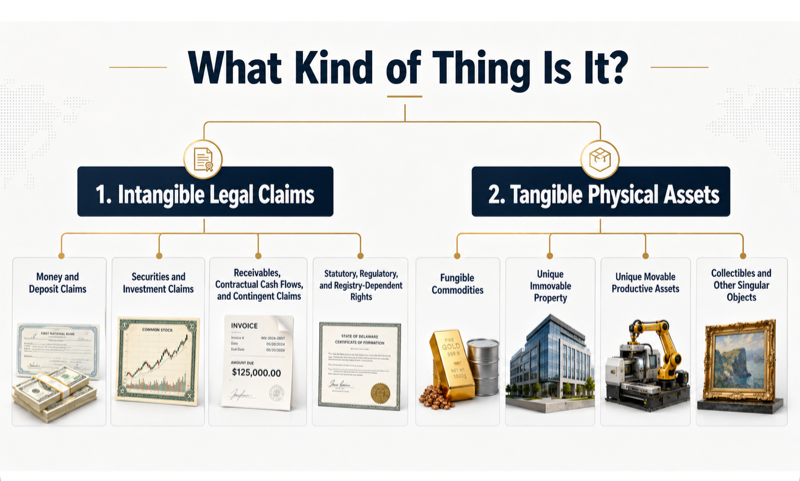
1. Intangible Legal Claims
These assets do not have to exist as physical objects at all. Their value comes from an enforceable legal, financial, or contractual relationship. A piece of paper or database entry may provide evidence of a right, but isn’t necessarily the right itself.
1.1 Money and Deposit Claims
These include:
- Bank deposits
- Payment balances
- Stablecoins backed by deposits or cash equivalents
- Perhaps other claims redeemable for currency
The asset is not a particular stack of dollar bills. It is a claim against a bank. The same questions apply to many stablecoins and tokenized payment balances. Who owes you? Where are the backing assets held? Can you redeem directly? What happens if the issuer, bank, or custodian fails? Tokenization may change how some of the rails work, but the simple question stays: Who owes what to whom?
1.2 Securities and Investment Claims
These include:
- Public and private equities
- Government and corporate bonds
- Money-market and other fund interests
- Private credit
A token may be the security itself, beneficial ownership through an intermediary, an SPV interest, or synthetic exposure. Tokenizing these instruments may change how it is issued, recorded, traded, or settled, and maybe how those managing records determine ownership. It does not change the fundamental nature of the underlying claim.
The SEC’s 2026 statement on tokenized securities makes this distinction directly. A tokenized security remains a security, but different structures may maintain ownership records in different ways and involve different intermediaries. BIS and IMF publications therefore tend to describe tokenization in terms of recording or representing financial claims on programmable ledgers. The takeaway is understanding as to what the legal and economic rights are.
1.3 Receivables, Contractual Cash Flows, and Contingent Claims
These include:
- Invoices and trade-finance claims
- Consumer and commercial loans
- Leases
- Royalties
- Insurance-related payment rights
Here, the asset is a right to receive money if specified conditions are met. Its value depends on the validity of the contract, the performance of the underlying activity, and the willingness and ability of someone else to pay. There’s been plenty of ways to monetize such things in traditional finance. And we’re starting to see them in tokenization. Tokenization is beginning to place versions of these structures on programmable ledgers. This is already a reminder of a larger potential problem. The token may be perfectly authentic while the invoice is fake, the reported sale never happened, or the debtor cannot pay. In the last case, this is part of the known risk you’re assuming. Well, I mean, it’s all risk you’re assuming. But I would argue that last part is the only real risk, or should be. That’s the bet you’re making and the reason why returns might be what they are; they’re based on this kind of risk, vs. outright fraud.
Platforms such as Centrifuge and Goldfinch have already placed versions of these claims into on-chain financing pools.
1.4 Statutory, Regulatory, and Registry-Dependent Rights
These are rights created or recognized by governments, regulators, registries, or other authorities.
Examples might include:
- Carbon credits and emissions allowances
- Development rights
- Mineral or extraction rights
- Licenses and permits
These rights exist because a government, regulator, registry, or recognized standards body creates or accepts them. Some are already being incorporated into tokenization projects. The BIS Innovation Hub’s Project Genesis 2.0, for example, developed prototypes for tokenized green bonds with tokenized carbon-forward instruments attached. Separately, the Carbon Opportunities Fund and Sumitomo Corporation of Americas completed one of the first transactions involving carbon credits tokenized on the Chia blockchain and reflected in the World Bank-supported Climate Action Data Trust. Outside carbon markets, Elmnts launched a Solana-based platform offering tokenized investment funds backed by oil and gas mineral-rights royalties. That distinction matters: investors receive an interest in a fund supported by royalty income, not necessarily direct ownership of a government lease or extraction right.
2. Tangible Physical Assets
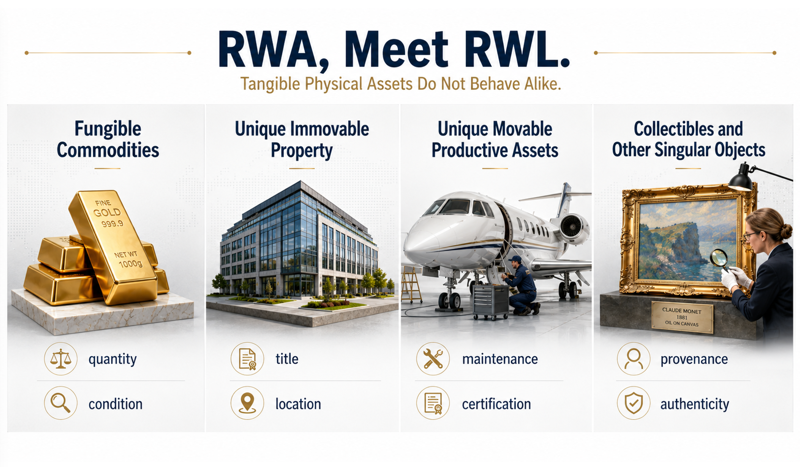
This is where we start to get into the more challenging types of assets to represent digitally. Or this is my claim right now anyway. It would be fair to argue, “No, these are the same thing. After all, if it can be represented on paper, how is it different digitally?” Sensible enough. These assets exist in the physical world. Someone can theoretically locate, inspect, measure, damage, steal, replace, or destroy them. Theoretically. However, “someone” rarely does. And not all physical assets behave alike. Okay, perhaps saying “rarely” isn’t fair. There are plenty of things that do get inspected and reported upon. However, our reality is that this can be weak right now in the real world as it is. Now we’re talking about also having such things captured and delivered, (somehow), to a wider potential audience of investors.
2.1 Fungible Commodities
These are better known and include:
- Gold and other precious metals
- Oil and natural gas
- Agricultural products
- Industrial metals
- Other standardized raw materials
A properly specified unit can generally be substituted for another unit of the same grade. One ounce of gold of a stated purity is economically similar to another ounce meeting the same standard. This is what makes them fungible by nature. (Or should.)
This makes commodities comparatively easy to divide, pool, price, and trade. But the token holder may still be relying on a custodian’s claim that the metal, oil, grain, or other material actually exists in the stated quantity and condition.
The token normally represents a claim against stored inventory, not the inventory itself. The blockchain can prove you hold the token; it cannot, by itself, prove that the promised metal exists, is unencumbered, and is available for redemption. The same gap has always existed with paper warehouse receipts. Blockchain makes the instrument harder to forge and easier to transfer; it doesn’t close the gap between the instrument and the underlying reality.
2.2 Unique Immovable Property
These include:
- Residential real estate
- Commercial buildings
- Land
- Infrastructure
- Resource-bearing property
Real estate is physical, but it is not commodity-like. Every property has a specific location, title history, physical condition, tax position, zoning status, and set of legal restrictions. Two neighboring buildings can have dramatically different values and liabilities.
Property is also governed by local title and recording systems that do not disappear merely because someone creates a token. As a result, tokenized real estate often does not represent direct title to the land. It may instead represent shares, partnership interests, debt, or another security issued by an entity that owns or finances the property. Research on tokenized real estate consequently describes structures built around fractional ownership rights and claims, not simply deeds placed on a blockchain. (At least, not quite yet.) Think about that a moment. Suppose you buy tokens connected to a building project, but the entity issuing the tokens does not own the underlying land. Perhaps it owns only the building, a leasehold interest, development rights, or shares in the company carrying out the project. The land belongs to someone else. If the ground lease is terminated, the landowner asserts a superior right, or another claimant emerges from the local title records, the blockchain may still show that you own your tokens perfectly accurately. But the real-world rights supporting them may be impaired, disputed, or even lost. Was it made clear before you invested exactly which layer of the property you were buying and who owned the rights underneath or ahead of yours? If you’re an experienced investor in this real world space, you’d probably check. But if it’s just another token listing on a property digital marketplace?
2.3 Unique Movable Productive Assets
These include:
- Aircraft
- Ships
- Vehicles
- Industrial machinery
- Medical equipment
- Other identifiable productive assets
These objects can be moved, leased, financed, damaged, or sold. Their value may depend heavily on maintenance history, usage, certification, location, and physical condition. And this is a potential friction point. A database can report that an aircraft received an inspection. It cannot, by itself, prove that the inspection was competently performed.
2.4 Collectibles and Other Singular Objects
These include:
- Art
- Antiques
- Jewelry
- Rare coins
- Wine
- Luxury goods
- Memorabilia
These assets are usually non-fungible in the traditional sense. Their value depends on identity, provenance, authenticity, condition, scarcity, and buyer opinion. And yes, they may be unique and movable, but they’re really of a different type than the prior category of things like aircraft, ships and such. Items in this category arguably have less of a common utility value. Or rather, functional value or productive value versus collectible value. Collectibles derive much more of their value from scarcity, provenance, aesthetics, cultural significance, status, and subjective buyer demand.
This category creates several distinct opportunities for lying. The object may not exist at all! It may be counterfeit. Its history may be fabricated. Its condition may be misrepresented. Or the seller may not actually own it.
The Second Taxonomy: What Does the Token Represent?
Classifying the underlying asset is only the first step. A second and equally important taxonomy describes the token holder’s actual legal claim.
A token might represent:
- Direct legal ownership, where the authoritative ownership record itself recognizes the token holder
- Beneficial ownership, where another party holds legal title on the investor’s behalf
- A custodial receipt, redeemable for an asset held by a custodian
- An interest in an SPV or other entity that owns the underlying asset
- A debt claim secured or supported by the asset
- A contractual right to revenue, without ownership of the asset itself
- A synthetic economic exposure, where payments track the asset’s value but no ownership right exists
These are not minor technical distinctions. They determine who owns what, who owes what, what happens in bankruptcy, whether redemption is possible, and which legal system must enforce the arrangement.
OECD analysis makes a similar distinction between assets issued natively on a ledger and digital representations, sometimes called digital twins, of assets or rights that continue to exist elsewhere.

So a useful RWA classification needs at least two coordinates:
- What is the underlying real-world asset or right?
- What legal claim does the token actually give its holder?
Calling everything an RWA without answering both questions is roughly equivalent to classifying every business as “a company.” Technically correct. Practically not very helpful. And you/we should know what we own. That’s the whole point of this discussion.
Wrapping Up
This is a first-cut map of conventional real-world assets. The next parts examine the information required to describe them and the people who must still be trusted. Part 5 returns to the taxonomy and adds digital-native assets, services, and credentials. Next up, we’ll take a quick look at Oracles in Part 2.
See Also
- BIS and CPMI, “Tokenisation in the Context of Money and Other Assets”: A framework for understanding tokens as claims on or representations of real and financial assets.
- IOSCO, “Tokenization of Financial Assets”: An examination of tokenized securities, funds, bonds, and related financial-market structures.
- OECD, “Understanding the Tokenisation of Assets in Financial Markets”: Discusses native digital issuance and digital representations of assets that exist outside the ledger.
- BIS, “When Bricks Meet Bytes: Does Tokenisation Fill Gaps in Traditional Real Estate Markets?”: Research into fractional ownership and tokenized real-estate structures.
- IMF, “Tokenized Finance”: A broader institutional treatment of financial assets and liabilities represented on programmable digital ledgers.
AI Disclosure: I used AI to help with these articles. The concepts are mine. The opinions and assertions are mine; though of course not necessarily unique. The drafts are mine. AI is used for spell/grammar check and sometimes to fill out a few example bullet points I may have missed, and – just as with search – find relevant references. Any additional claims that an AI may insert are manually checked and edited by me. All reference sources are manually checked by me. (Most were actually known prior to draft and may have even be the inspiration behind some articles.) Perhaps obviously, I’ll also use AI tools to generate graphics.