
Part 6 of 6 in “Real World Assets (RWA), Meet Real World Lies (RWL): Knowing What You Own in the Tokenized World,” a series about what tokenized assets represent, how information about them reaches the blockchain, and why none of this eliminates the need for trust.
The earlier parts of this series examined the underlying assets, the data that describes them, the people and institutions involved, and the failure modes that persist even when records are on-chain. This final part brings those threads together and offers a practical test.
The token is only one layer in a larger arrangement. The token is not the thing.
Which is fine.
Tokenization may eventually become part of nearly every kind of ownership interest, contract, license, entitlement, credential, and service relationship. It may improve settlement, transfer, automation, fractionalization, collateral use, and market access. But if almost everything can be tokenized, then “tokenized” tells us less and less about the thing itself. It tells us something about how that thing may be issued, recorded, transferred, accessed, financed, governed, or managed.
Now we can bring the argument back together. The point is not that tokenization is fake, useless, or inherently deceptive. The point is that the token is only one layer in a larger arrangement.
The Layers We Keep Collapsing Together
When people say an asset has been tokenized, they often collapse several distinct elements into one picture: the underlying thing, the token, the rights the token actually conveys, the authoritative record, the supporting data, and the people operating the system. These elements can line up cleanly or they can drift far apart. That is why “the blockchain says so” is never a complete answer.
Start With the Thing
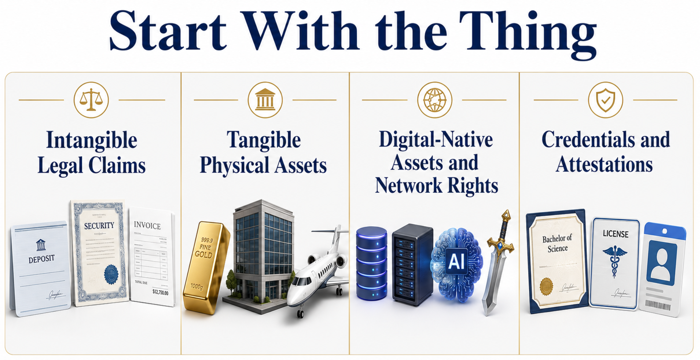
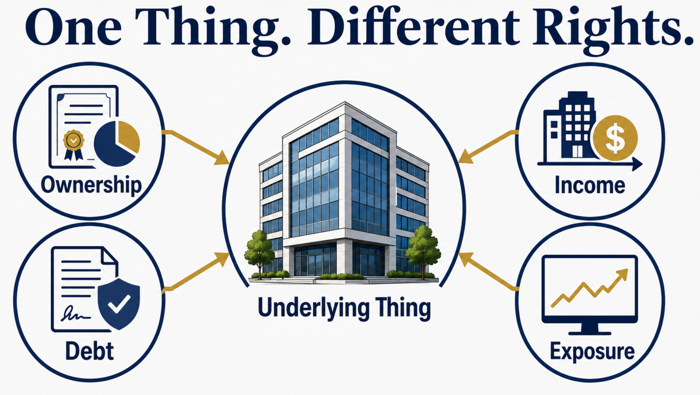
The practical starting point remains the same: identify the underlying thing, then identify the exact right the token gives its holder. Two tokens can point at the same building, dataset, or gold bar and still deliver completely different economic and legal outcomes. These are not cosmetic distinctions.
Find the Record That Actually Controls
A blockchain record may be important without being authoritative. Ownership or control may ultimately be determined by the blockchain itself, the issuer’s books, a transfer agent, a bank, a custodian, a government registry, a software platform, or some hybrid combination of these.
This creates a question that tokenization discussions sometimes glide past. Which record wins when they disagree? If your wallet shows a real-estate token but the legally recognized land registry identifies another owner, the wallet does not magically rewrite property law. If a token representing a security moves on-chain but the transfer agent does not recognize the new holder, what happened legally? If a game item remains in your wallet but the publisher removes it from the game, what do you still possess The token may be durable while the meaningful right is not.
“On-chain” does not automatically mean “legally controlling,” “practically enforceable,” or even “recognized by the system that matters.” Decentralized purists like to say “code is law” when referring to smart contracts. And as a practical matter, that may sometimes mean there’s no technical way around a smart contract. Or rather, there may be “practical obstacles to enforcement” as mentioned in the paper to be referenced in a moment. But people live in the real world and that’s subject to real law. Plenty have pointed out that code is not law. Law is law. And depending on what happens and how, (at least for now), if we find ourselves in front of a human judge, we will be shown that clearly enough. Many have used the “code is not law, law is not law” line, but a good recent reference for the idea is a 2026 paper by Carla L. Reyes, Andrea Tosato & Andrew Hinkes, Code Is Not Law, SMU Dedman School of Law Legal Studies Research Paper No. 721 (Feb. 3, 2026), available at SSRN. So “on-chain” doesn’t automatically mean legally controlling, enforceable, or recognized by the system that matters.
The same caution applies to the information supporting the arrangement. An oracle can deliver outside information to a blockchain, preserve who supplied it, and trigger automated action. It can’t make the information true. If an appraisal, reserve report, occupancy figure, inspection result, or shipment record is wrong, a smart contract may simply act on bad information more efficiently. Blockchain can help protect the integrity of the record, but not necessarily the reality behind it.
What Actually Changed?
Tokenization may create real improvements.
It may change:
- Issuance
- Recordkeeping
- Transfer and settlement
- Fractionalization
- Market access
- Collateral use
- Automated payments
- Governance
- Redemption mechanics
- Interoperability with other digital systems
Those changes may be meaningful enough to create entirely new products and markets. But tokenization can also change the legal structure, counterparty relationship, custody arrangement, bankruptcy treatment, control model, and risk profile in ways that are not obvious from the label.
Instead of directly owning stock, you may own a claim against an intermediary that owns the stock. Instead of owning real estate, you may own an interest in an SPV. Instead of owning gold, you may hold a contractual redemption claim against an issuer and custodian. Instead of owning data, you may have a revocable license to query it. Instead of buying compute directly, you may own a volatile token that can be exchanged for service under changing market conditions.
And on top of the old risks, you may now have wallet risk, smart-contract risk, bridge risk, oracle risk, governance risk, upgrade risk, cybersecurity risk, and legal uncertainty.
So the useful question is not whether tokenization is good or bad.
Ask what changed.
Five-Question Test
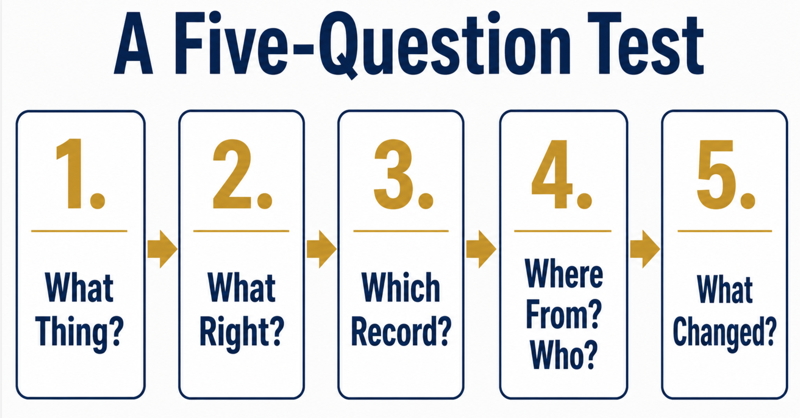
For any tokenized arrangement, I would ask five broad questions:
- What is the underlying thing?
Is it money, a security, a contractual claim, physical property, data, software, compute, intellectual property, a service, a network right, or a credential?
- What exact right does the token provide?
Do I receive ownership, beneficial ownership, redemption, income, access, governance, service capacity, synthetic exposure, or something else?
- Where is the authoritative record?
Does the blockchain control the right, or does the decisive record remain with an issuer, transfer agent, custodian, registry, company, or platform?
- Where does the information come from, and who is responsible?
Who supplied it? Who checked it? Was it observed, registered, independently attested, self-reported, or derived from a model? Who can change the rules or stop the system?
- What did tokenization improve, add, or obscure?
Did it create better access, automation, settlement, transferability, transparency, or collateral use? Did it also introduce new intermediaries, controls, dependencies, or failure modes? None of this is anti-tokenization. It is ordinary due diligence applied to a new wrapper. Because we really haven’t invented too many new things. Maybe some. But not really that many; just new ways to track and trade.
We Did Not Invent a New Reality
Tokenization improves the machinery around assets, rights, and services. It does not invent a new reality or remove the need to understand what sits underneath the token.
The five questions above are ordinary due diligence applied to a new wrapper. They are the practical takeaway of this series.
Tokenization may eventually become ordinary infrastructure. We seem to be barreling forward that way quickly. We may stop emphasizing that an asset is tokenized in the same way we stopped emphasizing that records are electronic, payments are digital, or businesses use databases and the internet.
But we’re not quite there yet.
For now, the novelty of the technology can create a marketing halo around the product. Familiar risks can look as though they have been engineered away because the record is on-chain, settlement is automated, or the dashboard is impressive.
They’re not.
Bad loans are still bad loans. Same with fake invoices. Or poorly maintained property. If something is mostly useless, having its token trade on an exchange doesn’t help it. Maybe it did for awhile, but those days seem – thankfully – over. (Mostly anyway.)
It also bears mentioning that a credential does not become transferable because someone made it into an NFT. Even if you can technically find a way to transfer garbage like this, that’s a bug, not a feature.
Blockchain can improve the machinery around these things. It can create better records, faster settlement, programmable controls, new markets, and useful forms of verification. It can also add new intermediaries, dependencies, controls, attack surfaces, and ways to obscure the relationship between a token and whatever it supposedly represents. The ledger can accurately record that something happened. It cannot guarantee that the premise behind it was true.
From Conclusion to Map
The six parts of this series have developed several related ways of examining the tokenized world. This article is the argumentative conclusion and capstone to that journey. So we’re all done here for now. Except for one big follow up. The next article, “The Tokenization Taxonomy: A Practical Map of Assets, Rights, Services, and Credentials,” is a standalone reference guide to the whole space and a couple of ways to look at it.
It brings the ideas developed throughout the series into one multidimensional framework. The underlying thing forms the primary hierarchy. Token-holder rights, authoritative records, supporting information, and the changes introduced by tokenization operate as additional dimensions across it. The more detailed oracle-data and actor frameworks remain companion tools for understanding the information and people surrounding the arrangement.
The reference guide can live on its own once I post it.
But this series explains why the map is necessary. (Or I suppose I should say, why I thought it might be useful as a reference guide.)
AI Disclosure: I used AI to help with these articles. The concepts are mine. The opinions and assertions are mine; though of course not necessarily unique. The drafts are mine. AI is used for spell/grammar check and sometimes to fill out a few example bullet points I may have missed, and – just as with search – find relevant references. Any additional claims that an AI may insert are manually checked and edited by me. All reference sources are manually checked by me. (Most were actually known prior to draft and may have even be the inspiration behind some articles.) Perhaps obviously, I’ll also use AI tools to generate graphics.