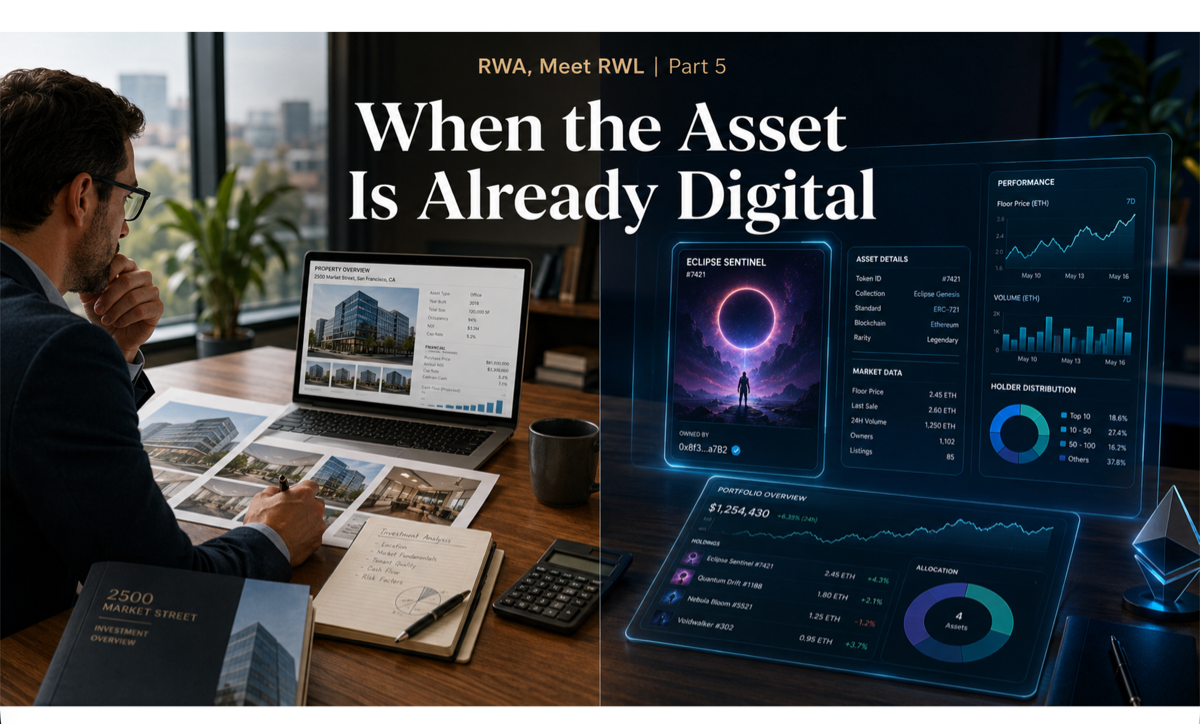
Part 5 of 6 in “Real World Assets (RWA), Meet Real World Lies (RWL): Knowing What You Own in the Tokenized World,” a series about what tokenized assets represent, how information about them reaches the blockchain, and why none of this eliminates the need for trust.
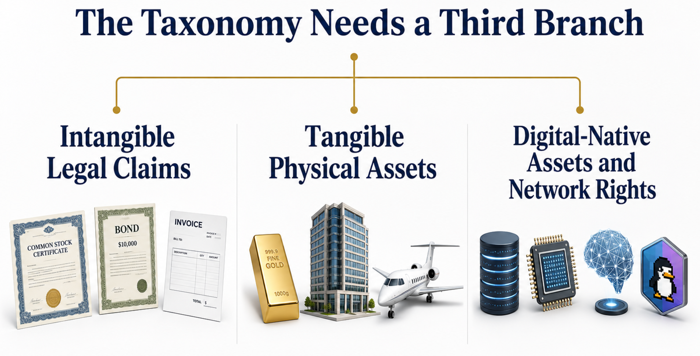
Parts 2–4 examined the data, the people, and the failure modes surrounding tokenized assets. We now return to the taxonomy itself. The original split between intangible legal claims and tangible physical assets works for most conventional RWAs. It does not cover the growing set of things that are digital from the start; data, compute, software, network rights, game objects, and credentials. Some of these are assets, some are services or licenses; some may not be assets at all. We need a third branch.
3. Digital-Native Assets and Network Rights
The best name I’ve come up with for this category – so far – is Digital-Native Assets and Network Rights.
That’s admittedly a little clunky. But the clunkiness reflects the problem. Unlike a gold token or tokenized building, the underlying thing may not exist independently in a vault, county registry, warehouse, or filing cabinet. It may be software, information, network capacity, or a right that exists only within a digital system.
The Organisation for Economic Co-operation and Development, (OECD,) has made a related distinction between tokens representing pre-existing off-chain assets and tokens that are “native” to a blockchain and live exclusively on the ledger. But even that split isn’t enough for everything developing now. Many of these things are hybrids. They’re digitally native in one sense and firmly attached to traditional legal and physical dependencies in another.
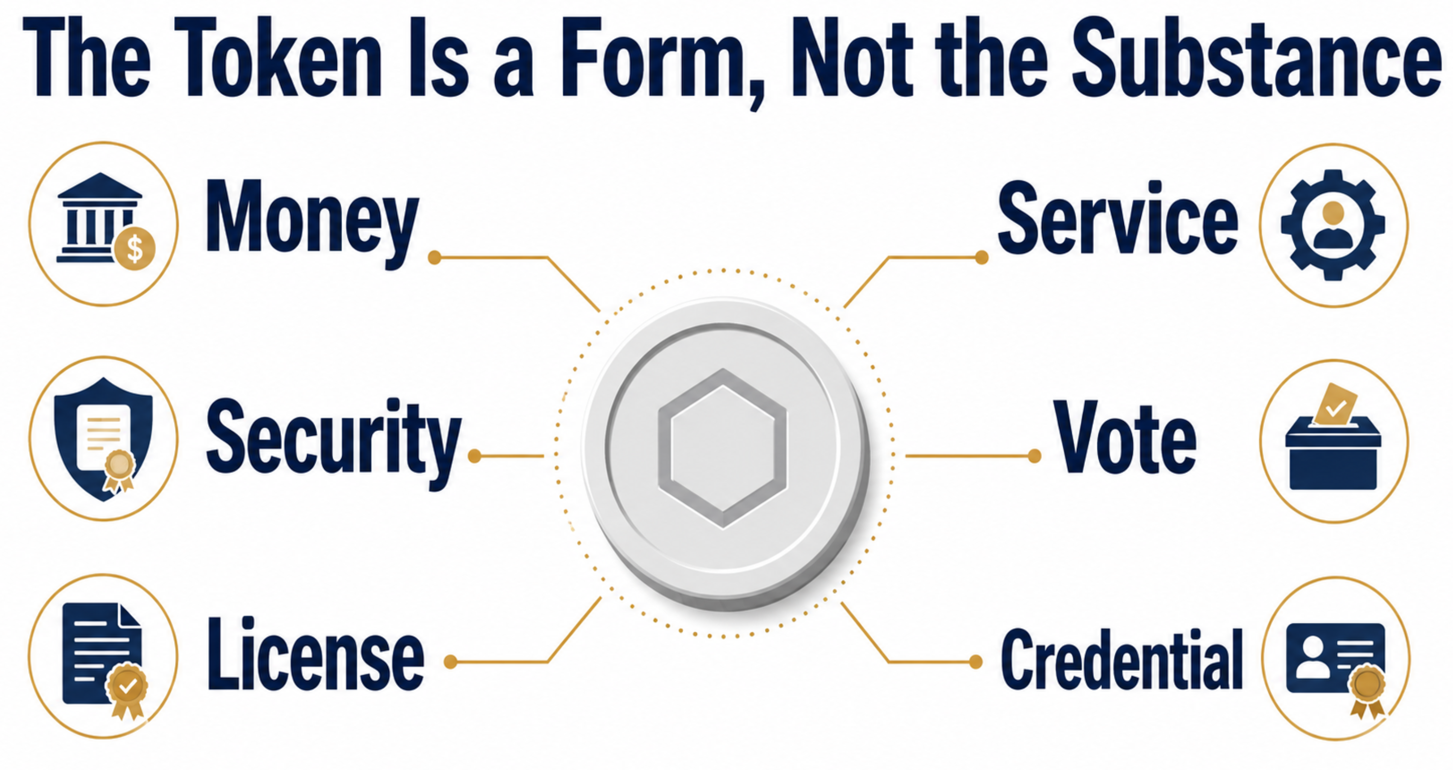
The fact that something has a token still does not tell you what kind of thing it is. The token is a technical form, not the economic or legal substance.
3.1 Data and Information Rights
Data is the most obvious missing category. We’ve spent years hearing data is “the new oil,” although that analogy has always been a little strained. Oil is depleted when it’s used. Data can be copied, combined, reused, corrected, leaked, stolen, sold to multiple parties, and used to create entirely new information. Some of our earlier clues that these issues were going to be different in the future goes back to the old Atoms vs. Bits Questions. Nicolas Negroponte started framing this more back in 1996 with “Being Digital”. Once again, issues of what digital scarcity vs. abundance might mean is out of scope here, but worth studying because it does inform some context in the areas we’re now expanding.
Companies buy and sell a wide variety of datasets. The AI boom has only elevated the questions, especially as agents will increasingly transact with varying levels of autonomy. Who owns or controls the material used to train a model? Who has the right to license it? Did the people who produced the underlying content consent to that use? Is the dataset accurate, complete, biased, outdated, duplicated, contaminated, or outright stolen? Can the usage rights even be adequately represented well enough to be used by smart contracts?
Tokenization can provide a mechanism for registering a dataset, controlling access, recording licenses, or distributing revenue. But “tokenized data” still doesn’t have one meaning. Nor is it sold in just one way. There could still be subscriptions, one off use, and more. With the x402 payments method, software agents will increasingly transact for data assets all on their own. What rights will such items carry with them? What rights can they even carry with them right now? What about across venues? Geography might not matter, but when payments bridge blockchains or use one currency to transact and another for gas, (which happens now), does that impact anything beyond just the transaction itself? What does a return guarantee look like? How could it even happen if there’s a seller that took a fee, a validator that got some gas, or a facilitator that made the transaction gasless?
A token might represent:
- Ownership of copyright or another intellectual-property interest
- An exclusive license to commercialize a dataset
- A limited right to access or query the data
- A subscription to a continuing data feed
- Permission to run an algorithm against private data without downloading it
- A share of future revenue generated from the data
Those are different rights, which is why calling all of them “data tokens” does almost nothing to clarify what the holder actually receives. Ocean Protocol’s own documentation illustrates the difference. It describes a Data NFT as representing the copyright or an exclusive license associated with a data asset, while its data tokens function as licenses to access the data or service. So one token may represent the claimed base intellectual-property right, while another provides permission to use based on terms.
That does not mean a datatoken holder “owns the data.” It may just mean the holder is allowed access.
And even the claimed ownership token comes with an obvious qualifier. Ocean’s documentation says the owner is entitled to the related rights assuming the claim is valid. There it is again. Blockchain can record a claim beautifully. It cannot independently establish that the person making the claim had the right to do so.
This gets messy with AI training data. A token could provide access to a well-documented, properly licensed dataset. Great. It could also provide access to a giant pile of material scraped from somewhere else by people who didn’t have the right to package and resell it. The access control can work perfectly in both cases.
So for tokenized data, the usual question, “What do I own?” expands into several questions:
- What data actually exists?
- Where is it stored?
- Who created or collected it?
- Who has the legal right to license it?
- What uses are permitted?
- Can the same access rights be sold to unlimited buyers?
- Can the data be updated, deleted, corrected, or revoked?
- What happens if privacy law, a court, or a contractual restriction prevents continued use?
A data token can make access programmable. It cannot make the underlying rights less complicated.
3.2 Compute, Storage, Bandwidth, and Digital Capacity
Next up is digital capacity. This includes compute, storage, bandwidth, rendering, AI inference, and similar services. These may feel like digital assets because the customer experiences them entirely through software. But underneath them are still GPUs, CPUs, disks, networks, power supplies, cooling systems, facilities, technicians, and companies or individuals responsible for keeping everything running.
This is where the broader idea of decentralized physical infrastructure networks, often called DePIN (Decentralized physical infrastructure network), starts to overlap with tokenization. The network coordinates physical resources through digital markets and incentives. The deliverable may be digital, but the infrastructure remains real.
Akash Network describes itself as an open marketplace for computing resources. Providers offer capacity, customers lease it, and the network helps coordinate the transaction. That doesn’t mean the customer owns part of a server, only compute capacity under an arrangement.
Filecoin’s documentation describes storage deals as contracts in which one party agrees to store another party’s data for a specified period. Again, the core economic object is a service commitment. You’re not necessarily buying a hard drive. You’re buying an obligation to store and, depending on the arrangement, retrieve data.
Render Network offers another version. GPU work can be purchased by burning RENDER tokens in exchange for Render Credits. Those credits are then used to request computing work. That looks less like ownership of a productive asset and more like a programmable service credit connected to a marketplace.
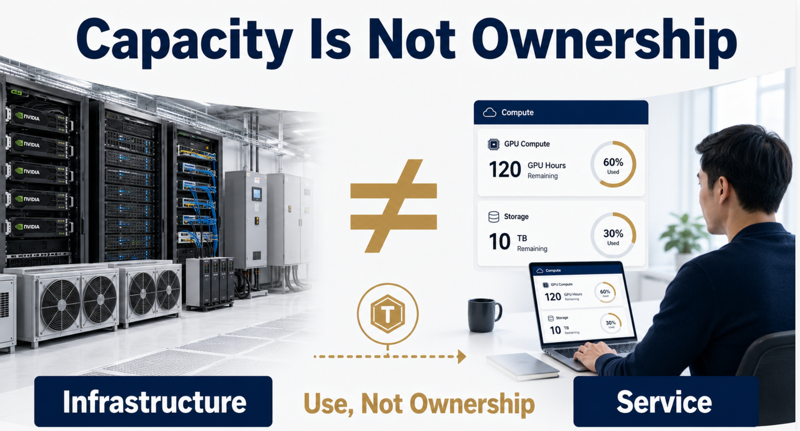
Capacity is not ownership. Or is it?
Which brings us to another taxonomy problem. Should a prepaid hour of compute be called an asset? If Forever postage stamps and metro cards are assets, (even if not effectively tradable), such things arguably are assets. After all, they obviously have economic value, right?
Accounting and finance people can argue this. A transferable right to future service may have value. But it’s not the same thing as owning the machine providing the service. The token may provide access to capacity, serve as payment, reward resource providers, support staking, or do several of those things at once.
And these systems reintroduce many real-world issues from the earlier parts of this series. Is the claimed GPU actually available? Does it meet the specification? What happens if the provider disappears halfway through a job? Who is responsible if confidential data is exposed? Can a network claim to have massive capacity when much of it is unreliable, oversubscribed, or economically unavailable at the price users expect? We’ve seen some of this with the rise of AI tools and occasional network failures. Who’s responsible when your agent fails because a provider didn’t deliver a piece of data. Somewhere deep down, there’s likely still some agreement or another that governs the relationship.
A proof system may establish that some storage or computation occurred. It still may not answer whether the service was useful, lawful, secure, timely, or suitable for the customer’s actual purpose.
So perhaps the right term here isn’t “digital asset” at all. It may be tokenized service capacity or a digital service entitlement. Less exciting for a pitch deck, maybe. More accurate though.
3.3 AI Models, Software, and Autonomous Agents
Now we get to “AI tokens.” What’s an AI token? Well, that depends entirely on who is using the phrase. Regarding use as value or governance of some sort, an AI token might be:
- A utility token used to pay for model access or inference
- A reward token for supplying compute, data, or model output
- A governance token for an AI-related network
- A staking token used to back a validator, model, or subnet
- A license to use model weights or software
- A share of revenue associated with an AI service
- A token associated with a particular autonomous agent
- A speculative token whose only meaningful connection to AI is its name
Maybe this is an asset class. As of this writing though, it feels more like a marketing label covering several unrelated economic structures.
Bittensor is a useful example because its documentation explicitly describes its independent subnets as markets that produce “digital commodities,” including compute, inference, storage, predictions, data, and models. Miners produce whatever the subnet is designed to reward, validators evaluate the work, and the network distributes incentives through TAO and subnet-specific tokens.
Interesting model. But owning TAO does not automatically mean you own an AI model. Owning a subnet token does not necessarily mean you own the compute, data, or predictions generated inside that subnet. The token’s function relates to the network’s incentive, staking, pricing, and governance mechanics. Those mechanics may create value, but they are not the same as title to a particular digital commodity.
What would actual ownership of an AI model mean anyway?
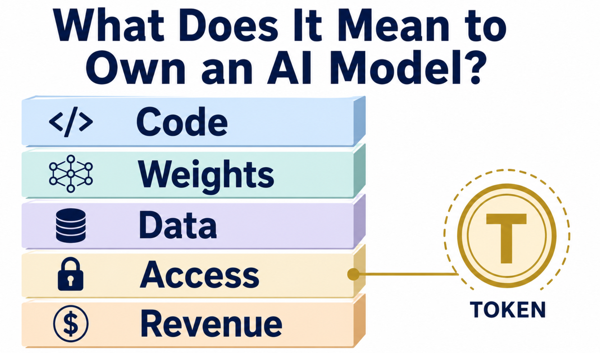
Would you own:
- The source code?
- The trained model weights?
- The training dataset?
- The right to run the model?
- The right to make copies or derivative versions?
- The API business that provides access?
- A share of the revenue produced by the model?
- The brand name under which it is sold?
Those things can all be separated. An AI model is not one clean object in the same way that a particular building or aircraft is. It’s assembled from software, training processes, data, model weights, configuration, infrastructure, and often continuing services supplied by third parties. A token could represent rights to one layer while giving the holder no rights at all to the others.
Autonomous agents add another level of confusion. A token could be associated with a specific agent, but what does that mean? Is the agent a piece of software, a running instance, a wallet, a brand, a collection of prompts and tools, or an ongoing service controlled by a developer? If the developer replaces the model, changes the prompts, adds tools, removes capabilities, or forks the agent into ten copies, which one does the token represent?
And then we get back to the whole theme of this series. Who is responsible for what the agent does? Who controls its credentials? Who can shut it down? Who receives its revenue? Who pays when it makes a mistake? Does a token holder have governance rights, economic rights, both, or neither?
Saying “the community owns the AI agent” is easy. Defining what that sentence means in law and in actual system control is much harder. I’ve included this section for completeness, but this area is what I think we can still fairly call early in terms of structural understanding of these new market spaces.
3.4 Intellectual Property and Programmable Licensing
Intellectual property already appeared elsewhere in this taxonomy because royalties and licensing revenue are contractual cash flows. But digital IP deserves a section of its own because tokenization can break ownership, licensing, attribution, derivative rights, and royalties into separate programmable pieces.
Possible underlying rights include:
- Copyright ownership
- Patent rights
- Software licenses
- Music and media catalogs, Character and brand rights
- Rights to create derivative works
- Model or dataset licenses
- Royalty participation
Story’s documentation, for example, describes an IP Asset with an associated NFT representing ownership over the IP, along with modules for licenses, derivative works, disputes, and royalty flows. Its system also allows separate License Tokens to represent permission to use the IP under defined terms.
Again, ownership and permission are different. I might own the copyright to an image. You might own a commercial license allowing you to print it on shirts. Someone else may have the right to create a derivative version. Another person might be entitled to five percent of the revenue. Tokens could represent any of those relationships.
And here’s where purely digital material behaves differently from a physical collectible. A painting can be forged, but the original physical object remains singular. A digital file can be copied perfectly in seconds. The scarcity usually exists in the recognized edition, registry entry, contractual right, or official association with the creator. It does not necessarily exist in the underlying bits.
An NFT, (when it represents something like an image), can make one token scarce, but it cannot make the image impossible to copy. The same will be true for a lot of types of objects that could be represented by NFTs, though perhaps not everything. We’ll see. Nor does the NFT itself prove that the person who created it owned the copyright. If someone can capture the digital object itself apart from the tokenization, someone can tokenize somebody else’s work just as easily as they can upload it to an ordinary website. The blockchain may give us a permanent record of who made an unauthorized claim first. That is not the same thing as solving the problem.
3.5 Gaming Assets, Digital Objects, and Virtual Property
There is also a broader category of purely digital objects. These include digital art, in-game items, domain names, virtual land, membership passes, collectibles, and other scarce or controlled objects that exist primarily inside software or a registry.
Some fit comfortably into the collectibles category from Part 1. Others behave more like licenses or platform permissions.
Suppose you “own” a sword in an online game. What do you really own?
Maybe you own a token that the game recognizes as giving your account the right to use the sword. But the publisher still controls the software, visual artwork, game rules, and servers. It may be able to change the sword’s capabilities, ban your account, discontinue the game, or alter whether the token is recognized at all.
Virtual land raises the same issue. It can be scarce within a platform because the platform defines a limited map and recognizes certain entries as property-like rights. But the land does not exist independently of the platform’s software, governance, user base, and continued operation.
A domain name is another interesting comparison. It has value, can be transferred, and may be central to a business. But it is ultimately a registry-dependent right to use a particular name under a particular system and set of rules. You don’t own the words in the abstract.
So these assets may be digitally native, but they are not necessarily independent. Their actual practical value can be entirely dependent on a platform continuing to recognize and support them.
That sounds a lot like the statutory and registry-dependent rights discussed in Part 1. The difference is that the governing authority may now be a protocol, software company, DAO, game publisher, or digital registry instead of a government agency. Different ruler. Same basic dependency.
3.6 Credentials and Attestations That May Not Be Assets
Here’s another area that tends to get mixed into tokenization even though much of it should not be called an asset at all.
Identity credentials, professional qualifications, educational records, compliance certifications, reputation scores, and proof-of-participation records can all have tremendous economic value. But that does not mean they should be transferable.
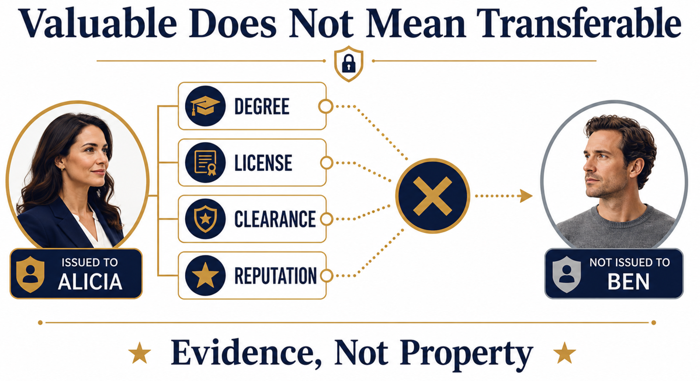
I cannot legitimately sell you my college degree, pilot certificate, security clearance, professional license, or clean driving record. Well, I suppose I could sell you a piece of paper or token claiming to represent it. That would be the problem. And probably not legal. Unless they failed in their own legalese, (which is possible), the issuers of such things would generally have something to say about such activities.
The World Wide Web Consortium’s Verifiable Credentials work provides standardized ways to express claims made by an issuer, such as an educational certificate or license. Its decentralized identifier standard provides a method for identifying people, organizations, devices, data models, and other subjects without necessarily relying on one centralized identity provider.
These tools can help answer questions such as:
- Who issued this credential?
- Was it altered?
- Does it refer to the person or entity presenting it?
- Has it expired or been revoked?
Useful. Very useful, actually. But the credential is evidence of a claim or status. It is not necessarily property. Making it transferable would typically destroy its meaning, practically by definition.
This distinction will become especially important for AI agents. Agents may need identities, credentials, permissions, spending limits, operating histories, and reputation. A business may need to know which company or person is responsible for a particular agent and what it’s authorized to do.
That does not mean the agent’s credential should trade like a stock. Not everything valuable is an asset, and not everything recorded on-chain should become a market. (That might be just an opinion, but there you go.)
3.7 Network Utility, Governance, and Incentive Rights
Finally, we have the giant bucket of tokens used to make digital networks function.
These tokens may be used to:
- Pay transaction or service fees
- Purchase access to a product
- Reward people who supply resources
- Stake behind validators, providers, or subnets
- Vote on protocol changes
- Allocate incentives
- Provide collateral inside a network
The OECD has described utility tokens as rights to access particular goods or services, often functioning like prepayment or a voucher rather than representing ownership of an asset. That’s a useful distinction, although modern network tokens often do several jobs at once.
A token could simultaneously serve as payment, staking collateral, a governance vote, and an incentive reward. That makes it harder to classify and harder to value. Is its price supported by demand for the underlying service? By speculation? By the need to stake? By expectations of governance power? By token issuance rules? By the hope that the network eventually becomes important?
And what exactly do governance rights get you? Owning a governance token does not necessarily give you equity in a company. It may not give you a legal claim against revenue, assets, or management. It may let you vote on selected protocol settings, assuming enough other holders participate and assuming the people operating the software actually implement the result.
That can be meaningful, but it is not the same thing as owning common stock. This is why “utility token,” “governance token,” “AI token,” and “DePIN token” are not enough. They describe a theme or one possible function. They don’t fully describe the holder’s legal rights, economic exposure, control, or remedies. Investors will likely have to dig deeper to truly know what they’re buying.
So, Are All Of These RWAs?
It remains to be seen. Some are. Some aren’t. Some sit directly on the border. There’s no official “Official Namer of Things RWA” out there. Maybe I’ll do it, for a small token fee of some sort. More likely we’ll just need some time to see how these things actually come into use and which persist, along with cascading consequences. A token that licenses access to a dataset stored on ordinary servers may look a lot like an intangible legal claim tied to an off-chain asset. whereas a tokenized right to GPU service is a digital service entitlement backed by physical infrastructure. A token representing copyright ownership is an intangible legal claim, even if the copyrighted work is digital. And a governance token native to a protocol may have no real-world backing at all. It’s somewhat all over the place.
That suggests a more complete taxonomy:
(Though I’m likely still missing some things.)
Traditional or Off-Chain Things Represented on a Ledger
- Money and financial claims
- Receivables and contractual cash flows
- Government- or registry-dependent rights
- Physical commodities and property
- Collectibles and other singular objects
Digital-Native Assets and Rights
- Data and information rights
- Software, AI models, and digital IP
- Digital objects and virtual property
- Network utility, governance, and incentive rights
Digital Service Entitlements
- Compute
- Storage
- Bandwidth
- Rendering
- AI inference and other processing services
Credentials and Attestations That Aren’t Really Assets
- Identity credentials
- Professional and educational qualifications
- Compliance status
- Reputation and operating history
- Proof of participation or authorization
And then, of course, there are hybrids everywhere. An AI inference token looks digital, but the service depends on GPUs, power, data centers, software, model licenses, network access, and operators. A data token may control a digital dataset, but the right to use that data depends on contracts, privacy rules, copyright, and the behavior of whoever hosts it. A virtual object may exist on-chain, but its usefulness depends on a game or platform continuing to recognize it.
We keep coming back to the same thing. Blockchain can help coordinate, record, transfer, and automate rights. It may create entirely new markets. It may make services easier to buy and resources easier to monetize. Those are real possibilities, and some are genuinely exciting. But it does not relieve us of the need to identify the underlying thing.
The Questions Don’t Change
Whether a token represents a building, an invoice, a dataset, an hour of GPU time, an AI model, a digital sword, or a vote in a network, the label tells you almost nothing by itself.
You still need to ask:
- What actually exists?
- What does the token represent?
- What legal, contractual, or technical rights do I receive?
- Is the right transferable?
- Who controls the underlying system?
- Who can change the rules?
- Who verifies performance?
- What happens if the service, platform, model, or network disappears?
- What remedy do I have if the promised thing was never legitimate?
“AI token” doesn’t answer any of that. Neither does “data token,” “utility token,” “governance token,” “DePIN token,” or even “RWA token.” They are starting points for more questions, not answers.
So maybe the broader lesson from this entire series is that we should stop treating tokenization as if it defines the asset. It defines a way of recording, transferring, accessing, or coordinating something. The something is still what matters.
Forget about the category label for a moment. Forget about whether it’s real-world, digital-native, AI-powered, decentralized, programmable, or any of the other words we’re going to pile onto these things.
The same question remains: What do I actually own?
See Also
- Ocean Protocol, “Data NFTs and Datatokens”: Distinguishes a token representing claimed base IP from tokens used to license access to a data asset or service.
- Akash Network, “What Is Akash?”: Describes a decentralized marketplace in which providers compete to supply compute and GPU resources.
- Filecoin Glossary: Defines storage and retrieval deals as contractual service arrangements between network participants.
- Render Network, “The RENDER SPL Token”: Explains how RENDER tokens are exchanged for credits used to purchase GPU computing work.
- Bittensor Documentation: Describes subnet markets that produce digital commodities such as compute, inference, storage, predictions, data, and models.
- Story Documentation: Explains its framework for registering IP assets and representing ownership, licenses, derivatives, disputes, and royalty relationships.
- W3C, “Verifiable Credentials Overview”: Introduces standardized methods for expressing and verifying claims issued about people, organizations, and other subjects.
- W3C, “Decentralized Identifiers”: Defines identifiers that can refer to people, organizations, devices, data models, and other subjects without depending on one centralized identity provider.
- OECD, “The Tokenisation of Assets and Potential Implications for Financial Markets”: Distinguishes tokens representing pre-existing off-chain assets from tokens built directly on-chain.
AI Disclosure: I used AI to help with these articles. The concepts are mine. The opinions and assertions are mine; though of course not necessarily unique. The drafts are mine. AI is used for spell/grammar check and sometimes to fill out a few example bullet points I may have missed, and – just as with search – find relevant references. Any additional claims that an AI may insert are manually checked and edited by me. All reference sources are manually checked by me. (Most were actually known prior to draft and may have even be the inspiration behind some articles.) Perhaps obviously, I’ll also use AI tools to generate graphics.