Part 4 of 6 in “Real World Assets (RWA), Meet Real World Lies (RWL): Knowing What You Own in the Tokenized World,” a series about what tokenized assets represent, how information about them reaches the blockchain, and why none of this eliminates the need for trust.
The first three parts looked at the assets, the data, and the people involved.
Part 1 asked what kind of thing was being tokenized and what claim the token actually gave its holder. Part 2 looked at the information required to describe and evaluate that thing. Part 3 examined the people and institutions responsible for reporting, checking, and acting on the information.
This part looks at what happens when those trust structures fail.
Some Uncomfortable Examples
The Camp Situation
This is an ongoing situation as of this writing that people I know are dealing with. It’s an example – allegedly – of convoluted accounting and asset definition. Such as what happens when land is owned separately from buildings on it, but both might be pledged as collateral. Just who owns what when debt is defaulted? This one isn’t tokenization related at all; just a great illustration of how “simple” real world assets can become convoluted in terms of clarity. The short of it is some private equity investors had a complicated collection of companies that somehow own a lot of summer camps. That right. Camps. Little kid happy places. But the land, the buildings, and other things were, (or rather are), apparently all separate entities which have been pledged here there and everywhere. Within six months of floating some bond investments, tens of millions of dollars disappears and they’re now doing fire sales as part of bankruptcy avoidance.
- “They Loved Debt”: How the Shabselses’ Half-Billion-Dollar Summer Camp Empire Spiraled Into Bankruptcy
- How Two Brothers From New York Fleeced Israeli Financiers
- Case Summary: SIMAD Holdings Chapter 11
And yet establishing what actually happened, who knew what, who was responsible, and who had the authority or incentive to do something about it appears to be surprisingly difficult. Here’s a main takeaway though: Some ostensibly sophisticated investment professionals who should be due diligence experts bought into these folks and six months later are looking at a bankruptcy. Could blockchain have helped here? Some might claim so. And maybe… maybe one day that will even be true. But not until or unless more dependent financial obligations become codified online such that these things could be tracked and checked.
Right now, it seems nothing about this particular mess required a sophisticated international conspiracy. Mostly, it required fragmented oversight, slow processes, conflicting incentives, and enough uncertainty for everyone involved to tell a slightly different version of the story; allegedly.
A blockchain record would – most likely – not have fixed this. It might have preserved one of those versions more permanently, but not what appear to be outright lies and multiple pledges for seemingly similar assets. Using blockchain might even make such things easier. This is exactly why such investments might need more, not less, due diligence.
FTX
FTX was a crypto exchange. You’ve probably seen the news about it and the founder. This one crossed out of crypto news into mainstream news. Its balances were digital. Its transactions supposedly occurred in an industry built around transparent ledgers, cryptographic verification, and the supposed reduction of dependence on trusted intermediaries.
And yet.. customers still had to trust the people operating the exchange. According to the U.S. Department of Justice, Sam Bankman-Fried orchestrated schemes involving the misappropriation of billions of dollars in customer funds. He was sentenced in March 2024 to 25 years in prison and ordered to forfeit more than $11 billion.
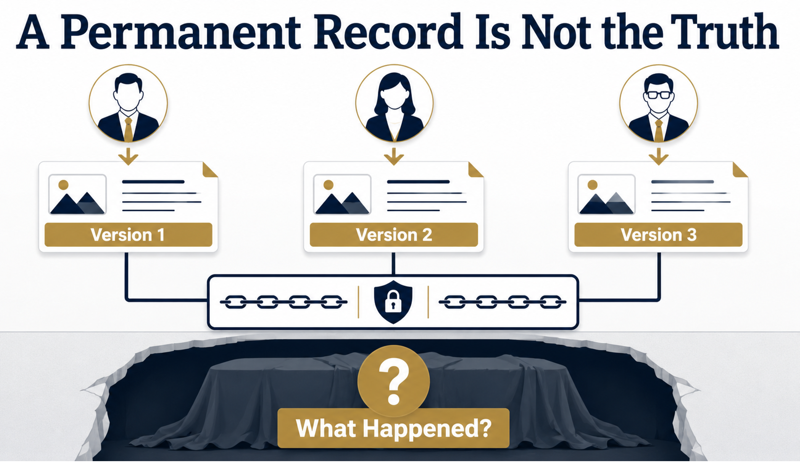
The blockchain did not fail to maintain its ledger. Customers failed because the balances they saw did not give them control over the assets they believed the exchange was holding for them. That is uncomfortably close to the central RWA problem. A token can be real while the backing, custody, or promise attached to it is not.
TerraUSD
TerraUSD was designed to maintain a one-dollar value through a relationship with another crypto asset, LUNA. The system was highly digital, highly automated, and visible on-chain.
That did not mean investors had an accurate understanding of how its stability had been maintained.
In 2024, a jury found Terraform Labs and Do Kwon liable for fraud, and the defendants agreed to pay more than $4.5 billion. The SEC said the case involved a years-long fraud, including misleading claims about the stability of the system and how its peg had been restored during an earlier devaluation.
This is the important part: the relevant transactions could be on-chain while the explanation of what those transactions meant was misleading. Transparency of activity is not the same as transparency of intent, control, or economic reality.
Trafigura and the Nickel That Wasn’t There
In 2023, commodities trader Trafigura recorded a charge of hundreds of millions of dollars after discovering that cargoes it believed contained high-grade nickel instead contained much lower-value materials.
Trafigura described the matter as systematic fraud. In January 2026, it won a roughly $600 million judgment after the High Court in London found that it had been induced into contracts through fraudulent representations.
This is almost a perfect RWA case study in bad behavior.
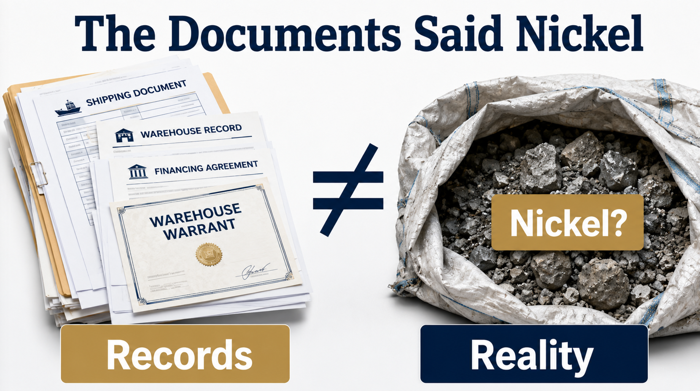
There were contracts. There were shipping documents. There were containers. There were financing arrangements. There were professional counterparties. There was data describing the cargoes. There just was not the nickel everyone thought the documents represented. Tokenizing the shipping documents would not have changed what was inside the containers.
The London Metal Exchange’s Bags of Stones
Around the same time, the London Metal Exchange discovered irregularities involving nickel stored in an approved warehouse. Nine warehouse warrants were canceled after material that was supposed to be nickel turned out to include bags of stones.
A warehouse warrant is already a kind of pre-blockchain RWA instrument. It is a document representing a claim against a physical commodity held somewhere else. The warrant can be authentic with an approved warehouse, and a database showing inventory. Then we have a legally recording transfer.
And the bag can still contain rocks. How would you like to own tokens representing that?
Evergrande
Real estate is particularly vulnerable because the asset is unique, local, difficult to inspect continuously, expensive to value, and surrounded by layers of companies, contracts, permits, loans, presales, construction obligations, and accounting judgments.
In 2024, Chinese regulators said Evergrande’s mainland unit had inflated revenue by approximately 214 billion yuan in 2019 and 350 billion yuan in 2020. The company then issued bonds using financial statements containing those inflated figures. In 2020, the allegedly inflated amount represented 78.5 percent of reported revenue. (Reuters)
Evergrande was not an obscure building owner with one questionable appraisal. It was one of the world’s largest property developers. It had auditors, banks, bondholders, regulators, professional investors, and enormous quantities of financial and operational data.
The existence of all those watchers did not make the reported reality true.
Everyone Had Watchers
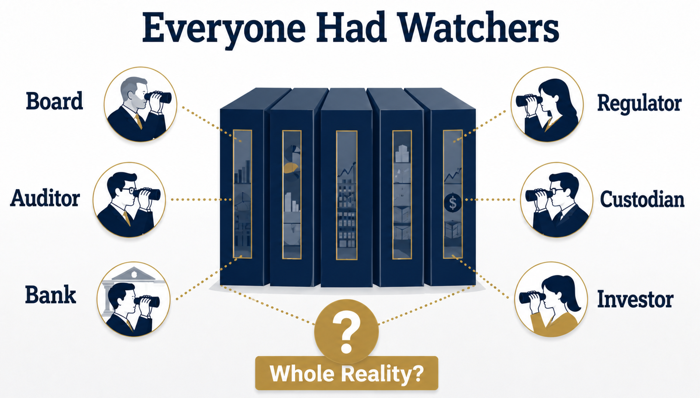
All of these had watchers. At least to some degree.
They had auditors, regulators, banks, boards, exchanges, custodians, warehouse operators, inspectors, professional investors, or sophisticated commercial counterparties. (I suppose I should say, supposedly sophisticated counterparties.)
In some cases, the lies survived because the checkpoints were intermittent. In others, each watcher examined only a narrow part of the system. Some relied on documents produced by another party. Maybe others assumed another professional had verified the underlying facts. Some probably saw warning signs but lacked the authority, incentive, budget, or courage to keep digging. And yes, others were perhaps just fooled.
That doesn’t mean oversight is useless. It also doesn’t mean every person who resists another audit, inspection, or disclosure requirement is trying to cheat. Compliance can be extraordinarily expensive, and poorly designed requirements can impose real burdens on legitimate organizations. Not everyone who objects to another audit, inspection, or disclosure rule is trying to cheat.
But the opposite is also true.
Organizations that appear or actually are legitimate screw things up with disturbing regularity. Sometimes they lie or persuade themselves that a temporary deception will buy enough time to fix the underlying problem. Other times the watchers fail. And sometimes all of this cascades until the consequences become systemic.
Fine. Well, I mean, not fine really… but ok, we know this is just part of the world. The point is, transporting this mess to blockchain solves nothing.
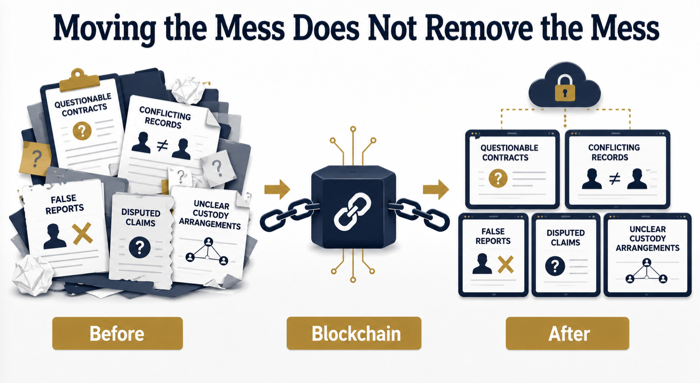
Or rather, maybe some aspects can be mitigated with blockchain if coupled with other tools. We just shouldn’t look at some of the marketing halo of this area and feel like all of this has evaporated. It hasn’t. You still need to do your own due diligence insofar as that’s possible.
The Things No One Has Looked At Yet
Mostly, these things are probably not caught. And this may be the most uncomfortable part. How much is happening right now that has not surfaced simply because no one has looked in the correct account, opened the correct container, called the supposed customer, inspected the correct building, or asked why two systems contain different answers?
Warren Buffett’s actual line is even better than the version people usually repeat:
“It’s only when the tide goes out that you learn who’s been swimming naked.”
He wrote that in Berkshire Hathaway’s 1992 shareholder letter while discussing insurers whose inadequate protection became visible only after Hurricane Andrew. The lesson is supposed to be that the tide does not create the problem. It reveals the problem that was already there.
Disclosure
This post may be especially negative, which I feel a little bad about.
Mostly, even when I write about risks, I am optimistic about the future. My entire career has involved new digital technologies and techniques. I think tokenization, programmable finance, better data standards, and improved settlement systems can produce real benefits. I do like a great deal of these new things!
But it’s worth remembering these issues and paying attention as we evaluate new opportunities, especially investments promoted as if blockchain has somehow engineered familiar human problems out of existence.
In the end, all of this becomes fairly simple.
Forget about the tech for a moment. Forget about the blockchain. Forget about the oracle architecture, proof-of-reserve dashboard, token standard, automated settlement, and gee-whiz opportunities these new instruments provide.
Start with the same question that has always mattered:
Who is running this thing?

Wrapping Up
Parts 1 through 4 have mostly dealt with familiar off-chain assets, claims, records, and institutions.
Part 1 asked what kind of asset or right the token represented. Part 2 examined the information required to describe it. Part 3 looked at the people and institutions responsible for supplying, checking, and acting on that information. This article showed what can happen when those people and systems fail.
But the taxonomy still has a hole in it. What happens when the underlying thing is already digital?
What about data, software, an AI model, a digital object, network capacity, or an hour of GPU time? Are those assets, services, licenses, access rights, or something else?
That’s where Part 5 picks up the classification problem again.
AI Disclosure: I used AI to help with these articles. The concepts are mine. The opinions and assertions are mine; though of course not necessarily unique. The drafts are mine. AI is used for spell/grammar check and sometimes to fill out a few example bullet points I may have missed, and – just as with search – find relevant references. Any additional claims that an AI may insert are manually checked and edited by me. All reference sources are manually checked by me. (Most were actually known prior to draft and may have even be the inspiration behind some articles.) Perhaps obviously, I’ll also use AI tools to generate graphics.