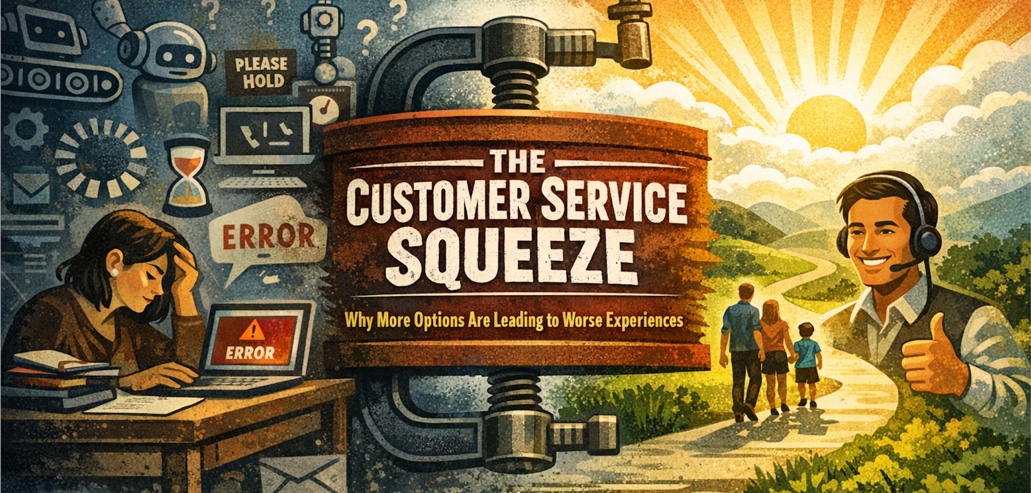
One Family, One Month, Multiple Customer Service Failures. Many Insights.
Over one month, our family logged bad customer service experiences. Not quite a formal study, but we did it because the same kinds of friction kept showing up. We’re both marketers, one in digital product, the other a corporate brand manager. So we analyze things. For example, when we go to a store, it’s not just shopping, it’s consumer ethnography. Like anyone facing typical consumer issues, we usually just power through minor annoyances and move on. But then thought “For one month, let’s pay closer attention and see what happens?”
The log at the end is just reference, but this is not really about one family’s month. Anecdotes are not statistics. Still, asking around, our experience seems typical. The market-share opportunity is complicated because there doesn’t seem to be much competitive pressure to do better. If everyone is squeezing costs and margin becomes the dominant value, a tacit industry agreement to be lousy can be hard to overcome.
There is opportunity for companies that want to do better. It exists because many markets today are defined not by scarcity, but by abundance, substitution, and constant competition for share. We have more choices, channels, and messaging than ever. Yet the customer experience often feels worse.
The Contradiction is the Point
Bad customer service has always been an opportunity for companies that refuse the race to the bottom, but especially now. The bar has fallen so low that a company doesn’t need an exotic strategy to win share. It may only need to stop making life harder for its own customers.
A lot of companies are creating churn they cannot see. They save money short term through weaker support, brittle workflows, bad automation, fragmented communication, and policies that make resolution harder. Damage appears later in poor retention, eroded brand trust, and lower lifetime value. By the time KPI pain is obvious, customer habits have already shifted elsewhere.
Over the next few years, some firms will discover that what looked like efficiency was actually customer loss. They’ll realize too late they optimized handling costs instead of customer outcomes. Call-handling KPIs can look strong while customers are simply leaving. Average handle time and similar measures track operational efficiency, not customer health. So problem-handling metrics may improve while customer reality worsens. They can reflect customers giving up, avoiding support, or leaving. Industry coverage has warned against treating service as a “deflection mechanism,” because making support harder to reach can hurt. (See Why customer service shouldn’t be ‘a deflection mechanism‘)
Lately, at least some of this seems driven by lame AI chatbots. AI is a real step change. But bad tool use is still bad tool use. Chasing efficiency, speed, and labor reduction without thinking enough about the customer experience can lead to bad outcomes. One lens is Jevons paradox. In economics, increased efficiency can lower the cost of using something and, rather than reducing total consumption, increase it. The fit to customer operations is not exact, but similar. When service interactions become cheaper through automation, companies do not necessarily deliver the same service more efficiently. They often generate more outreach, nudges, notifications, scripted flows, and fragmented touchpoints. The quantity of interaction rises while the quality falls.
So customers do not necessarily get better service. They often just get more service surface area to fight through.
That connects to what I’ll call Scott’s Paradox: When a product or service category becomes overly abundant and overly commoditized, quality can decline rather than improve because everyone is under pressure to squeeze margin. In theory, fierce competition should produce better outcomes. In practice, if one company cuts corners and gets away with it, others follow. So the irony can become in markets with abundant competition, customers may get worse experiences on average, not better ones.
Plain Sight
We’re all aware of the problems below. Some may be intractable. Others, you decide. Forget research for a moment and think about your own behavior. Add your spouse, kids, and friends. Ask what you would do when alternatives appear that avoid these problems. It’s not all about costs and overpriced cookies.

- AI chat bots,both text and voice, seem to be getting worse. This may be temporary. There’s research showing issues here though. Some of the negativity may be based on different expectations of bots vs. humans, but the reason doesn’t matter as compared to the outcome.
- No one has solved the flood of spam email. This makes people less tolerant in general. It might not be your fault, but it is your problem. Reports note notification and click fatigue are at a breaking point. Users are developing ruthless habits, like marking legitimate but annoying messages as spam, aggressively unsubscribing/blocking, or ignoring everything non-essential.
- Shrinkflation tries to trick consumers to accept less for the same money. Until they just choose something else.
- Customers are conditioned to wait for sales as list prices feel detached from reality. There’s one cookie brand at our supermarket that has become stupidly expensive. They took themselves from a premium to a luxury price. They took a “low involvement, low think” purchase to a thought process more like, “Holy crap, EACH cookie in this package now costs $X? That was more a pricing issue than customer service, but it’s a brand experience failure. Making our own is actually better anyway.
- Many software vendors still create miserable experiences for customers and employees.
- No one has solved endless password resets, authentication friction, and account recovery misery.
- Subscription cancellation is harder than subscription signup.
- Billing errors are painful to fix for customers and employees.
- Apps and websites offload basic troubleshooting work onto the customer.
- Companies send too many notifications, reminders, and “helpful” nudges that become noise.
- Search within many sites is still shockingly bad. If your customers have to use external search, AI or Reddit to sort out what to do with you, that’s a problem.
- Inventory visibility is often unreliable, both online and in-store.
- Self-service systems are often just labor transfer from company to customer.
- Policies are often optimized for internal consistency rather than customer resolution.
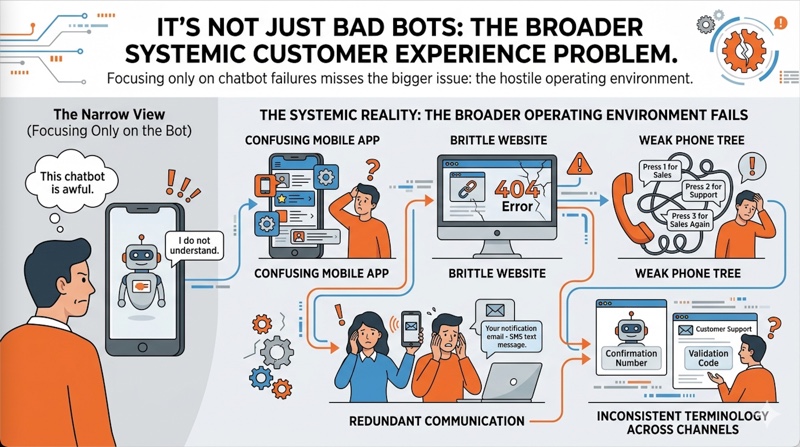
The problem is not just bad bots. The bigger issue is the whole system around them: confusing apps, brittle websites, weak phone trees, redundant communication, shifting terminology, and human reps blocked by policy or system design from actually solving the problem.
Consumers are not delighted or loyal. They’re satisficing; accepting solutions that clear a minimum threshold relative to alternatives. Switching can be costly, inconvenient, risky, time-consuming, or just exhausting, depending on the category. So people stay with average or subpar products and services because leaving still feels worse. I explored this more directly in an earlier piece, Why Do Customers Switch? How to keep from being just a Satisficer?
The Self Delusional Trap
Companies may interpret customer inertia as loyalty when it’s not. They stay customers only until they find a workable escape hatch, then leave with surprising speed. This is why bad customer service can sit hidden for a long time and then suddenly becomes visible as churn.
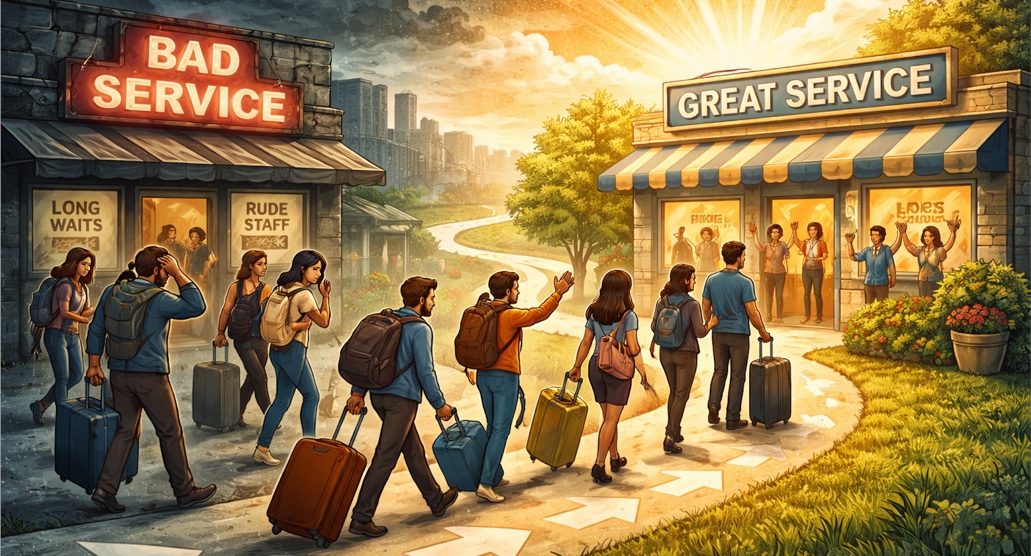
The strategic opportunity here isn’t fancy. You don’t need to invent a whole new thing. In many markets, there is a simpler path: reduce friction, respect the customer’s time, make your flow easier, cut redundant communication, empower human judgment where actually needed, and stop forcing customers to absorb internal complexity that should have stayed invisible.
This sounds obvious, but many firms talk themselves out of it. They say they know their customer, but usually they know only a dashboard version: segments, funnels, campaign metrics, maybe a workshop journey map. What they seem to not know is what it actually feels like to be on the receiving end of the experience they built, even though they probably face similar situations with vendors themselves.
- They do not fully feel the annoyance of ten repetitive reminders.
- They do not feel the dead-end workflow.
- They do not feel the inconsistency across app, website, phone, and email. (By the way, if you want to understand contemporary contextual information architecture across boundaries better, see Understanding Context: Environment, Language, and Information Architecture, and Pervasive Information Architecture: Designing Cross-Channel User Experiences.
- They do not feel what it’s like when the representative wants to help but is blocked by their own system.
These friction experiences wear us down over time. We ignore little things, and then one day we’ve just had enough. Real experience is also why AI will not solve these issues. Asking models to simulate a customer journey is not the same as understanding one. AI regresses toward common patterns. If the market norm is mediocre service design, copying the norm more efficiently is not a breakthrough. It’s just industrialized mediocrity at scale. I have zero data, (yet), to back up the following assertion, but I believe that using more AI generated customer persona and user journeys will make this worse, not better. Here’s why…
- Practitioners under Pressure: Product and marketing people using AI to generate Ideal Customer Profiles, User Personas, and Customer Journeys may be choosing speed over quality. They produce the basics and call it done. These outputs may reflect the most statistically plausible patterns, not the most strategically important truths. There is nothing wrong with using these tools as starting points. But stopping there is begging for mediocrity. Worse, because LLMs can be confidently wrong, teams that keep building on weak outputs may amplify problems.
- The Tools: Regressing to the Mean: You know what AI Large Language Models are? Averages. They work off that which has already been. Yes, it’s possible to get new insights and there are methods and hyperparameters like temperature that can be set for more creativity. (If you want details here, see my article on LLM / Text Vectors for Product Managers.) Now, for some this may still generate fantastic insights. Even ‘average’ new information can be valuable and new if you didn’t know it! What AI lacks though, is human context. We are still more than just what seems to be getting captured in data. Over time, more agent bots will be transacting. (See my article on BEO – Bot Engine Optimization.) But as long as humans are involved, there’s an overall context, often emotional, that’s not going to get fully captured by automation just yet.
So What Should Companies Do?
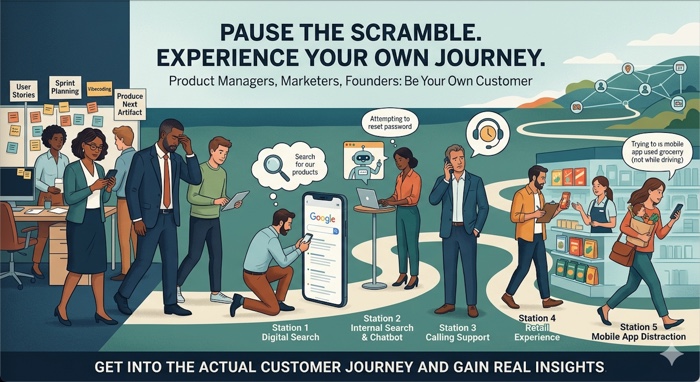
Pause. Stop scrambling to vibecode or crank out the next artifact or user story. Have product managers, marketers, operators, founders, and executives go through their own customer journey end to end. Search for your products the way real customers do, through Search, AI tools, and your own site search. Call your service line. Try the chatbot. Attempt a return. Unsubscribe from your marketing. Reset a password. Check out as a guest. Use the mobile app while distracted and in a hurry. If you sell through retail, walk the aisle, find the shelf, inspect your packaging, compare it with competitors, and see whether the buying experience makes sense in the real world. Ask store personnel questions. Do they recommend you? Are they even familiar with you or the category? Talk to people. Don’t just hire a firm or run a focus group. Or do that too, but put people making product and process decisions directly into the customer journey.
Market data matters. But nothing is more eye-opening than direct experience with your own broken process. All kinds of slop likely crept in over time. Some friction may be unavoidable, especially from legal or regulatory constraints. But some of it is just feature creep or historical artifacts that once had value and now get in the way. There is a special clarity in hitting that friction yourself and instantly asking, “Why would they do that?”
And that’s the critical reminder: you are they.
If you have poor reactions to your own company’s experience, treat it as a signal. It means something was built around internal convenience, legacy assumptions, or organizational blindness rather than customer success. The right response is not to explain it away. It’s to fix it. Yes, it is fair to ask how often it really happens, and yes, costs matter. If it’s truly one in a million, fine, treat it as an exception. Chances are it’s not.
Deeper Issues
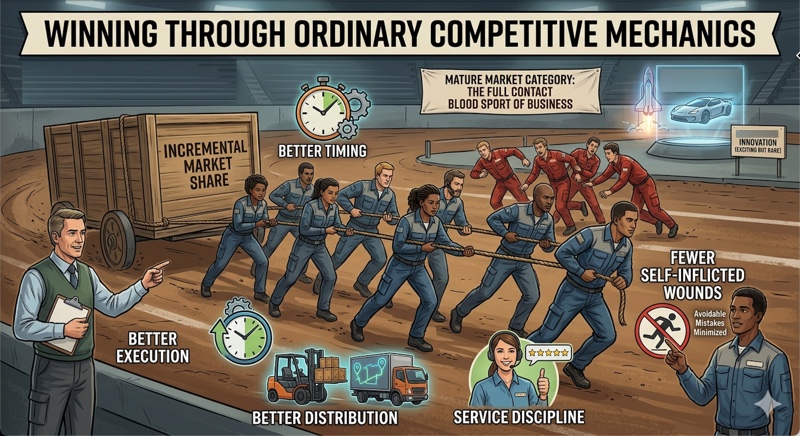
There is a deeper strategic question. Strategists may say being merely “better than” is not a durable strategy, and in the abstract that is often true. I love what Alex MH Smith has to say about these things in both his feed and his book No Bullsh*t Strategy. However, many businesses win for long stretches through ordinary competitive mechanics: better execution, better timing, better distribution, better service discipline, and fewer self-inflicted wounds. That might not be as exciting as brand new product categories and world changing innovation. Yet it can still be enough to defend or take share.
In a market where service quality has deteriorated, being noticeably easier to do business with than the competition can matter. It may not be a permanent moat, but it can be a way to win customers now.
Winners over the next few years may be firms that rediscover operational basics while everyone else is distracted by tooling hype. They will use AI where it genuinely helps, but not confuse automation with service. They will simplify flows instead of multiplying touchpoints, cut unnecessary messaging, put real people where judgment matters, and make routine tasks feel routine again. You may already have seen companies marketing the value of having a real person doing customer service.
Who tends to be best at this? Often, in my experience and likely yours, it is smaller to midsize businesses where an owner, founder, or local operator is still close enough to care when things go wrong. That is not universally true. Some large firms do this well, and some small firms are a disaster. But better experiences often come from places where someone with a stake still has pride in the outcome. That kind of care is less likely in companies where people are working under their desks, (even remotely!), hiding from the AI-optimization axe of the CFO. Which came first, the employee monitoring due to lost loyalty/trust? Or the corporate behavior that destroyed any chance of earning these?
Many of these things surface in a month of bad service logs from just one family. Customers are not just buying products. They are absorbing the operating philosophy of the companies they deal with. When a company treats them like a burden, they notice. When it makes simple tasks unnecessarily hard, they notice. And when a competitor shows up that is more competent, respectful, and less irritating, that becomes a market opportunity.
I want to tell you about my personal favorite definition of branding. There’s a lot of textbook definitions. Sometimes they talk about perception. Sometimes about messaging, or a “brand promise” etc. Here’s mine:
A Brand is a Promise Made Over Time.
It’s everything. It’s every touch point. Every interaction. Every perception. And importantly, it’s over time. It lives on its own and also in an environment with a wide variety of competition. Like any form of reputation, it can take lots of time and work to build into a positive thing, and only moments to damage it. Though perhaps a strong history earns you a second chance.
Right now, even with our supposedly better tools, especially AI, there seems to be a harder-than-ever push for bottom-line gains by squeezing Ops as much as possible. That makes sense in markets facing competition from every angle. And it’s often easier to focus on internal levers than the messier real world. During this squeeze play, it is worth taking care. In the rush to optimize the business, don’t accidentally optimize the customer out of it. The winners may not be the firms with the most automation, but the ones that remember the customer is not the obstacle.
See Also:
- Experience is everything. Get it right. (pwc) from the report… Bad experiences are driving customers away—faster than you think.
- 92 customer service statistics you need to know in 2026
- Contact center trends 2025: The three big shifts shaping customer experience
- AI-Powered Customer Service Fails at Four Times the Rate of Other Tasks
- One Negative Chatbot Experience Drives Away 30% Of Customers
- Understanding consumer reactions to chatbot service failures
- New research reveals an alarming customer experience decline
- Email Industry Data 2025–2026: A Comprehensive Research Report
Appendix: Family Log of Customer Service Fails for March
This was the motivation for this article. It’s not a very exciting section. Besides, you probably don’t need ours. It’s very likely you have your own. It could be we just had a rough month. I may keep the tracking going a couple more months. I think it’s possible we’ve just gotten so used to bad customer service, we don’t even notice; we just deal with it and move on. Hey look, shtuff happens sometimes. We get it. Things aren’t always going to be perfect. That’s life. A lot of this though, seems like “unforced errors” that result from lack of basic attention. Either way, at certain points, it means changes in consumer behavior.
March 24
We got what is perhaps the 15th or more message from our school system about some survey that not enough parents have filled out. We did it on first message just to be done with it. OK, some may take longer. But really, just keep track of who completes and stop this. It can be done and still have anonymous results. How many are opting out or ignoring all messages now? Besides the plethora of utterly useless things they also send. Maybe the school can get away with this because it’s so critical to us. But companies? Anytime there’s a choice?
March 23
Our home mortgage got sold. Again. We got that notice, but no info on where or how we might need to transfer payment. Or how they’ll handle tax escrow. A day later, we got some info about the payment changes. We’ll see about the taxes. Last time it took several calls to sort out. For a process these companies go through all the time. Stunning.
March 23
Funny, even as I try to finish typing this, just 10 feet away, more bad customer service! Some companies, like national brands that have some local retail presence, seem to be optimizing their shipping logistics through private contractor local drop-off. Great. Saves costs and not everything needs to come in a UPS or Amazon truck. But when you use some random person in their 1970s Ford Pinto shows up to deliver something on a rainy day, maybe tell them not to leave it on the wet ground by the garage. It’s just dog food, but I’m not sure how long that package would have held out since it was just the bag. No protective plastic, no shipping invoice. Fine. I’m all for minimal packaging. When we’re both working from home, not a big deal thanks to the door camera alert. Still. Really now?
March 22
Ordered kids’ shoes for next-day pickup but got no confirmation by midday. A human first answered, then disconnected. The phone chatbot was the usual useless loop of order and identity questions and resolved nothing. A later human confirmed the order was in and being processed, and the confirmation finally came. Bottom line: weak human support still worked; the chatbot was mostly infuriating.
March 18
A contractor on a digital product missed a task deadline and then went non-responsive in both the project system and email. We later learned there had been a family issue and got it sorted out. Fair enough, but it was still another avoidable obstacle to manage.
March 15
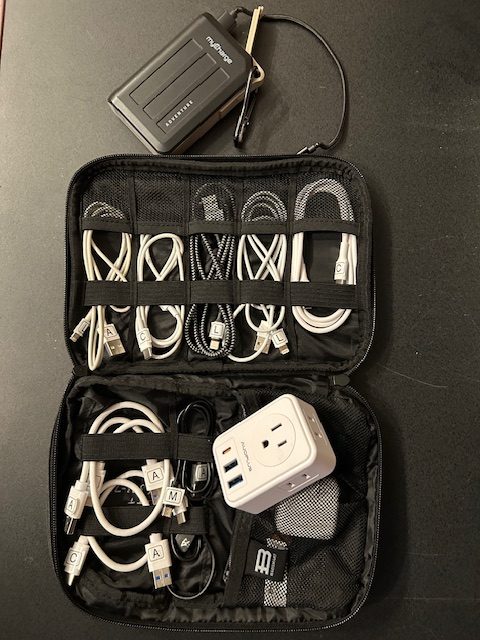
One of our newer iPhones would not charge properly with an older backup charger. Between wattage differences, cable quality, and unclear standards, this stuff is far less obvious than it should be. The question is, did the industry do this on purpose to force us all into needing $100+ worth of cable management? (And yes, I’m this crazy about cable management, and this doesn’t even include my international kit.)
March 11
Our community center where we are paid members advertised a children’s enrichment class, but when we tried to sign up in the app, the cart and purchase flow were unavailable. We will probably call and hear, yet again, that the app is unreliable and everyone knows it.
March 10
With a new health plan, we enrolled in automatic pharmacy service and thought it was confirmed. The postal letter looked like a confirmation, but a small unexplained warning-style icon actually signaled a problem. Later, I got a call that the prescription was ready locally at the old delivery place, which made clear the setup had failed or stalled. I think I sorted it out, but the communication was absurdly unclear.
March 9
As administrator for a family estate account, I called a financial services firm to understand their procedures after a client death. It was hard to even find the right number. I got conflicting guidance, was told to mail paperwork without any clear attention line, got referred to a “Life Events” number that was having technical issues, and then received a callback from someone who had confused me with another caller entirely. A messy process for a delicate situation that should be handled cleanly.
March 6
We are dealing with a relatively minor legal matter. The lawyer seems competent enough, but the follow-up is poor and we often have to push for information. When their paperwork process had issues, I strongly suspect we still paid for the wasted time. We are somewhat trapped until the matter is over, which makes the weak service even more irritating.
March 6
Of all the things to go wrong! Automated backup software stopped working because it needed an upgrade, but there had been no warning at all. There was no obvious in-product way to check version or updates, so customer service email was required. To their credit, support responded within a day and solved it.
March 4
We bought a ski-and-stay package for a discount, but the booking and ticketing flow was split and confusing. The confirmation email linked back to a cart showing full price ski lift tickets, and resolving it required deleting the cart, finding the right link, and entering what was called a “Validation Number,” which was actually labeled a “Confirmation Number” from one specific email, as opposed to an earlier reservation confirmation note. A great phone rep helped us fix it, but the process was a maze. One she knew how to navigate as she’d been through it before. Separately, a child on a Vermont ski pass can only reserve within a week, even though parents may need to buy lodging and tickets earlier, creating a ridiculous risk that the family commits money to a reservation in advance, but the child’s desired ticket date(s) may be blocked when you go to sign up at the required time.
March 4
Mac Optimization Software
I bought an additional license for a second machine, but the unlock process insisted I only had one license. When I tried to contact support through the website, the submission flow stalled after I had already written out the issue. I left the tab open and, about 30 minutes later, was finally able to submit it. (Not yet resolved though.)
March 2
Our snowblower engine may be dying, so I brought it to a local repair shop after trying the basic consumer fixes myself. They have had it for weeks, missed at least one snowstorm window, and have been poor about answering or returning calls. Each in-person visit produces vague updates but no clear resolution. At this point, the repair may become more costly simply because of all the trial-and-error.