Quick History and Value
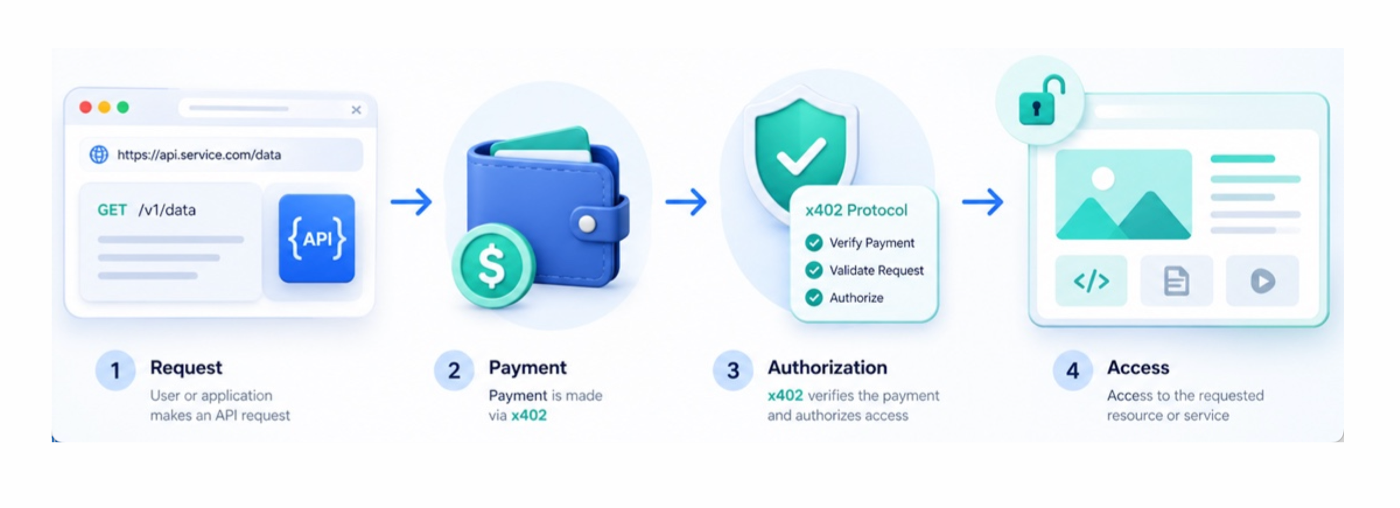
The web was built to move information quickly, but not value. A page can load in milliseconds, yet payment usually happens somewhere else: through a checkout page, account or subscription. This separation still shapes how digital access is sold. Even when the product is fully online, the payment flow often feels added on top of the web rather than built into it. That separation is finally ending. x402 turns the long-dormant HTTP 402 ‘Payment Required’ status into a native, instant payment layer, letting AI agents and apps pay per request in stablecoins without accounts, logins, or manual steps.”
x402 tries to close that gap by making payment part of the HTTP request itself. When access requires payment, a server can return payment details instead of sending the user or application into a separate billing flow. The client pays, repeats the request and receives the resource. In simple terms, x402 turns payment into part of the same request-response pattern that already powers the web.
Now for the deeper story…
Why Small Payments Need a Different Logic
A payment flow is not only the moment when someone clicks “Pay.” Before access opens, the service has to understand what exactly is being sold and whether the payment gives the user the right to receive it. After that, the business still needs a record of what happened. That is why payment is also a system of control.
This model works well when the purchase is large enough to justify the process. A $100 order, a SaaS subscription or a longer service contract can absorb the extra steps around payment. The model becomes less natural when the paid action is much smaller. In those cases, the process around the payment can become heavier than the purchase itself. The issue is not that card payments are broken. They were simply designed for a different type of online behavior.
Payments are becoming part of how software operates, not just how people transact. As AI systems take over more decision-making tasks, there’s an increasing need for payment at the point of use. x402 helps solve that problem by enabling services to be billed just-in-time, rather than requiring pre-payments or post-billing.
What x402 Changes in the Payment Flow
x402 changes the way a paid request is handled. The server does not have to guess whether the client has permission to access the resource. It can return a clear payment requirement through the HTTP 402 response. The client then pays, attaches proof of that payment and sends the request again. If the proof is accepted, the resource becomes available.
The important shift is that payment starts to work like a condition for access. A service can price a specific request instead of forcing everything into a larger plan or account structure. If the payment is confirmed, the service can unlock that exact request and nothing more.
This transforms payment for data, models, and APIs. Instead of fixed contracts or subscriptions, usage becomes immediate and measurable. Understanding how this works is key to assessing where it fits in modern financial and technical systems. If you’re thinking you’ve maybe heard the number or term 402 or wondered if that’s like the 404 not found http responses, you’re not far off. It might be of interest to take another look at the history here. x402 is not brand new. It was fundamentally built around the HTTP 402 “Payment Required” status code. It revives and standardizes this long-dormant HTTP status (defined in RFC 7231 but rarely used before) to make payments a native part of the web request-response cycle. It’s arguably fair to say that it was an unused part of early internet protocols and that if it had been implemented, there might never have been as much early free content.
Without an easy, low-friction native payment mechanism, early web creators and publishers turned to advertising, (the dominant model that made most content “free”), Subscriptions / paywalls (later, when scale allowed), and Freemium + data collection. Many analysts and retroactive discussions note that the lack of built-in micropayments helped entrench the “everything is free, funded by ads” model that defined the early web.
Micropayments were tried repeatedly, but they struggled. Early attempts (e.g., Cybercoin, various 1990s schemes) failed partly because there was no protocol-level support, transaction fees were too high, and user friction was massive. A working 402 standard might have accelerated better solutions earlier. Maybe. Even with 402 in action, practical barriers would have remained. There were no mature digital cash or stable low-fee rails (credit cards have high fees and chargebacks that kill true micropayments), and then there’s human psychology. People hate paying small amounts repeatedly (“penny shaving” aversion).
So the absence of a working payment layer definitely contributed to the explosion of free/ad-supported content, but it wasn’t the only reason.
x402 is essentially activating the original vision now that the missing pieces (stablecoins, fast/cheap blockchains, AI agents) exist. It shows the early designers were prescient, however, they just anticipated the infrastructure would arrive sooner.
More On What x402 Is and How It Works
While x402 can be used by people doing transactions and using wallets, we’re likely going to see heavier volume in automated transactions. Traditional payment systems were built for people and finance teams, not software acting on its own. They depend on accounts, billing cycles, and approvals that slow down anything that needs instant access. As mentioned, the HTTP 402 “Payment Required” feature has been in the spec since the late 1990s. The designers (including Tim Berners-Lee’s team) explicitly reserved it for digital cash or micropayment systems. It was a forward-looking placeholder for native, per-request payments on the web. However, it was effectively “left out” in practice. There was no standard implementation, no browser or server conventions, and it was marked “reserved for future use.” For ~30 years it sat dormant while the web exploded.
Getting back to today and a likely soon tomorrow then, people can use this feature interacting with x402 using a crypto wallet (e.g., Coinbase Wallet, MetaMask) that supports the required chains (primarily Base, Solana, Arbitrum). This requires no account creation or subscriptions on the service side, just a funded wallet. It could be used for pay-per-use or paywall billing. Still, there would be friction in using the wallet, signing transactions and so on. We’re more likely to see this protocol being heavily used for agent and AI workflows where payments are needed.
An AI agent pulling a single market data point or running a one-off compliance check cannot wait for contracts or monthly invoices. This creates delays, wasted spend on unused subscriptions, and wider security exposure through shared credentials.
x402 replaces that structure with a direct, per-use payment model built into HTTP. When a paid resource is requested, the server responds with a 402 status and payment details such as price, token, network, and deposit address.
The client pays, then retries the request with proof. Stripe’s implementation shows this clearly. A PaymentIntent generates a USDC deposit address on networks like Base, and once funds arrive on-chain, the payment is confirmed, and the request completes without manual steps.
Behind the scenes, the flow follows a simple cycle. The server defines pricing, creates a payment request, and returns it. The client sends funds on-chain, and a facilitator, which is a service that handles on-chain verification, monitors the transaction, and confirms settlement. Once verified, access is granted. This setup removes subscriptions and replaces them with precise, on-demand payments that match how modern systems operate.
Why AI Agents Make This More Relevant
AI agents show why this payment model matters. A person can create an account, add a card, choose a plan and wait for access. An automated system needs something simpler. If it has to complete a task, it needs to see the price, make the payment and continue without a manual step in the middle.
That is why x402 fits use cases where access is narrow and paid only when needed. The service does not have to sell a full subscription if the actual demand is much smaller. It can charge for one useful action at a time.
This model is especially relevant for:
- one paid data check;
- one generated report;
- one scraping or extraction request;
- one agent tool call.
Early real-world adoption of x402 is already appearing in AI agent and machine-to-machine workflows. AI agents use it to pay per query for blockchain analytics from Nansen, high-quality web search results from Exa, and model inference from providers like Hyperbolic and Nous Research. Compliance agents perform on-demand wallet risk checks via Circle-integrated services, while content platforms experiment with per-article or per-crawl micropayments. These implementations demonstrate x402 enabling narrow, just-in-time access to data, compute, and tools without subscriptions or manual approvals.
The bigger point is that software is becoming a buyer of digital services. When that happens, payments need to work in smaller units. x402 is one attempt to make that possible inside the normal flow of a web request.
Why x402 Matters for Financial Services and AI Systems
AI systems can analyze markets, run models, and make decisions, but they still depend on humans to complete payments. That gap slows everything down. x402 closes it by letting agents pay for services directly, turning them into full participants in financial workflows rather than partial ones.
This shift changes how systems operate in practice. A trading agent can pull real-time market data and pay a few cents per request instead of relying on fixed subscriptions. In lending, agents can query credit or risk models only when needed, reducing waste.
Insurance workflows benefit in the same way, where pricing or risk data is accessed per case, not through broad vendor contracts. Services become modular, and agents can choose between providers based on price or accuracy in real time.
The economic impact is just as clear. Payments in stablecoins like USDC take seconds to process on chains like Base and Solana, with low fees. This enables small and regular payments, which are inefficient on legacy payment rails. Developers no longer have to sign large contracts. Usage aligns with demand, and costs scale naturally with activity.
There is also a strong audit trail built into the system. Each payment is recorded on-chain and tied to a specific request. Firms can track usage, verify transactions, and meet regulatory expectations without relying on fragmented billing records. This level of visibility fits well with financial services, where traceability and control are part of daily operations.
By early 2026, it had facilitated over 119 million transactions on Base and 35 million on Solana with an annualized value of around $600 million. The x402 Foundation, established in September 2025 by Coinbase and Cloudflare, oversees the protocol.
Google, Visa, Amazon Web Services (AWS), Circle, Cloudflare, and Coinbase are among its members, illustrating that interest here is not limited to crypto-focused companies but also extends to mainstream tech and financial companies.
Evaluating x402 in Practice: Infrastructure and Use Cases
x402 moves from concept to value when it fits cleanly into real systems. That means looking at how agents pay, how providers charge, and how both sides operate at scale.
Agent Side: Payment-Capable AI Systems
On the agent side, the setup is straightforward but needs discipline. An agent sends a request, reads a 402 response, pays in USDC, then retries with proof. Frameworks such as Amazon Bedrock AgentCore or Coinbase AgentKit can handle this flow using simple middleware.
The harder part is security and control. Wallet keys need strong protection, often through Hardware Security Module (HSM)-backed storage. Agents also track usage, budgets, and sessions so finance teams can see what is being spent and why. Some firms centralize payments through one service, while others let each agent manage its own wallet.
Provider Side: Monetizing Data and Services
For providers, x402 turns existing APIs into paid endpoints without a rebuild. A service can return a 402 response for selected routes, generate a unique deposit address via a facilitator, and release data once payment has cleared. This works with standard cloud setups like CloudFront and Lambda@Edge.
The model fits data vendors well. A risk API can charge a few cents per call instead of locking clients into contracts. This lowers entry barriers for new users and scales naturally with demand, from small trials to heavy institutional usage.
How x402 Fits Into Real Systems
x402 reframes payments as a native part of digital interaction rather than a separate process. By embedding payment logic into standard HTTP flows, it removes the delays and rigid structures that hold back automated systems. Agents no longer stop at the point of payment. They complete tasks end-to-end, from decision to execution, without waiting on human input.
For financial institutions, this creates a cleaner operating model. Costs track actual usage, access to data becomes immediate, and every transaction leaves a clear, verifiable record. Providers also gain flexibility, offering services in smaller units without complex contracts or billing layers.
Adoption still depends on strong implementation. Proper key management, governance, and infrastructure are vital to seeing if the system can stand up in practice. When this is in place, x402 enables faster and more transparent value transfer across digital services.
Is x402 Actually Scaling Yet?
The idea behind x402 is easy to like, but scale is a separate question. A protocol can attract attention, get strong partners and still remain early in real usage. That is why x402 should be judged from two sides: who is backing it and how much actual demand it is showing.
Market Interest Is Ahead of Real Usage
x402 is no longer just a Coinbase experiment. In April 2026, the Linux Foundation launched the x402 Foundation and accepted Coinbase’s contribution of the protocol. That matters because it moves x402 toward a more neutral governance model and gives the standard more credibility outside the crypto-native circle. The early supporter list features major names from payments, cloud infrastructure and web services, including Stripe, Adyen, AWS, Google, Mastercard, Visa and Shopify.

x402 monthly transaction activity. Source: Dune
Still, industry support is not the same as real payment demand. Dune data shows that x402 monthly transactions peaked at about 27.2 million in November 2025. By March 2026, that figure had fallen to around 3.5 million. An OKX Ventures report cited by BlockBeats also warned that part of x402 activity may have been inflated, which means raw transaction counts can overstate organic demand.
This does not make x402 irrelevant. It simply shows that the protocol is still early. The infrastructure story is strong, but the demand side is not fully proven yet. Many AI agents still rely on normal API keys, subscriptions or human-approved workflows. For x402 to scale beyond experiments, more services need to expose paid endpoints that agents and developers actually want to use.
Where x402 Fits Best
x402 makes the most sense in places where the product is already digital, narrow and easy to measure. It is less convincing for large consumer purchases, where users still expect familiar checkout pages, refunds, support and payment protections. Its stronger use case is different: paid access to small units of software, data or compute.
That is why adoption will depend on more than the protocol itself. Developers need simple tooling, services need clear pricing, and users or agents need enough valuable endpoints to justify using it. Without that supply, x402 remains mostly infrastructure. With it, the protocol can become a practical layer for paid digital access.