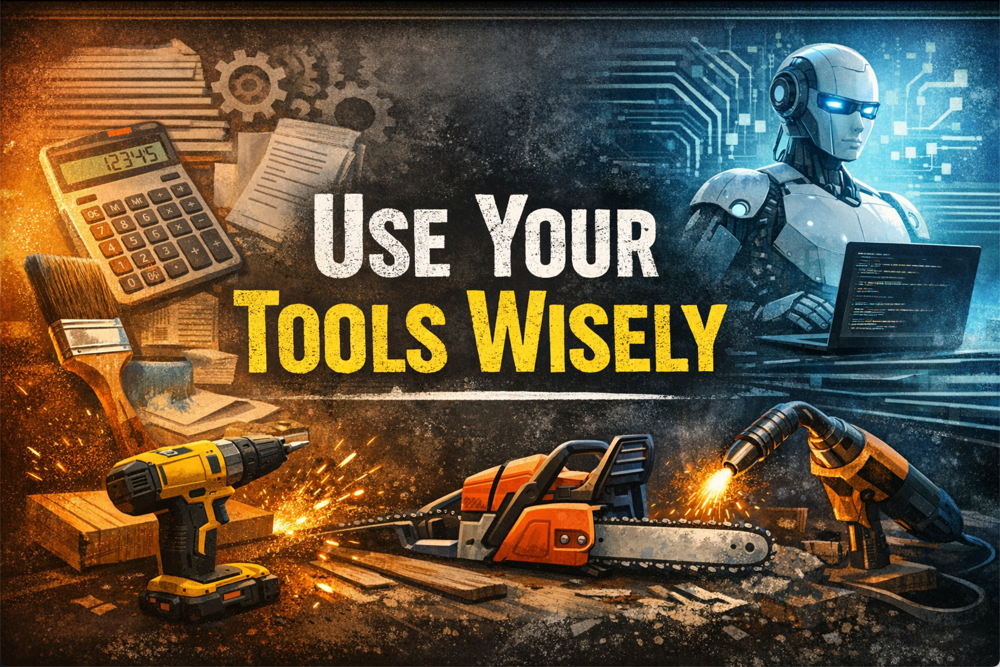
This isn’t about a contest about what cohort is more or less valuable. It’s an exploration into different types of skillsets and some of what’s been going on lately with AI.
Let’s run a thought experiment about workers in general and ageism in particular. With all the talk of AI displacement, I keep wondering if there’s a less dystopian view. A lot of roles may change or vanish, but we could also see growth in niche areas. And maybe the loud claim that “we won’t need so many people” turns out to be overstated. If so, do deep skills and hard-earned judgment become more valuable, not less?
All of a sudden, some who shed too much staff, (and as is often the case, the wrong people), need to hire at least some back. Meanwhile, the nature of expertise changes such that “older” workers, wherever you want to draw that line, turn out to have a lot more value because a) the smarter machines are amazing, but turn out to still have limits, and b) AI may hollow out some early-career task bundles, and that can raise the relative value of people who can frame problems, validate outputs, and take responsibility for outcomes. I’m a huge fan of the latest AI tools and a frequent user of multiple models, several bots and agentic workflows. I’m fully buzzword compliant! And yet, in spite of the dire warnings of the viral Shumer post “Something Big Is Happening“, there may be a still be a place for talented and experienced humans. See Joe Procopio’s “It Turns Out, AI Agents Suck At Replacing White-Collar Workers” for one of many examples.
Some companies who claim they’ve cut staff thanks to AI may discover they cut too deep, losing exactly the people they really need. Meanwhile, expertise may be repriced. AI is impressive, but has limits, and it can hollow out early-career task bundles. That raises the value of people who can frame problems, validate outputs, and own outcomes. I’m a heavy user of modern AI tools and workflows, yet even with the “Something Big Is Happening” hype, there still seems to be plenty of room for talented, experienced humans See Joe Procopio’s “It Turns Out, AI Agents Suck At Replacing White-Collar Workers” for one of many examples.
Maybe this sounds naïve, but perhaps multiple cohorts will remain valuable, just in different ways. Through it’s looking to be a rocky transition. Yes, Skynet could wake up next week, but there’s also a world where things mostly work out fine. I know I’m supposed to say “if you’re not using AI in the shower, you’re doing it wrong.” I’ll work on the clickbait. For now, let’s talk about what’s actually changing.
Kids These Days
They’re often far more fluent with modern tools than we were, and they’ve grown up swimming in information; more volume, more variety, better teaching methods. But by definition, most early-career workers have limited lived experience. They may have had a few jobs in high school and college, maybe even a small side hustle, but the rest has been school, hobbies, and a first job or two.

They may also have less intuition than older cohorts did at the same age, not because they’re incapable, but because so much is abstracted away. More services handle more of life, reducing cognitive load in ways that can erode “practice-based” skills (navigation via GPS is the cliché example). Sol Rashidi calls this “Intellectual Atrophy™.” Even if that term is AI-focused, the broader pattern predates LLMs. And yet, younger workers can be astonishingly capable especially in tech while still missing some “common sense” that usually comes from scar tissue plus environment.
[Read more…]