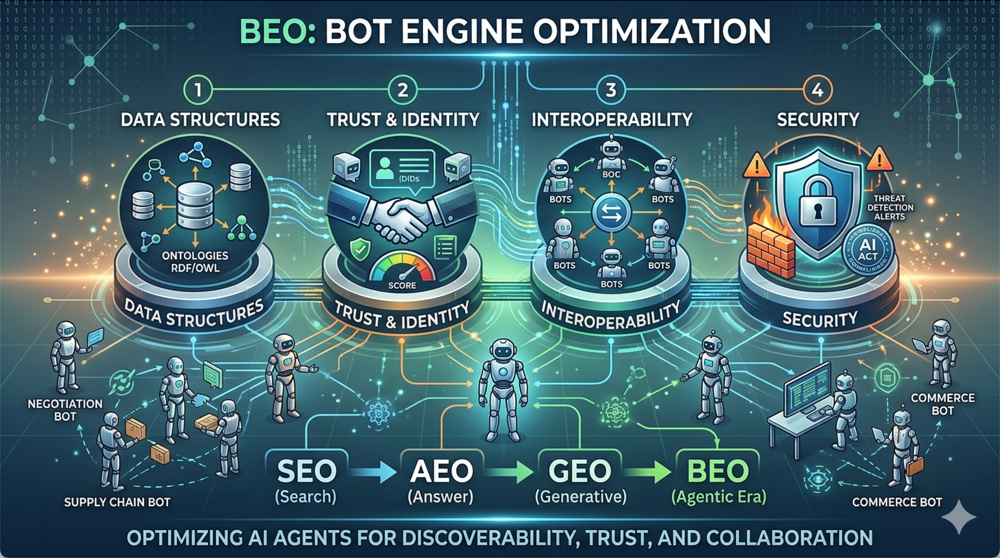
Most people discussing agent optimization are talking about basic visibility or commerce mechanics. I’d like to go deeper: data structures, trust, identity, interoperability, and security. I’m not sorry about trying to coin the term BEO. Except, as it turns out after a search, I’m maybe a month or so from not being first with this, (so close!). Though I’d like to extend the concept anyway, based on my own experience building and what I’ve been seeing.
We shouldn’t use AEO, for “agent”, because that’s taken. We need something new because as we all know if there’s no acronym, it really can’t be a technology. And wouldn’t it be nice to have unambiguous names? I mean, “DaaS” can apparently be “Data as a Service” or “Desktop as a Service” and we have plenty of other ambiguous mess. We should try to do better with our naming. Why Bot Engines now? We’ve trudged through the cave-dwelling ancient history of Search Engine Optimization (SEO), evolved into Answer Engine Optimization (AEO), and now we’re managing Generative Engine Optimization (GEO). So, naturally, we need something fresh. I’d like to try out BEO for the win as an idea. It’s the art and science of tuning bots, agents, and autonomous systems to thrive in interconnected digital ecosystems; optimizing them not just for performance, but for discoverability, interoperability, and trustworthiness in a world where machines negotiate, transact, and collaborate on our behalf.
It’s SEO, (though much more), for the agentic era. Just as websites compete for search visibility, bots will need to stand out in marketplaces, integrate with protocols, and build reputations.
[Read more…]