TetraMesa

  • About Us
  • Services
  • Clients
  • Contact
  • Blog

BEO – Bot Engine Optimization

March 12, 2026 By Scott

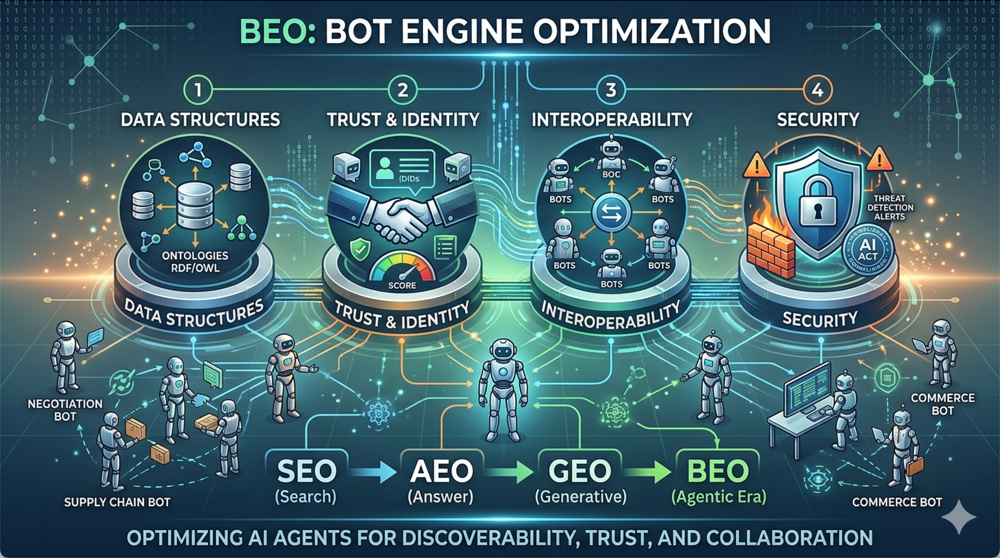
Most people discussing agent optimization are talking about basic visibility or commerce mechanics. I’d like to go deeper: data structures, trust, identity, interoperability, and security. I’m not sorry about trying to coin the term BEO. Except, as it turns out after a search, I’m maybe a month or so from not being first with this, (so close!). Though I’d like to extend the concept anyway, based on my own experience building and what I’ve been seeing.

We shouldn’t use AEO, for “agent”, because that’s taken. We need something new because as we all know if there’s no acronym, it really can’t be a technology. And wouldn’t it be nice to have unambiguous names? I mean, “DaaS” can apparently be “Data as a Service” or “Desktop as a Service” and we have plenty of other ambiguous mess. We should try to do better with our naming. Why Bot Engines now? We’ve trudged through the cave-dwelling ancient history of Search Engine Optimization (SEO), evolved into Answer Engine Optimization (AEO), and now we’re managing Generative Engine Optimization (GEO). So, naturally, we need something fresh. I’d like to try out BEO for the win as an idea. It’s the art and science of tuning bots, agents, and autonomous systems to thrive in interconnected digital ecosystems; optimizing them not just for performance, but for discoverability, interoperability, and trustworthiness in a world where machines negotiate, transact, and collaborate on our behalf.

It’s SEO, (though much more), for the agentic era. Just as websites compete for search visibility, bots will need to stand out in marketplaces, integrate with protocols, and build reputations.

[Read more…]

Filed Under: Marketing, Product Management, Tech / Business / General

Claude Skills for Baseline Competitive Analysis

March 3, 2026 By Scott

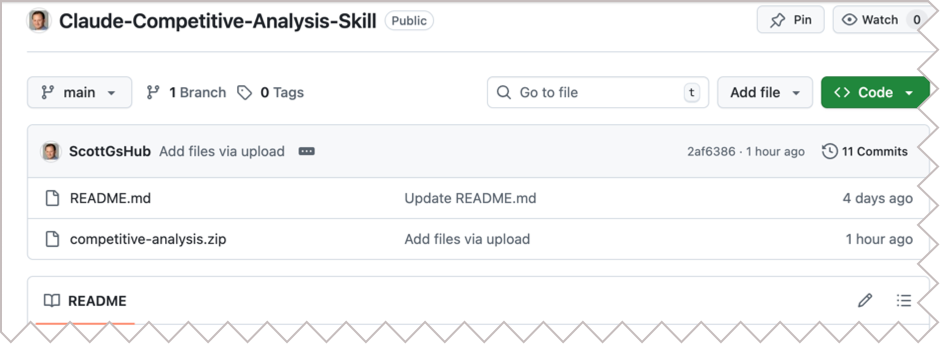
The following goes over a fast way to get a jumpstart on a basic competitive analysis using Claude.ai along with the increasingly popular Skill function, complete with a slide deck and an Excel workbook. Spoiler Alert: Just skip down to “How to Install…” if you want to skip the explanations.

The catch: AI can accelerate the first draft, but it can’t replace judgment. Treat the output as a structured hypotheses, not truth. You’ll still need to validate claims, metrics, and positioning with primary sources and customer reality.

  • Understanding Your Own Work: When doing strategic analysis, I believe part of understanding is in doing some of the discovery yourself. As great as AI is, it’s increasingly clear we sometimes lose at least a little something when we just have all the work done for us. That being said, the tools can help us get a big jump on things as a starting place.
  • About Claude Skills: Claude.ai from Anthropic is one of many AI tools we have for generative language tasks. All these tools are bulking up with everything from training models, to agent tools collecting data, project organization and more. “Skills” are structured instruction files that shape how an AI behaves. It’s like an operating runbook for an assistant. They’re especially helpful for repetitive tasks.
[Read more…]

Filed Under: Marketing, Product Management, Tech / Business / General

Are Boomer & GenX Workers About to be More Valuable?

February 19, 2026 By Scott

This isn’t about a contest about what cohort is more or less valuable. It’s an exploration into different types of skillsets and some of what’s been going on lately with AI.

Let’s run a thought experiment about workers in general and ageism in particular. With all the talk of AI displacement, I keep wondering if there’s a less dystopian view. A lot of roles may change or vanish, but we could also see growth in niche areas. And maybe the loud claim that “we won’t need so many people” turns out to be overstated. If so, do deep skills and hard-earned judgment become more valuable, not less?

All of a sudden, some who shed too much staff, (and as is often the case, the wrong people), need to hire at least some back. Meanwhile, the nature of expertise changes such that “older” workers, wherever you want to draw that line, turn out to have a lot more value because a) the smarter machines are amazing, but turn out to still have limits, and b) AI may hollow out some early-career task bundles, and that can raise the relative value of people who can frame problems, validate outputs, and take responsibility for outcomes. I’m a huge fan of the latest AI tools and a frequent user of multiple models, several bots and agentic workflows. I’m fully buzzword compliant! And yet, in spite of the dire warnings of the viral Shumer post “Something Big Is Happening“, there may be a still be a place for talented and experienced humans. See Joe Procopio’s “It Turns Out, AI Agents Suck At Replacing White-Collar Workers” for one of many examples.

Some companies who claim they’ve cut staff thanks to AI may discover they cut too deep, losing exactly the people they really need. Meanwhile, expertise may be repriced. AI is impressive, but has limits, and it can hollow out early-career task bundles. That raises the value of people who can frame problems, validate outputs, and own outcomes. I’m a heavy user of modern AI tools and workflows, yet even with the “Something Big Is Happening” hype, there still seems to be plenty of room for talented, experienced humans See Joe Procopio’s “It Turns Out, AI Agents Suck At Replacing White-Collar Workers” for one of many examples.

Maybe this sounds naïve, but perhaps multiple cohorts will remain valuable, just in different ways. Through it’s looking to be a rocky transition. Yes, Skynet could wake up next week, but there’s also a world where things mostly work out fine. I know I’m supposed to say “if you’re not using AI in the shower, you’re doing it wrong.” I’ll work on the clickbait. For now, let’s talk about what’s actually changing.

Kids These Days

They’re often far more fluent with modern tools than we were, and they’ve grown up swimming in information; more volume, more variety, better teaching methods. But by definition, most early-career workers have limited lived experience. They may have had a few jobs in high school and college, maybe even a small side hustle, but the rest has been school, hobbies, and a first job or two.

They may also have less intuition than older cohorts did at the same age, not because they’re incapable, but because so much is abstracted away. More services handle more of life, reducing cognitive load in ways that can erode “practice-based” skills (navigation via GPS is the cliché example). Sol Rashidi calls this “Intellectual Atrophy™.” Even if that term is AI-focused, the broader pattern predates LLMs. And yet, younger workers can be astonishingly capable especially in tech while still missing some “common sense” that usually comes from scar tissue plus environment.

[Read more…]

Filed Under: Marketing, Product Management, Tech / Business / General, UI / UX

Identity Phonership – You, Yourcellf

December 15, 2025 By Scott

First off, apologies for the bad puns in the headline. I am a dad though. So bad dad puns just come with the territory. Here, I saw a chance for a double, so had to take it.

Today it’s time to discuss some pros, cons, risks, and mitigations for the reality that our cellphones have accidentally become our gatekeepers to all manner of things digital. And often physical as well. You likely already know how integrated, (and dependent), a lot of digital activities have become on our mobile devices. But how? And what might this mean? Smartphones as identity gatekeepers has been discussed before. However, what we’re experiencing now in the mid 2020s is arguably a new level.

How did our cell phone companies become the gatekeepers of our identities?

How many things now push for multi-factor authentication via our smartphones? There’s products where it seems if you don’t have a smartphone, you’re simply not going to be able to participate. How might this play out? Do phone companies know about this? Of course. Will they try to exploit this role to just extract more fees given they’re arguably in strategically poor commodity businesses with competitive margin pressure?

Phones are no longer just credentials; they’re becoming identity custodians. Security is often thought of as three things: What you have, (such as debit card), what you know, (PIN code), and what you are, (biometrics.) With our phones we seem to have shifted from just something you have to the thing that vouches for everything else.

Recovery, coercion, or loss were not first-class design considerations.

[Read more…]

Filed Under: Marketing, Product Management, Tech / Business / General, UI / UX

Your Outage Risk Feels Less Black Swanny

November 18, 2025 By Scott

I’ve spent some time the past year on an important project, potentially life-saving for many. But if the site went down for a few hours or even a day, no one would die immediately. Maybe some revenue loss, but nothing catastrophic. What about yours? Is it mission or safety critical? Or doing so much business that a half a day is millions in loss? Not to mention the customer service issues?

Major digital outages keep happening. The Internet was designed to survive nuclear war, yet we’ve layered on centralization that increases failure risk. And it seems to be getting worse as new inflection points pile up.

[Read more…]

Filed Under: Marketing, Product Management, Tech / Business / General

Product Lessons from DeFi’s Rise

November 6, 2025 By Scott

If you follow crypto, you’ve likely noticed the rise in DeFi activity the past several months. As Traditional Finance (TradFi) evolves and co-opts parts of crypto, we’re seeing emergence of a hybrid model called Centralized Finance (CeFi) and watching what may be an inflection year. Every year seems like “the year of SOMEthing,” but with trillions finding new pathways, it seems a fair statement now. Growth of Decentralized Finance (DeFi) despite easier Central Exchange (CEX) options is telling. DeFi remains difficult and risky. Yet it’s growing as percentage of crypto activity. Some of this may be episodic, but it reveals a deeper signal about marketplace pain points: users will endure hardship just to escape worse systems. It’s a story of value over comfort, like drivers taking a pothole-filled detour to avoid a toll road they no longer trust, but there’s someplace they’ve just got to go.

[Read more…]

Filed Under: Marketing, Product Management, Tech / Business / General, UI / UX

Will RWA Tokenization Growth Increase Systemic Risk?

October 15, 2025 By Scott

As a product person and retail investor, I’m sensing what I would have thought is an obvious risk with Real World Assets (RWA) tokenization, but don’t see much discussion beyond esoteric finance venues. I’m a believer in blockchain and crypto opportunities. However, I prefer a more thoughtful approach than the breathless crypto maxi hype spew. With that perspective, I’d like to offer a primer for product managers and investors interested in this area. I’m trying for a deeper sense of what’s going on than, “The RWA Tokens Are Coming, Invest Before You Miss It!” Or as Darth Crypto would say, “The FOMO is Strong with This One.” Disclaimer: I’m not a finance person… these are my explorations into this world as a retail investor and digital product builder. I’d just like to help my friends and colleagues with informed choices.

[Read more…]

Filed Under: Marketing, Product Management, Tech / Business / General

How to Capture Sales / Margin by Just Being Less Bad

October 7, 2025 By Scott

Maybe it was back-to-school season or random, but in my family we’ve recently switched multiple brands, vendors, and products for reasons from quality to service to pricing. Each move had friction: annoying phone calls, returns, learning new systems. How bad does something have to be to push customers past switching cost barriers to seek alternatives? Although I’m coming from a consumer perspective with this, it all applies to B2B as well.

I’ve shared my perspective on brand loyalty before. This is now about how average or bad is more frequent. For consumers, it’s frustrating. For product leaders, an opportunity. While quality is subjective, evidence shows decline (or at least perception of decline) recently in product and service quality. Forrester’s 2024 US Customer Experience Index reports quality among brands in the U.S. is at an all-time low, declining for a third consecutive year. Then we have The American Customer Satisfaction Index (ACSI) reporting U.S. overall customer satisfaction dropping for three consecutive quarters.

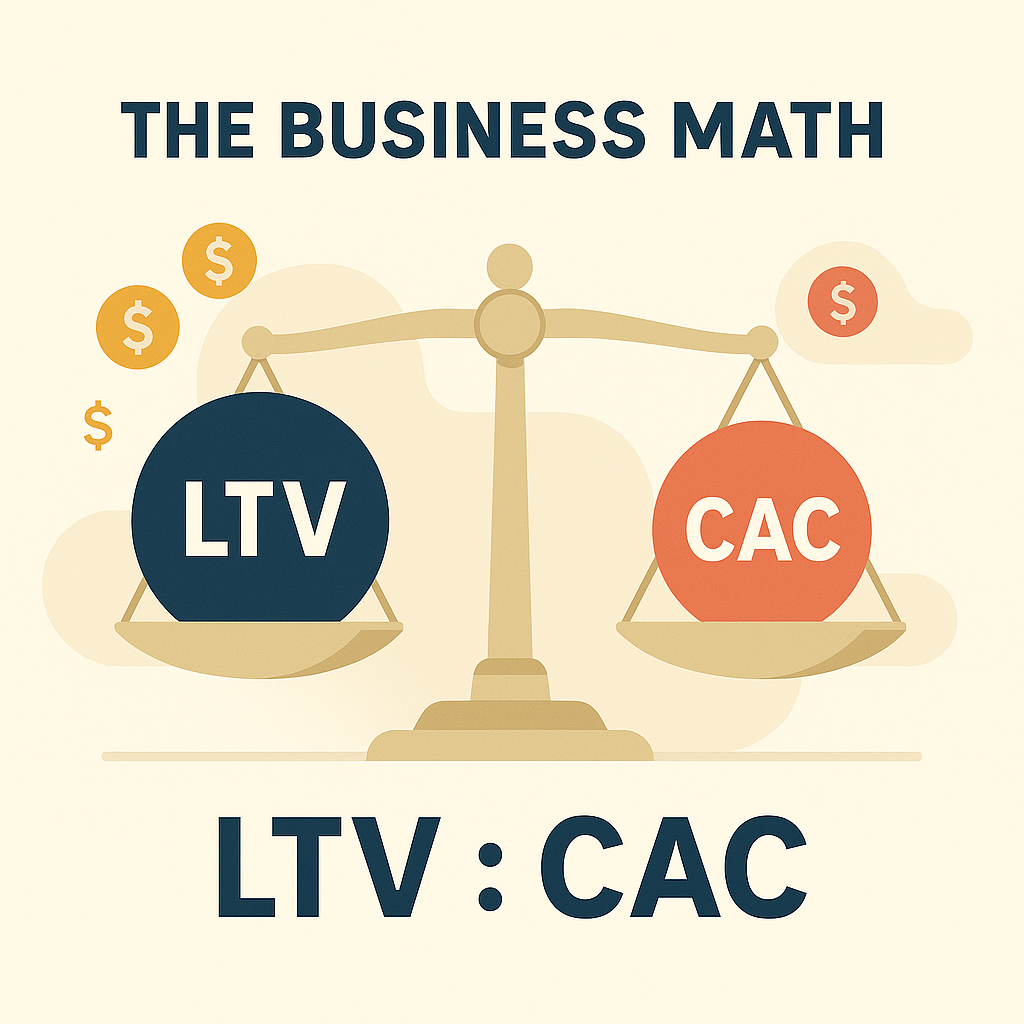
What’s behind this? Execs in the Know suggests cost cutting, bad customer service bots and lack of focus on customer satisfaction. One fundamental business ratio is Lifetime Value of Customer (LTV) and Customer Acquisition Costs (CAC). Leaving aside operating costs and understanding there are variations by industry… For the LTV:CAC ratio, at 1:1 you’re breaking even, 3:1 you’re likely healthy. Below 2:1 chances are you have thin margins and below 1:1 you’re losing money. LTV:CAC is a lagging indicator because churn and retention metrics might take awhile to show.

It’s one thing to have customers you erroneously think might be happy. It’s another to have some that can’t stand you and switching cost is the only thing barely keeping them with you.

[Read more…]

Filed Under: Marketing, Product Management

PM Perspective: Is AI a Great Business?

August 12, 2025 By Scott

Introduction

Short Answer? Maybe not so much. (At least when talking about the core tech vs. specialized solutions.) This won’t be as much about AI as about category and startup creation in general. AI just happens to provide us with a great developing case to review. (At least in terms of Large Language Models (LLMs) and Generative Pre-trained Transformer (GPT) products.)

Product people need to zoom in and out. There’s so much noise around new AI features, we may forget to take a wider view. While we’re often responsible for detailed product roadmaps, some of us also do strategy and business planning. In that role, we need to think about offerings in terms of long term strategy. Rapid growth in AI LLMs / GPTs provides a case worth study in terms of new category creation. We should keep in mind that AI / ML has been around for decades. What’s interesting now is the LLM / GPT space is a great example of a Blue Ocean strategy that is perhaps only fulfilling its promise in a general way. That is, the rising tide is lifting many boats, but early pioneers might not be able to take margin advantaged positions, which should be a benefit in a new category. (If you buy the book, be sure to get the latest edition.) Even though OpenAI bust this category open, they didn’t get to a winner-take-all or even winner-take-most position.

Why?

[Read more…]

Filed Under: Marketing, Product Management, Tech / Business / General

GPTs and LLMs from a User Use Case Perspective

July 25, 2025 By Scott

Companies are missing the mark with AI projects. The headlines are not great.

  • Gartner Predicts 30% of Generative AI Projects Will Be Abandoned After Proof of Concept By End of 2025
  • Research by the RAND Corporation estimates more than 80% of AI projects fail, which is twice the rate of failure of non-AI projects.
  • Deloitte shows some benefits accruing such as uncovering ideas and insights with ROI generally positive, and yet, barriers due to mistakes with real-world consequences.
  • BCG’s 2025 survey indicates only “25% of executives are seeing significant value from AI”, with projects vulnerable due to unclear use cases and poor data readiness.

What’s going on? And more to the point; can product people help improve these outcomes?

Perhaps there are efforts to solve tech problems, but not always customer problems. From a Product person’s perspective, it’s time to re-visit basics and use cases. In the add AI scramble, there’s confusion about our shiny new toys. You see it in the drive to do anything with them. You see ridiculous job requirements posted from tech to product asking 5 – 10 years experience deploying AI. (For traditional ML, that may be fair. But they usually mean GPTs/LLMs, which have only been around a handful of years.)

Let’s reconsider our new capabilities from customer use case perspectives with focus on LLMs/GPTs. While also growing, we’ll skip traditional ML as it’s a separate and better understood category. (Things like regression models, decision trees, or clustering algorithms used in fields like finance, logistics, or medical diagnostics, which have established frameworks and decades of practical application.)

Why should we try a look from use case perspectives? Because for those of us that work in Product, instead of panicking figuring out how to check off the “We’re doing AI” into a checkbox in an Annual Report or a marketing piece, it might be useful to have clarity of purpose. We’ll focus on Generative Pre-trained Transformers (GPTs) and the Large Language Models (LLMs) over traditional ML or multi-modal GPTs.

[Read more…]

Filed Under: Marketing, Product Management, Tech / Business / General

  • 1
  • 2
  • 3
  • Next Page »

Recent Posts

  • BEO – Bot Engine Optimization
  • Claude Skills for Baseline Competitive Analysis
  • Hidden Stablecoin Trade-Offs
  • Are Boomer & GenX Workers About to be More Valuable?
  • Maintaining Healthy Cognition Living With AI

Categories

  • Analytics
  • Book Review
  • Crypto
  • Marketing
  • Product Management
  • Tech / Business / General
  • Travel
  • UI / UX
  • Uncategorized

Location

We're located in Stamford, CT, "The City that Works." Most of our in person engagement Clients are located in the metro NYC area in either New York City, Westchester or Fairfield Counties, as well as Los Angeles and San Francisco. We do off site work for a variety of Clients as well.

Have a Project?

If you have a project you would like to discuss, just get in touch via our Contact Form.

Connect

As a small consultancy, we spend more time with our Clients' social media than our own. If you would like to keep up with us the rare times we have something important enough to say via social media, feel free to follow our accounts.
  • Facebook
  • LinkedIn
  • Twitter

Copyright © 2026 · TetraMesa, LLC · All Rights Reserved