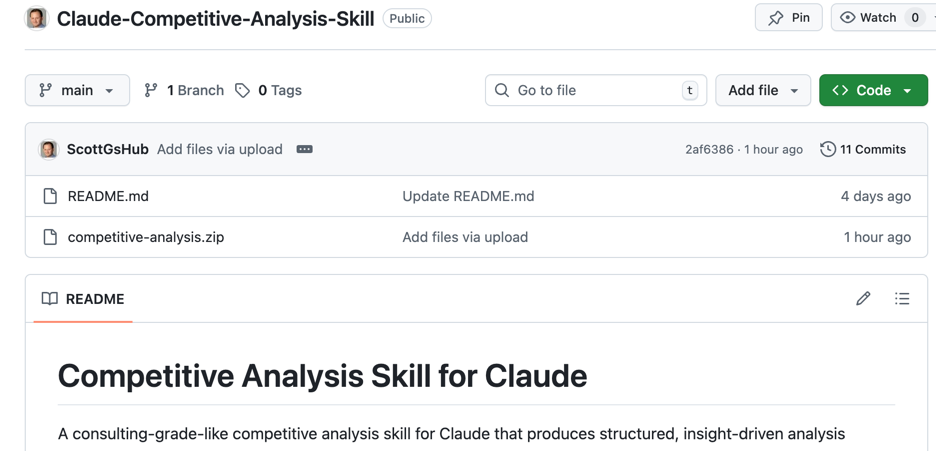
This is a fast way to get a jumpstart on a basic baseline competitive analysis using a Claude Skill, complete with a slide deck and an Excel “backup” workbook.
The catch: AI can accelerate the first draft, but it can’t replace judgment. Treat the output as structured hypotheses, not truth. You’ll still need to validate claims, metrics, and positioning with primary sources and customer reality.
- Understanding Your Own Work: Reports are great. Industry analysis obviously helps understand big pictures. When doing your own strategic analysis though, I believe that part of the understanding is in doing some of the work yourself. As great as AI is, it’s increasingly clear that we sometimes lose at least a little something when we just have all the work done for us. That being said, the tools can help us get a big jump on things as a starting place.
- About Claude Skills: claude.ai from Anthropic is one of the several, (or many), AI tools we have available to do some interesting generative language tasks. All of the tools are working on bulking themselves up with everything from initial training models, to use of agent tools to collect other data, project organization and more. What “Skills” do is add some specific instructions or instruction sets as background for completing a task. Think of it like a rulebook or set of guidelines for doing something.
About this Skill and a Warning
As a product person, we have lot of eclectic tasks. The role varies among and within industries along several continuum, from technical to business and then depth and breadth within each. All of us though, work in environments where we likely operate in competitive marketplaces. There may be some rare exceptions for truly new categories. Some of us work with large marketing departments or maybe whole strategy groups, others might be solo in a startup. Truly great strategic analysis isn’t just data gathering and pretty slide decks. There’s some insight involved, which can vary from intuition born of deep experience, studying the larger industry and so on. However, some of the rote data collection work is often at least a pre-requisite towards base level understanding of a market space. This Claude skill helps build some of those basics and an understanding from a company perspective. Just realize this isn’t rocket science. AIs are awesome and maybe magical in some ways. But if you learn how they really work, the bottom line is the output is a probabilistic synthesis from just one AI tool, using only its own limited sources unless additional tools are called upon. Depending on your Claude plan and settings, it may browse the web / cite sources / or rely on its internal knowledge. Treat outputs as hypotheses and verify with primary sources. As with the other AIs, it will confidently weave a story, that might be off or outright wrong in some places. The insights it may offer are basically an amalgam of others’ thoughts. Some may seem deep, but that’s likely because you just didn’t happen to know them. However, someone else did.
The main point of this is to offer a starting place, not an ending place. There’s plenty of people who use search engines and stop at the first list of 10 blue links. That can work. And the AIs even let us skip that information foraging part to develop answers.
What this Skill Will Do
The skill is designed to output a PowerPoint file and spreadsheet backup data. I’ve included a variety of strategic or competitive analysis frameworks just to try to give a variety of perspectives. There are of course more frameworks, and you can modify the skill files yourself if you want to add, update, delete any of these.
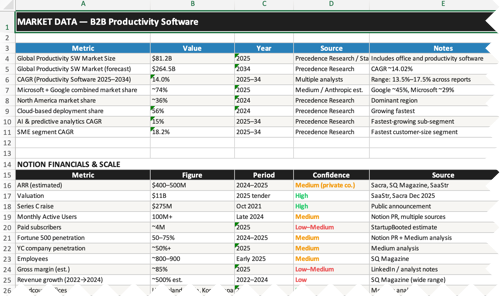
Here’s some of the frameworks I’ve included.
Here’s some of the frameworks explicitly in the skill files. There’s actually a few more in the SKILLmd file, which are optional. And Claude may just add some more. If you’re not thrilled with the output, just ask it for another go at things with your requested additions and deletions.
- Competitive Positioning Map
- Feature & Capability Scorecard (20-criteria heatmap, scored 1–5)
- SWOT Analysis
- Porter’s Five Forces
- Jobs-to-Be-Done / Buyer Segmentation
- Ansoff Matrix (growth vectors)
- Enterprise Readiness Scorecard (gap analysis)
- Battle Cards (competitive win/loss framework)
About the Output
The output may be a bit sloppy. There’s a variety of generative tools out there specific to slide decks or spreadsheets. And there’s additional skills to hone these better. I’m not doing anything overly polished here. This is just “get it done, knock out the basics” meant to be a fast starting place for a marketplace understanding. The slide deck will likely have some rough formatting; the value is in the first-pass structure and hypotheses. That’s not nearly as important at the information itself, which may be incomplete. Assume it’s incomplete. I can’t say it enough, this is an overview starting place. If you want to, extend the capabilities and share back any updates.
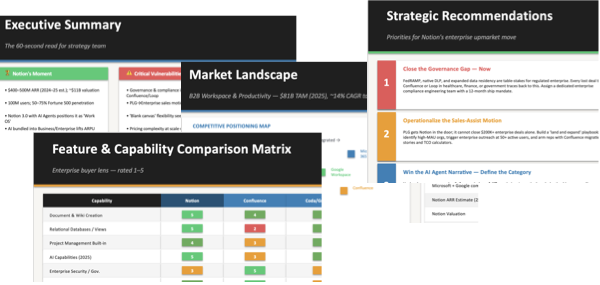
Remember your goals, whatever they are. We study the past and present to try to predict or change the future. Doing so to good effect towards our goals depends on having a rational, true and as complete a view as possible. There is always the “paralysis by analysis” risk, and we often need to make choices with partial data. But there’s a difference between deciding you have enough info vs. just being lazy or cheap. The fact that some information or insights may just be hidden is, after all, part of seeking opportunities. Let me ask you something though… “When do you stop looking for something?” The answer? “When you think you’ve found it.” For your cell phone or house keys, that pretty much a binary thing, but for information? You’ll likely never have it all and that’s ok. That’s part of the game. Just opt into verification, not vibes alone.
Additional Paywall Sources
My instructions include to reference additional sources at the end of the report that may have been unavailable due to costs. There’s talk about how AI might impact various paid services. Likely somewhat true. However, these services have always had value. There’s plenty of expensive to collect and transform data and skilled analysts that produce amazing work. Understandably, a small business or solo consultant might not be able to justify these costs. And true, sometimes such things are unnecessary or might not add much. However, the higher quality sources usually do. Over time, it’
It’s likely a lot of these sources will be available to AI agents directly with some kind of payment. You’ll probably have to set thresholds or rules for your agents to choose the value of such things and budget or bid accordingly. Whether that’s via subscriptions to data marketplaces, payment in stablecoins or other tokens, at some point you may want to add those capabilities to skills like this. For now, this one just operates on its own.
What You’ll Need
This skill was built for a basic Claude.ai paid subscription. It will maybe work on a free plan, but possibly very slowly and might not complete before you run out of token allotment. You can probably run it using an open claw bot as well, however I have not tested that path yet. I realize the open claw bots are all the rage right now, but I don’t fully trust mine and he stays in a box on a separate sandboxed computer, which is probably not where you want the final output to be fro this task.
How to Install It
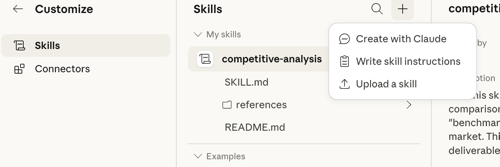
- Go to my GitHub Repo for this skill:
- Claude-Competitive-Analysis-Skill
- Check the README.md file for any updates.
- Download the competitive-analysis.zip file.
- Go to Claude, open the sidebar and select “Customize”. (Note: this may change. If you don’t see this menu choice, hunt around or just ask it where to update skills.)
- Select the [+] option, then Upload a Skill, then drag and drop the zip file.
- That should do it.
How to Use It
Set Up a Project First
First, I recommend using the Project feature to build particular outputs. With Project, you can set up some initial conditions that can help. So your first step is to set up a Project called “Competitive Analysis” and in the instructions area, add this, and as with all things, modify it as you see fit:
------
Use the competitive analysis skills for this project.

Consider additional business analysis frameworks that might be appropriate beyond what the skills may include.

Use whatever publicly available data you can reach.

In an appendix, list any other data sources, (up to 10), which might be useful, but were unavailable as they're behind paywalls or subscriptions.
------
Run the Skill
This example will build an analysis for the Notion product, a productivity software service.
Just start a new chat and say something like:
“Run a competitive analysis for Notion in the B2B productivity and workspace software market.”
That’s enough to trigger the skill. Claude may ask you a few scoping questions before diving in; things like who the audience is, what decision this is meant to inform, and how deep you want to go.
If you want to skip back-and-forth questions, you can front-load the details in your first message:
“Run a competitive analysis for Notion in the B2B workspace and productivity software market. Main competitors to include: Confluence, Coda, Microsoft Loop, and Notion’s own positioning against Google Docs/Microsoft 365. The goal is to understand Notion’s competitive strengths and vulnerabilities as they move upmarket into enterprise. Audience is a product strategy team. I want the full output: PowerPoint deck and Excel backup.”
That single message should give Claude everything it needs to go straight into research without stopping to ask clarifying questions, though it might.
One tip: if you created a Claude Project for competitive analysis as suggested, make sure to start the chat inside that project. That way any custom instructions you added like “consider additional frameworks” or “list unavailable data sources in an appendix” will apply automatically without you having to repeat them.
Validate
In the “trust but verify” category, consider doing some manual validation.
- Confirm competitor list is complete for your segment.
- Spot-check top 5 claims with primary sources.
- Double check numbers and replace with real metrics where necessary.
- Confirm any positioning map axes match reality.
- Identify 3 hypotheses to test with customers/sales.
- Log citations and update any assumptions.
Make Changes
As mentioned, you can change the rules here easily. If you do, I’d appreciate any shares back with updates. You can do this the technical way with GitHub or just send me a message with what you did or a new file. Getting back to just design for a moment, if you get your slide deck powerpoint mostly the way you want, you can always clean that up yourself, import into Beautiful.ai, Canva, or Gamma and have those work on the deck. Or use Microsoft Copilot Pro Plan to clean up directly in PowerPoint. As fast as things are progressing, some tools aren’t as integrated with Claude or other AIs as they likely will be soon. For example, we’d ideally be able to just call an API to do something or another, but not all of these services have APIs amenable to agent treatment as yet, nor do they have MCP (Model Context Protocol) running to easily connect to AIs. This will likely all come soon enough.
See Also:
- Extend Claude with skills
- The Complete Guide to Building Skills for Claude (pdf)
- The Busy Person’s Intro to Claude Skills (a feature that might be bigger than MCP)
- Master 95% of Claude Code Skills in 28 Minutes (YouTube)